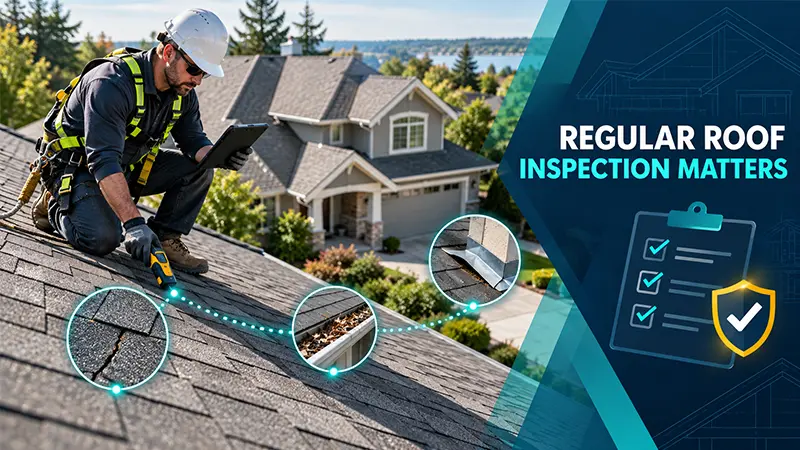
Did you know that “around 65% of the roof failures could have been prevented if timely inspections were done”?
Still, many property owners – either homeowners or business facility managers plan for an inspection when they find out about some leaks or when a storm hits.
Something similar happened with Nitin in Bengaluru – “he found out a small ceiling stain after a rain, but ignored it. After two months, he found out that the stain had transformed into a full leak, which was potentially damaging the furniture and walls. The repair cost him more than ₹70,000”.
Contradicting this, “when a retail shop owner inspected his roof, he found out a slight membrane damage. Got it fixed with a full roof replacement in just ₹6,000”.
The purpose of both the roofs was – protection, but the process to be inspected and repaired was completely different. These differences are not just related to technicality – but with minimizing investments, ensuring safety, and avoiding expensive repairs.
So, if you are here to explore the differences between residential and commercial roofing inspection processes – you are at the right place. Keep reading the post to build a complete understanding.
Understanding Residential Roofing Inspections
A residential roof is like a helmet that protects the members from any external elements of the environment, be rain, storm, or hail. Even so, after knowing that it is the first line of defence for the home, many homeowners do not consider its inspections.
A small crack in the helmet seems harmless till the time next fall arrives, the same way issues that seem to be minor can turn disastrous at any moment.
To support this, here is a fact – “More than 70% of the roof leaks begin from the corners and areas that homeowners rarely inspect”. This includes gutter and flashing.
Let’s understand the areas that roof inspections mainly focus on to detect early signs of wear and damage.
- Reshaped or missing shingles.
- Leaks and water stains in the attic.
- Flashing around the chimneys and vents.
- Poor drainage system with blocked gutters.
Today’s advanced modern inspections use drones and moisture meters for more accuracy. This allows us to check the hidden spots that are not easily accessible.
Commercial Roofing Inspection Challenges
The commercial one is way different – it includes more technicality, often has a big scale to execute, and requires higher roof inspection pricing. And often uses flat or low-slope systems like TPO or PVC membranes.
It asks for necessary inspections, if doing so may result in heavy payoffs. As a famous proverb says, “a commercial roof doesn’t leak often, but when it does, it can take away businesses with it”.
Commercial roofing inspection is challenging and requires professional help, as it involves:
- Collected water due to improper drainage.
- Gaps in membrane sheets.
- Damage to the structure by HVAC systems.
- Insulation breakdown beneath the surface.
A single ignorance in commercial roofing can cost much in the future. It’s better to fix its complexities with professional help.
Frequency and Timing of Inspections
“Professionals suggest that without regular inspections, roofs lose upto 40% of their expected lifespan”.
This statement might bring a question to your mind – what is the right time to get my roof inspected, to ensure its proper working and increased lifespan? Let’s figure this out:
- Residential roofs should be inspected their roofs twice a year. Once before the monsoon and once after.
- Commercial roofs require a strict routine, usually once every quarter, or at least biannually.
Note: Urgent inspections should be done after storms, hail or other extreme weather conditions.
Although inspection timing also depends on other factors, such as the type of area you are living in and the type of roofing materials.
Inspector Qualifications and Training
Residential roofing inspections can be done by licensed home inspectors. They will identify fixes and suggest practical solutions for it.
However, the commercial one requires specialized expertise. Inspectors often have professional certificates. For instance, the National Roofing Contractors Association (NRCA) or Roof Consultants Institute (RCI). They should also consider safety protocols under OSHA compliance.
A residential inspector is like an MBBS doctor, while a commercial one is a DNB(super-specialty).
Assessing and Reporting Findings
“More than 60% of the roof claims are rejected due to improper inspection or incomplete documentation reports”.
To make sure this will not be your case, understand the reporting difference:
In residential properties, reports are simple and clear, with straightforward solutions. For example, clean the gutters.
Opposite to it commercial setting has a complex report. It includes:
- Thermal imaging for moisture detection.
- Sampling for understanding insulation complexity.
- Reports having past and present comparison analysis.
- Suggestions based on warranty limits.
These reports help to fix the inconsistencies in the core and end up with solutions for a long-term lifespan.
Summing it up
Both residential and commercial roofing have the same goal to protect, but their approach to it differs in area, technology, expertise, and reporting.
Still, a common thing that stands out is the fact – “Proactive inspection today stands firm in between to prevent reactive expenses tomorrow”.
Concluding with a fact that –
“The strongest roofs are not just assembled well, but inspected wisely”.