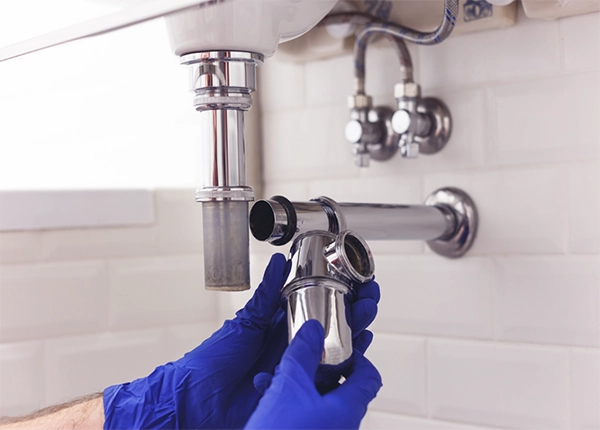
“Plumbing is the only profession where you hear the leak before you see it.”
Plumbing fittings are the essential connectors of the infrastructure of your home; they act as the silent guardians that prevent leaks. While decorative faucets do get the attention, these functional components manage the integrity of the system.
Specialized fittings such as couplings bridge the gaps between pipes, while bushings reduce the diameter. Acknowledging the role of each piece, from street elbows to compression fittings, is the ultimate weapon against water damage. By mastering this hidden anatomy, you make sure DIY renovations remain professional, and your home’s kitchen floor stays completely dry and safe.
Key Takeaways
- Never compromise with material; do not mix incompatible metals without a dielectric union to prevent any corrosion.
- Always use unions for fixtures that you know will need maintenance eventually.
- Check the pressure; you should keep the home water pressure below 80 psi so that you can protect fittings.
How Proper Plumbing Fittings Contribute to a Leak-Free Home
Consider plumbing as a circulatory system where pipes are veins and fittings are joints. Healthy fittings make sure that there is a smooth flow; however, a mess could be created in case of failures. Besides providing simple connections, these compliments manage pressure and handle thermal expansion well.
A high-quality fitting maintains a watertight seal even during water hammer shockwaves or heat-induced expansion. Contrarily, poor fittings serve as weak links and constant pressure eventually exploits tiny flaws, which can transform a silent system into a dreaded midnight drip.
Common Causes of Leaks Related to Incorrect Plumbing Fittings
You might be surprised to learn that leaks are rarely caused by the pipe bursting in the middle. The connection point is always the culprit. Here is where people often go wrong:
- Mismatched Materials: A Combination of copper and galvanized steel can cause galvanic corrosion, and this chemical reaction could corrode the metal, further leading to inevitable leaks over time.
- Wrong Sizing: Precision matters, and even slight diameter differences can cause loose seals. Solder or tape cannot permanently withstand pressure when the fit is incorrect.
- Overtightening: Excessive force can crack the plastic or even strip metal threads. This includes the integrity of the seal, creating new gaps for water to escape.
- Ignoring Thread Type: Misaligned threads can cause joints to leak water regardless of the sealant.
Main Types of Plumbing Fittings Used in Residential Systems
Figuring out the plumbing aisle can make you feel like learning a new language. Let’s decode it so that you can grab exactly what you need confidently.
Elbows
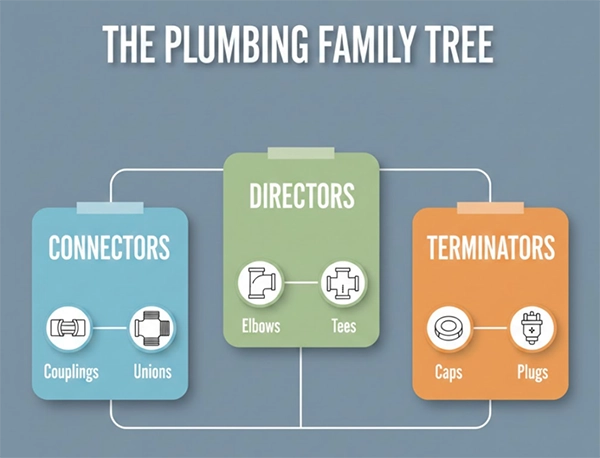
Elbows are the navigators of the plumbing system. When a pipe runs into a wall or a beam, the elbow has the task of guiding it around. Standard elbows come in 90-degree and 45-degree angles.
Tees
They look exactly like the letter ‘T’ and are the traffic controllers. They have the task of splitting one stream of water into two or combining two streams into one. You will find tees mostly in the main supply lines.
Couplings
Couplings are the actual peacemakers; they bring two pipes together. Unlike more complex fittings, their exact job is to extend a run of pipe. In times of repair, the slip couplings act as lifesavers.
Unions
Unions are similar to couplings, but with a minor twist. They are designed to be taken apart. If you are installing a piece of equipment that might need replacing later, such as a water heater or a pump, you should use a union.
Adapters
Adapters are the translators. An adapter is your go-to if you need to go from copper to PVC. They reduce the gap between different types of pipes, making sure that there is a strong connection despite the material differences.
Fun Fact: The word ‘plumber’ comes from the Latin word ‘plumbum,’ which means ‘lead’ because the ancient Roman pipes and fittings were mostly made of lead.
Reducers
A reducer is used when you need to maintain water pressure while moving from a main supply line to a branch line. It funnels the water down from a larger diameter to a smaller one seamlessly.
Caps
Caps are exactly what they are called; they are like hats for your pipes and seal the end of a pipe. You will see caps usually in areas where a future renovation is planned.
Plugs
While the cap goes over a pipe, the plug goes inside a fitting. They are threaded to screw into an unused opening of a tee or an elbow to seal it tightly.
Matching Plumbing Fittings With Pipe Materials and Applications
Matching fittings to pipe material is essential for a durable seal. Copper needs soldered sweat fittings, while PVC makes use of glued slip connectors. PEX, the modern standard, uses crimp rings or push-to-connect systems.
Did You Know?
Over 3,000 gallons of water per year is wasted because of a leak of just one drip per second, which is equivalent to taking more than 180 showers!
For reliable longevity, professionals recommend using the services of high-quality retailers like PlumbingSell.com, which have components that are tested for pressure. Quality parts prevent the cracks and failures that are common with generic alternatives.
Preventive Plumbing Practices to Avoid Future Leaks
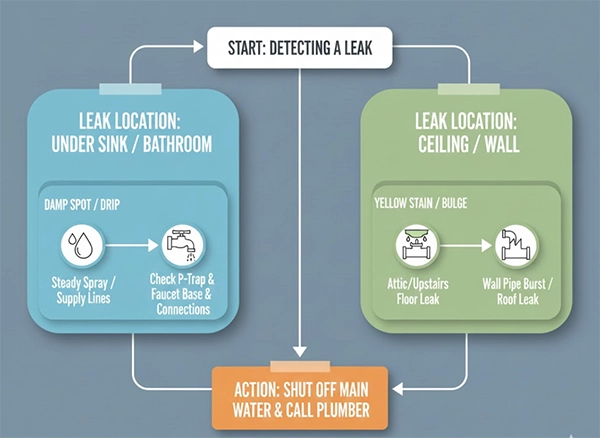
Your task isn’t just installing the right fittings; you also need to know how you can keep them leak-free for the next 20 years.
- Monitor pressure, as high pressure puts stress on the joints. If it exceeds 80 psi, you need to install a reducing valve to protect your fittings from damage.
- Annual inspections are necessary; you can use flashlights yearly to check for green fuzz on copper or rust on steel.
- Frozen water expands, which shatters metal fittings. Therefore, always insulate pipes in unheated areas such as crawl spaces or garages to prevent bursts.
- Speed is a vital element during failure. Make sure all residents know the main water valve’s location and how to turn it off.
Can I use old plumbing fittings?
No. Soldered fittings cannot be reused. Threaded fittings might be used again if the threads are pristine, but it is not worth the risk of a leak.
Why is my new fitting leaking?
The most common reasons are missing Teflon tape, debris on the threads, or if the pipe was not cut straight before insertion. To fix it, you need to take it apart, clean the item, and then try it again.
What is the best fit for DIY beginners?
‘Push-to-connect’, such as SharkBite, is a good option for beginners, as they don’t need soldering or glue, and you just have to push the pipe in.