
“A renovation is not just a change of scenery; it is an evolution of how you inhabit your world.”
If you are reading this blog, you are ready to take the plunge. A whole-house renovation is undoubtedly one of the most exhilarating journeys you’ll ever embark on as a homeowner. But let’s be real; without the right homework, it can quickly turn into a stressful saga.
Before the first sledgehammer swings, you need to transition from a dreamer to a researcher. Think of this phase as the ‘architectural soul-searching,’ which is required to ensure that your home doesn’t just look better, but actually lives better.
Key Takeaways
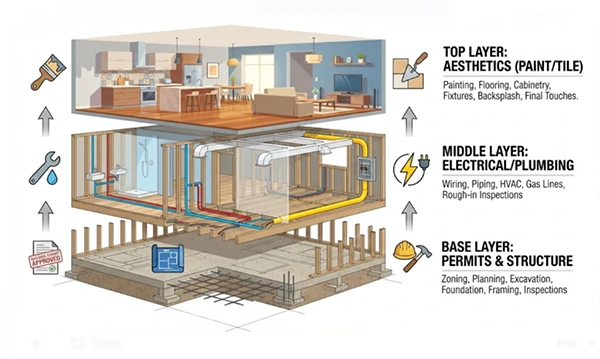
- Always fix the plumbing and roof before the expensive tiles.
- Your budget is a theory, and the contingency fund is the reality.
- A cheap contractor is often wrong and one of the most expensive choices you make.
- You should choose your fixtures before the renovation starts to avoid panic-buying.
Understanding the Scope and Goals of Your Renovation Project
Before picking paint, you should define your goal: whether you are renovating to boost resale value or you wish to create a forever home that fits your personality. Knowing your primary objective is essential, as it will guide every decision you make throughout the project.
- You should focus on high-ROI areas such as baths, kitchens. and neutral curb appeal.
- You should first address the foundational issues, energy efficiency, and roofing.
- You should prioritize custom storage, high-end comfort, and layouts that fit your specific hobbies.
Decide your ‘must-haves’ and ‘nice-to-haves’. It is easy to get swept away by Pinterest boards; however, your scope should be rooted in the functional reality of your daily life. It is essential to decide whether you need a double oven or if you would want to use the same space for a walk-in pantry.
Key Areas Homeowners Should Research Before Renovation
The key areas homeowners must research before starting renovations include:
Budget Planning and Financing Options
Underestimating the hidden costs is the most common mistake people often make. When you sit down to calculate the numbers, you need to set a realistic budget that consists of a 15-20% contingency fund for the inevitable surprises, such as finding 1970s wiring behind a 2020s wall.
Research your finding options carefully! HELOCs offer flexibility with variable rates, personal loans grant fast access despite higher interest costs, and cash savings offer the safest but most limited path.
Did You Know?
A complete renovation rarely takes less than 4 to 6 months; if a contractor says 4 weeks, start asking questions!
Permits and Building Codes
This is a boring part; however, it can save you thousands in legal headaches. Every municipality has its own quirks regarding what requires a permit. Researching your local building codes makes sure that your beautiful new deck won’t be ordered for demolition by the city inspector after a few months or a year.
Do not be dependent on a ‘wait and see’ approach; smartness is in knowing the rules of the game before you start playing it.
Contractor Requirements
During renovation, you’ll be closer to your builder than some of your friends for the next few months; therefore, do not hire the first person who gives you a low bid. Look for these home renovation professionals who come with verified protocols, glowing references, and transparent insurance policies. The things you should verify are specialization, licensing, and communication style.
Evaluating Your Home’s Structural and System Readiness
It is easy to get excited about the marble countertops, but what is actually happening behind the drywall? You should research the age of your plumbing, HVAC, and electrical systems. If your home is around 50 years old, there is a high possibility that your electrical panel cannot handle a modern gourmet kitchen’s power demands.
Do not forget to check the invisible basics! Inspect for rusted galvanized plumbing versus copper/PEX, evaluate attic insulation, and also check for foundation cracks. Paying attention to these structural essentials prevents costly failures after your renovation is done.
Timeline Expectations and Living Arrangements During Renovation
Renovation time could be long, and it could be messy, loud, and intrusive. You need to be aware of exactly how long each phase (demolition, framing, rough-in, and finishing) generally takes in your area. When planning a renovation, lead times are the silent budget-killers that demand early attention.
High-quality custom cabinets and energy-efficient windows often need six months for delivery because of long manufacturing times and global logistics. Being aware of these timelines beforehand will ensure that your project remains on schedule, preventing costly delays that can extend your stay in a dust-free zone or a temporary rental.
Fun Fact: Houses that are renovated with high-end finishes in the master bathroom often see higher emotional attachment from buyers, which further leads to faster sales.
Planning for Post-Renovation Maintenance
Once the contractors leave and the dust settles, your new home will enter a different phase. High-end materials often need high-end care; also, you need to do proper research on the specific maintenance needs of your new finishes.
- If you have used natural stone, you will need to seal it every 6-12 months.
- For hardwood, you will need specific cleaners and a clean no to steam mops.
- If your newly renovated home has smart home tech, it will require software updates and occasional troubleshooting.
FAQ
Should I buy materials on my own to save money
No, as professionals often get trade discounts. Also, if you mistakenly purchase a broken tub, you have to pay the plumber again, and if they buy it, they cut that cost.
How should I handle ‘Scope Creep’?
Scope creep is when you say, “While we are at it, let’s do the kitchen as well.” It is necessary to research your limits and strictly adhere to your written plan unless it’s a structural necessity.
Do I really need a permit for interior work?
For things like paint and carpet, you don’t need a permit; however, for adding a window, changing plumbing, moving a wall, etc, you will surely need a permit. Unpermitted work can kill a home sale later.