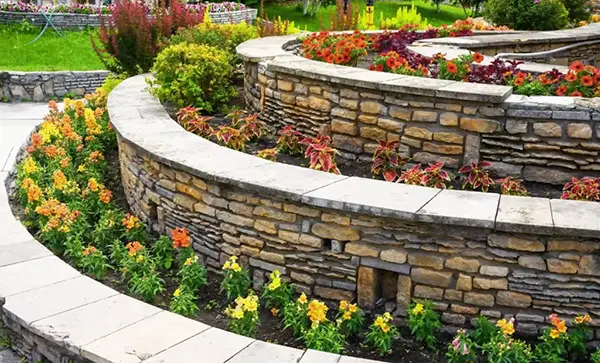
“Every year, erosion and soil movement cause millions of dollars in property damage worldwide – yet just a well designed retaining wall can reduce soil erosion by upto 80% on steep slopes and drastically protect homes, foundations and landscape from costly repair”. (Source – MBC)
Retaining walls are the landscape’s version of a seatbelt – holding back the earth so it doesn’t cause damage on your property.
Whether you are struggling with a steep slope or planning for a terraced garden – retaining walls are the most practical and easy to go solutions in landscape design. The efficiency increases with the same is done through professionals, like retaining wall construction in Michigan. (Source – Wikipedia)
Continue reading to delve into retaining walls – their types, requirements, and functionality.
What a Retaining Wall Is and Its Role in Landscape Design
In its simplest form, a retaining wall is a structure built to hold back soil between two different elevations. Engineers define it as a rigid barrier designed to resist lateral earth pressure when the terrain pressure changes suddenly.
Think of it as a bookshelf for soil – instead of books spilling onto the floor, the wall prevents soil from sliding down during rain or irrigation.
And they aren’t just functional. In landscape designs, they act as outdoor architectural elements: they shape terraces, define garden zones and create dramatic visual layers.
Firm your understanding with this case study –
CASE STUDY
One homeowner was tired of looking at their backyard slowly sliding down every rain. Muddy water had pooled near the patio. They simply added a retaining wall with proper drainage and the whole problem was resolved. The slope transformed into a small garden terrace, cleanup disappeared and the yard eventually felt useful instead of stressful.
Common Reasons Homeowners Install Retaining Walls
Homeowners install retaining walls for reasons that are both practical and aesthetic –
- Prevent Soil Erosion and Landslides – Rainwater can easily collect in the downward area, eroding soil and washing it toward your home or garden beds.
- Create Usable Space – Sloped land is outdoor real estate that’s hard to use. Retaining walls turn it into flat platforms perfect for patios, lawns or seating areas.
- Manage Water and Runoff – Without control, water rushes downhill. A wall redirects that flow safely away from foundations.
- Enhance Curb Appeal – beyond adding functionality, a well designed wall adds structure and texture to your landscape. Materials like stone can echo your home’s style and elevate the property’s value.
Different Types of Retaining Walls Based on Structure and Support
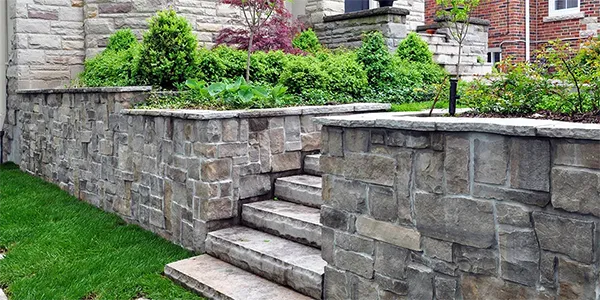
There is no one perfect solution for all. Different structures have their different needs –
- Gravity Retaining Walls – These are sheer weight dependent. They’re often built with stone, concrete blocks and dry stacked rock.
- Cantilever Retaining Walls – It’s a more advanced solution with the use of a reinforced concrete base and stem to leverage soil pressure down and away from the wall.
- Anchored Walls – In high soil pressure, anchors or cables drive into the slope to add extra support and similar to guy wires on a radio tower.
- Sheet Pile Walls – These use interlocking sheets driven into the ground – perfect when space is tight or soil is soft.
These are also modular options like Segmental retaining walls that use interlocking blocks for flexibility in design, enabling curves and terraces that fit your garden’s aesthetics and environment.
Critical Requirements for Building a Retaining Wall
Along with good intentions, proper planning is also required –
- Stable Foundation – Walls require a compacted base that extends below ground to prevent sliding or tilting.
- Drainage – Without it, water builds pressure and can destroy even heavy walls. Drainage pipes help water to escape.
- Soil Considerations – Different soils exert different pressures – clay behaves very differently to clay soil.
- Height Limits and Permits – Higher walls often require professional design.
Skipping these basics is similar to building a snowman without packing the snow – good until the sun hits it.
Long-Term Maintenance and Structural Inspection
Retaining walls aren’t “set and forget”. Annual inspections should be done for cracks, leaning or bulging. Especially after heavy rains, storms and extreme weather conditions. Proper drainage upkeep is often the difference between decades of service and an expensive redo.
Ensuring clean drainage paths can make the difference between a wall that lasts for decades and one that usually requires costly repairs far sooner than expected.
Final Words
Retaining walls are more than just functional barriers – they’re landscape engineers that transform uneven land into safe and beautiful spaces. They integrate structural necessity with the flexible designs, turning issues like erosion and poor drainage into enhancing opportunities. When done well, they offer peace of mind and curb appeal for years to come.
Are retaining walls only for sloped yards?
Mostly, but not necessarily. They’re also used to build raised garden beds and define outdoor spaces.
What are the early signs that retaining walls are failing?
Cracks, bulging and water pooling around the wall are the common warning signs that shouldn’t be ignored.
Can I build it myself?
Low walls are often DIY friendly, but taller walls near foundations usually require professional design.