“He who fails to plan is planning to fail’ – Benjamin Franklin (Founding Father of the US)
You are standing in a house full of bare studs and sawdust, looking at a calendar and wondering if your home will ever be finished. Don’t worry, you are not the only one feeling it! Many renovation projects often face severe delays, which often push the finish dates back by months.
While most people depend on their gut feeling, experts use a more organized system that keeps them moving ahead. To avoid the stress that comes when you are in a construction zone, you need a proper strategy that shows exactly which tasks are holding up the finish line.
This is where the Critical Path Method (CPM) comes into the scene and will become the best tool for you. It will help you see the most important steps so that you can finish your project on time with much less worry.
Key Takeaways
- CPM identifies the sequence of tasks to help the project get done soon.
- Know the sequence; you can’t do Task B without doing Task A.
- Knowing your critical path helps you reduce stress.
- Digital scheduling will make tracking complex things simple.
What Is the Critical Path Method (CPM) in Construction Planning
If you have ever had the feeling that you are renovating a huge puzzle where pieces are supported to fit in a certain order, you already understand the basics of the Critical Path Method (CPM).
To put it simply, it is a way to find the most important jobs that will decide when your project will actually be finished. It is like finding the fastest route to complete your home. In any renovation, some jobs can happen at the same time, such as picking furniture, while other people paint it.
But other jobs are dependent, which means one needs to finish the work before the next person can start their job. For example, you cannot lay a tile floor until the concrete underneath it is dry. Using construction planning and scheduling software will help you see which jobs are important and which aren’t.
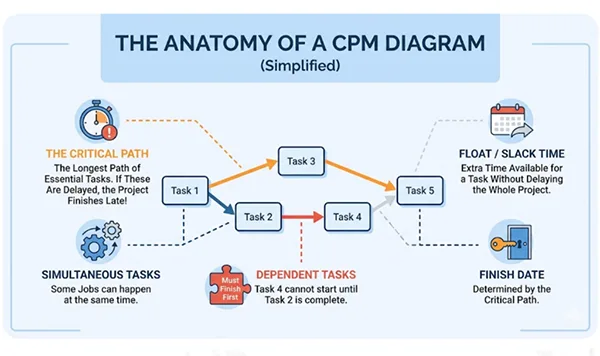
This diagram shows how one job leads to another and how they are connected, which helps you see the quickest way to finish your home.
Key Benefits of Using CPM Tools for Home Renovation Projects
Moving from a basic list to a professional schedule changes everything. It helps you have a clear conversation with your builders and manage your money better. You will feel much more in control of your project, and you can also control your daily stress level.
- Clear Roadmap: It will turn your messy notes and receipts into a simple, easy-to-read plan. This allows you to see the big picture and see exactly what needs to happen next.
- Better Planning: You will know exactly when each worker needs to arrive. This prevents people from standing around wasting time and waiting for someone else to finish their part of the job.
- Lower Risk: It identifies which tasks have extra time. This allows you to handle small problems or delays without worrying that the entire project will fall behind its final deadline.
- Real Dates: Guessing work will vanish. You can give your family solid data when your house will be finally ready for you to enjoy.
Using these smart tools will help you stay ahead of the problems with a solution already in your mind. Instead of just waiting for things to go wrong and reacting, you need to become a leader who keeps the whole home project on track.
How to Create a Home Reconstruction Timeline Using CPM
Building a timeline is not just picking a finish date. It means you need to start with your finished dream home in mind and then look backward to today. This will help you figure out each and every step you need to take to get to the results on time.
- Make a List First
The first thing you need to do is to write down every small job. Instead of just ‘Fix Bathroom,’ make a list of things like ‘Plumbing,’ ‘Tiling,’ and ‘Installing Sinks’. This will make the whole project a lot easier to track.
- Check the Order
Find out which tasks need to be finished before the next one can be started. For example, you need to fix the pipes first before you close the walls.
- Guess the Time
Be honest with yourself about how much time each job takes. You need to ask your builder for a timeframe and always add a few extra days to each task in case something goes wrong.
- Find the Main Path
You need to put your tasks in order. The longest chain of jobs that needs to be done back-to-back is your ‘Critical Path’. This will set the final finish date of your home’s reconstruction.
- Keep Updating
It is normal for the schedule to change as the work happens. So you must update it often so you can see how a small delay might change the date of your move into your home.
Fun Fact:
Constructions of projects like Burj Khalifa used advanced versions of CPM to manage thousands of workers over the years.
Common Mistakes to Avoid When Planning Reconstruction Timelines
Even if you have a great plan, if you are not careful, things may go wrong. You need to look out for some simple mistakes that can slow down the process and make the entire project harder and more expensive than it was supposed to be.
- Order Early: Some items, such as custom cabinets, often take months to arrive; hence, don’t wait until the last minute to order them, or your whole project will come to a halt.
- Be Realistic: It will be unrealistic to believe that everything will go perfectly. Bad weather or failed inspections happen; you need to keep extra time in your plan for common delays.
- Talk to Your Team: If your workers don’t know about the plan, they won’t follow it. You need to keep everybody on the same page and make sure that everyone knows the plan so that you all stay on track.
- Don’t Overstress: Not every small task is urgent. You must focus on the big jobs that matter the most at the moment so that you don’t get tired out too early.
Tips to Stay on Schedule and Avoid Project Delays
To finish your work on time, you need a clear plan and the focus to stick to your work. Staying organized daily will keep everything moving smoothly and will help you avoid any unexpected or stressful delays during the project.
- Talk Every Day: It would turn out to be helpful if you talk to your team each morning for 10 minutes to go over what they need to get done that day.
- Choose Early: You can save your time and protect yourself from the last-minute stress if you choose your tiles, paint, and handles even before you start. Waiting too long can also lead to big delays later.
- Plan for Surprises: As mentioned, adding a little extra time to your schedule for hidden and unexpected problems is a wise decision. You may encounter sudden issues like bad wiring or old pipes behind the walls, which would take some more time to get the task done.
- Use Good Tools: Do not try to track a big project on scrap paper. You can use a simple app or computer program to keep an eye on your progress.
Using these simple habits can make a huge difference. By being organized and talking clearly with your team, you can keep your project moving forward and even finish your beautiful new home on time.
Conclusion
Think of your home renovation as an adventure rather than a headache. Usually become stressed because they don’t know what comes next or why things are taking so long. But if you use the simple method called the Critical Path, you can see exactly which jobs must be done first to keep everything moving smoothly.
It will help you identify the must-do tasks, such as fixing the wires before finalizing the walls, so that you don’t waste time. It also shows you what things you can take a bit lightly so that you don’t have to panic over every tiny change.
Even though it will take some of your time to sit down and plan everything out at the beginning, it will save you time and money later. You will feel much more in control of your home, your budget, and your mental health from the beginning to the end.
Ques: What is ‘Float’ in a renovation schedule?
Ans: It is a little extra time a task can take without any delay in the final completion date.
Ques: Is CPM too complicated for a small DIY project?
Ans: No! If you stay organized and know what needs to be done first and what later, it will be very easy.
Ques: Can the Critical Path method be used when I’m doing the work myself?
Ans: Yes, it will keep your personal schedule organized to help you finish the project on time.