“We shape our buildings; thereafter they shape us.” — Winston Churchill (Former UK PM)
Walk into your home after a long day and notice what happens. Do your shoulders drop… or tighten a little more? That reaction isn’t random. Your surroundings are constantly nudging your brain, quietly influencing how you feel, think, and function.
Research in environmental psychology backs this up. Even small, intentional tweaks to your living space can lead to 21% drop in stress and improve focus over time. In other words, your lighting, layout, and color choices aren’t just aesthetic decisions. They’re daily inputs into your mental state.
If better focus, lower stress, or simply feeling “lighter” at home is on your list, your decor might be the most underrated place to start.
In this article, I’ll elaborate on how home decor affects mood and mental clarity. The following sections give practical, science-backed tips to reduce stress, improve focus, and design a space that supports your wellbeing.
KEY TAKEAWAYS
- Your home environment directly affects stress levels, focus, and emotional balance.
- Clutter and sensory overload quietly drain mental energy over time.
- Designing for calm, clarity, and control creates lasting psychological benefits.
- Changing the lighting and color are the easiest modifications.
What the Research Actually Says About Space and Psychological State
Let’s move past “vibes” and talk facts. Environmental psychology is now a well-funded, well-documented field that gives us measurable data on how light, color, clutter density, and spatial arrangement affect everything from cortisol levels to decision-making capacity.
There’s something particularly relevant about this conversation for people living in the Bellevue, Washington area, a city that pulls in both directions, urban ambition on one side, Pacific Northwest stillness on the other.
High-achieving residents here often find that pairing thoughtful home adjustments with professional support, through an Outpatient Mental Health Center In Bellevue produces changes that neither strategy alone fully achieves. The environment and the inner work reinforce each other.
So what’s actually happening in your brain when you walk into a room?
Your Brain Is Threat-Scanning Before You Even Sit Down
Within milliseconds of entering a space, your brain is already running a low-level risk assessment. Visual chaos, tight layouts, sharp angular furniture, unresolved clutter, these trigger mild stress responses. Nothing dramatic. But the cortisol adds up.
Soft curves, breathing room between objects, and a clear visual anchor point do the opposite: they signal safety, and that signal frees up the cognitive energy your brain would otherwise spend on vigilance.
Sensory Overload Is Costing You More Than You Think
Every piece of sensory input in your environment, the pile of mail on the counter, the hum of a screen, the smell of yesterday’s dinner, demands a slice of your attention.
Designers call intentionally limiting this “sensory editing.” It sounds abstract, but the downstream effect is real: less ambient noise in your environment means more bandwidth for the things that actually matter. That’s not decoration theory. That’s neuroscience with a paint roller.
Three Principles That Actually Work: Calm, Clarity, and Control
Instead of chasing trends, anchor your home around three psychological outcomes: calm, clarity, and control.
Calm, Lowering the Emotional Noise Floor
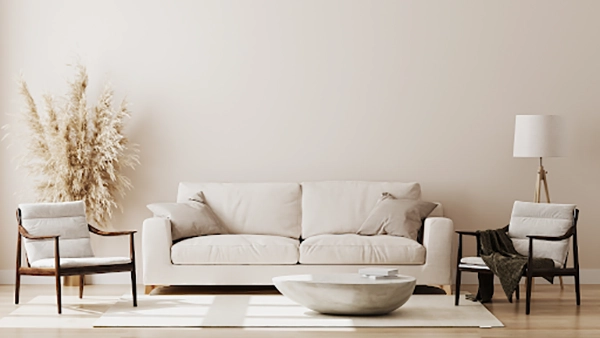
A calming space isn’t a bare one. It’s one where the background doesn’t compete with you. Warm neutrals, simplified surfaces, and layered soft lighting achieve this without making your home feel sterile.
The goal isn’t minimalism for aesthetics, it’s minimalism in service of your nervous system. Less visual static in rest zones means your body actually gets to rest there.
Clarity, Giving Your Brain Permission to Focus
Tidy surfaces do something specific: they reduce what psychologists call “decision residue”, the low-level mental cost of managing unresolved visual information.
Creating micro-zones within a room, a dedicated reading chair, a work desk with boundaries, a phone-free corner teaches your brain what each area is for. When your brain knows the script, it stops improvising. Productivity and focus follow almost automatically.
Control, Predictability as a Form of Psychological Safety
There’s a reason you feel better after reorganizing a chaotic drawer. Small acts of environmental control reinforce agency, and agency is one of the most powerful antidotes to stress.
Seasonal rearrangements, a new lighting configuration, a weekend DIY project, these aren’t trivial. They’re your brain proving to itself that it’s still in charge of something. During high-pressure periods, especially, that matters enormously.
Light, Color, and the Fastest Levers You Have
If you want quick results, start here. Light and color regulate emotion, energy, and attention in ways most people have never connected to their environment.
Natural Light Does Something No Lamp Can Fully Replicate
Sunlight anchors your circadian rhythm, the biological clock governing sleep quality, energy levels, and morning cognition.
Simple adjustments go a long way: position your desk near a window, swap heavy drapes for sheer curtains in work areas, and use mirrors strategically to pull daylight deeper into darker rooms. These aren’t design tricks. They’re circadian biology applied to square footage.
Artificial Light Needs to Work in Two Directions
Cooler, higher-Kelvin bulbs drive alertness in kitchens and home offices. Warm, dimmable lighting does the opposite in bedrooms and living rooms; it signals the brain to start winding down.
Smart bulbs with adjustable color temperature are one of the most cost-effective upgrades you can make. No rewiring required, and the behavioral impact is genuinely noticeable within days.
The Color Story: Calm Isn’t Boring
Blues and greens reduce anxiety and support sustained thinking. Muted terracotta and dusty mustard introduce warmth without visual aggression. Soft neutrals give your eyes and your brain somewhere to rest.
If you want to know the psychological meaning of all colors, here’s an infographic listing that:
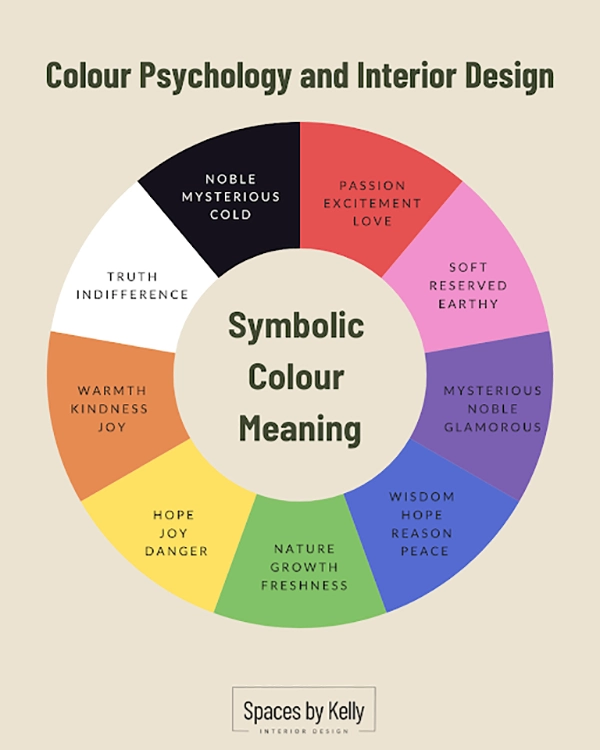
One important practical note: always test paint samples in both daylight and evening artificial light. A paint chip that reads as tranquil at noon can feel completely different at 9 PM. Don’t skip this step.
Here’s a summarizing table of design elements, their applications, and the benefits to mental health:
| Design Element | Mental Health Benefit | Best Room Application |
| Natural daylight | Anchors the circadian rhythm, boosts energy | Home office, reading chair near window |
| Cool-white artificial light | Supports alertness and focus | Kitchen, work zones |
| Warm dimmed lighting | Promotes relaxation and sleep prep | Bedroom, living room |
| Blue/green color palette | Reduces anxiety, supports cognitive ease | Bedroom, study corners |
| Soft neutrals | Creates mental “white space” | Any room needing calm |
| Controlled muted accents | Adds energy without overwhelm | Living room, entryway |
Room-by-Room Strategies That Actually Move the Needle
Let’s see how you should change your decor based on the type of room we’re talking.
A Living Room Built for Decompression
Pick one strong focal point, a fireplace, a statement bookshelf, a large piece of art, and let everything else support it rather than compete.
Overhead lighting alone creates flat, harsh environments; layer in floor lamps and table lamps for dimension and warmth. Natural materials, linen cushions, a wooden side table, and a potted fiddle leaf soften the room and cue your nervous system to slow down.
A Bedroom That Actually Lets You Recover
Keep the palette low-contrast and deliberately muted. Minimize visible technology wherever you can. The research on this is pointed: people who live in clean, well-organized homes report 25% higher emotional stability and measurably better sleep quality. Tactile details, quality bedding, and a soft rug underfoot first thing in the morning carry more psychological weight than most people expect. Don’t overlook them.
A Home Office That Doesn’t Swallow You Whole
Try the “clean desk plus one meaningful object” rule. A single plant, a photo, a small sculpture, one deliberate thing that signals this space belongs to you, without crowding your field of view.
Use a visual boundary, a rug, a shelving unit, or a folding screen to separate work from rest, even in a studio apartment. If you can manage a window view, even a partial one, research consistently shows it supports alertness and reduces fatigue.
The Hidden Cost of Clutter
Clutter simply lingers invisibly. It just chips away at your cognitive reserves all day, every day. It drives low-grade decision fatigue, feeds procrastination, and sustains a kind of ambient anxiety that’s easy to normalize until you finally clear the space and realize how much lighter you feel.
Sustainable organization beats a single marathon purge every time. Build storage around how you actually live. Keep things where they get used. A mail station near the front door, labeled baskets for shared household items, and a designated charging drawer. Each one eliminates a recurring micro-decision that was quietly costing you mental energy.
Design Intentionally Not Perfectly
Your home doesn’t need to look like a magazine spread. It just needs to support your life.
Start with light. Address clutter. Then build in color and texture gradually, at a pace that doesn’t itself become a stressor.
The most important design principle you’ll ever apply is deceptively simple: build an environment that actively serves the person you’re trying to be. You deserve that investment, and your mental clarity will reflect it.
Frequently Asked Questions
Can rearranging my home genuinely reduce anxiety?
Yes. Studies show measurable stress reductions from targeted changes like better lighting, added greenery, and simplified surfaces. Consistency matters more than scale.
Where should I start if everything feels overwhelming?
The bedroom. Sleep quality is foundational to every other dimension of mental health, and improving that one space tends to build momentum elsewhere.
What decor choices actually worsen anxiety?
High-contrast patterns, harsh overhead lighting, and cluttered surfaces are the most common culprits. Sharp-edged furniture and excessive visual layering can also sustain an elevated baseline stress response.
What can renters do without painting or renovating?
Lighting swaps, removable wallpaper panels, soft textiles, plants, and strategic furniture rearrangement all deliver meaningful results, no permission needed.
When is professional support the right call?
Whenever persistent anxiety, depression, or emotional distress continues despite environmental changes, qualified mental health care is the appropriate next step. Good design supports well-being; it doesn’t replace clinical care.