
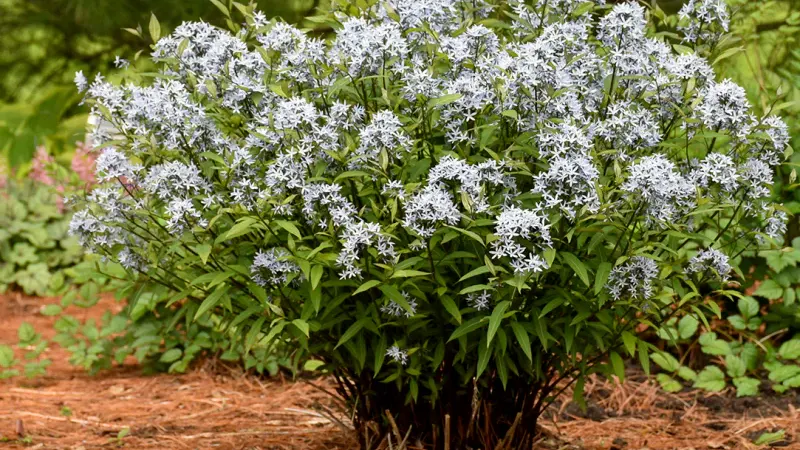


| Common Name | Bluestar, Blue Dogbane, Threadleaf Bluestar | Maintenance | Low |
|---|---|---|---|
| Native Region | North America | Average Height | 1-3 feet |
| Plant Type | Herbaceous Perennial | Average Width | 2-3 feet |
Bluestar, botanically called Amsonia tabernaemontana, earns a spot as a perfect garden member with its early spring blooming, attractive star-shaped light blue flowers, fine-textured willow-like foliage and stunning golden yellow fall colour. Easy to grow in average soil type, the plant supports an extensive range of pollinators.
Key Features and Benefits of Amsonia
- Thanks to the shrub-like habit of Amsonia Blue Star, it is ideal for filling in space in mixed borders, rain gardens, cottage gardens or in mass planting.
- Amsonia hubrichtii are typically long-lived with thick clump-like, V-shaped form, typically growing 2-4 feet tall.
- It requires minimal fertiliser to support growth and flowering, and over-fertilising is not preferred as it can cause weak and floppy stems.
- Amsonia blue ice has a deep tap root system, which makes the plant tolerant to dry spells and well-suited for water-wise gardening.
Care Guide, Advantages, and Disadvantages of Amsonia
- Growing Zone: USDA 3-9
- Sunlight Exposure: More than 6 hours of daily sunlight is required to prevent the “floppy” appearance.
- Water Needs: Regular moisture is needed, especially in the first year. Once established, it is found be to drought tolerant.
- Soil Type: With well-drained and neutral pH, it is adaptable to various soil types, including sand, loam, and clay.
Advantages
- Generally considered unaffected by deer and rabbits.
- Shows strong resistance to mostly bacterial and fungal plant diseases.
- Supports bees, butterflies and hummingbirds with nectar-rich flowers.
- The fibrous, dense roots bind the soil particles together and prevent erosion, particularly on slopes.
Disadvantages
- Contains a milky sap that can cause skin irritation.
- In too much shade and nutrient-rich soil, the plant can become floppy.
- Has relatively short blooming time when compared to its long-season foliage.
- Grows slowly to reach its full potential, often taking years to become a shrubby plant.

Pamela Harris –
I added this perennial mixed border. I love how it provides a trio of beauty with beautiful blue flowers, green foliage, and golden fall colour.
Jonathan Martin –
The plant is a low-maintenance performer that appeals to butterflies, bees, and hummingbirds, and is resistant to deer, becoming a trouble-free addition to the landscape.
Samuel Lewis –
My father planted it in the rain garden a year ago. Everyone loves its multi-season appeal as it blooms with blue flowers in spring and provide the amazing golden display in the fall.
Patrick Edwards –
Spotted this plant in a nearby park. It has the shrub like form that adds structure to the garden throughout the year.
Bob –
I bought the Storm Cloud Bluestar Amsonia because I wanted something a little unusual for my garden. It arrived healthy and in good condition, and I really like the fine foliage. I’m excited to see how it develops through the seasons.
Andrew –
The Storm Cloud Bluestar Amsonia arrived safely from YourHomify and looked great right away. I chose it because of its interesting foliage and seasonal color, and it already looks like a nice addition to the garden.