


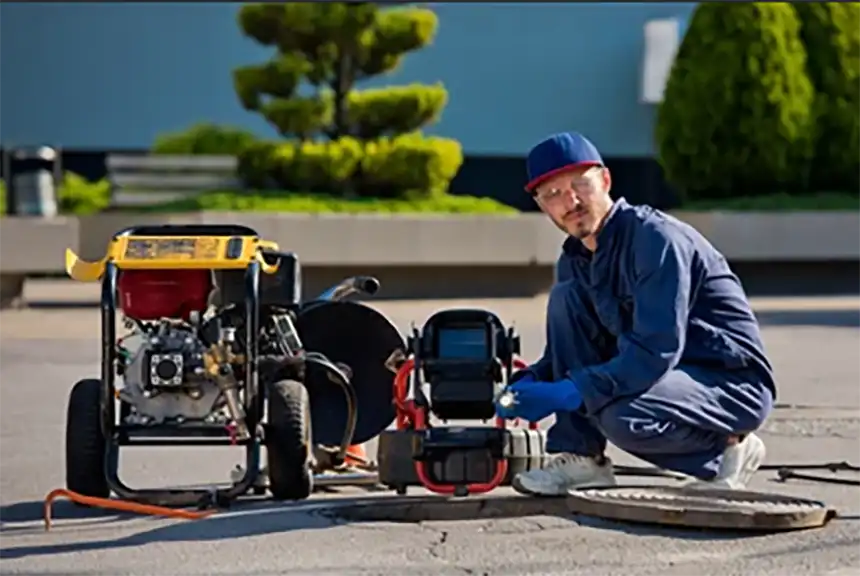
“You’ve got a four about thirty feet out.” That is what most of the technicians say when the camera comes out, and most of the homeowners will say yes and will believe along. But even after agreeing, they are in constant tension about whether the cost will come to 5 figures or what.
The number is real; it comes from a published grading standard, and it is the most useful thing on the report. Nobody explains it at the edge and they way it should be.
Below is what the footage genuinely shows, how the grade actually works out, what the camera cannot see, and what to ask for before anyone quotes the price.
Quick answer
A sewer camera reveals four things worth acting on: the pipe material, where the wall is broken, where roots have got in, and where the line sags and holds water. Everything else is interpretation, and interpretation is where the cost gets decided.
What the Camera Actually Shows You
Sewer inspection is a smart step before a sewer repair, and nobody in the trade argues with that, but the footage itself is smaller than most homeowners expect.
A camera head goes in through a cleanout, a counter ticks off the footage on a monitor propped on the van, and what comes back is a video of one pipe wall.
Within those limits, it might be a good document. You can know that by seeing the accounts up clearly, and so can anything that has worked through them, along with cracks, missing wall, collapsed sections, and the scale narrowing the bore. Material shows up too, and it matters most, because it decides whether lining the pipe is an option or is very necessary.
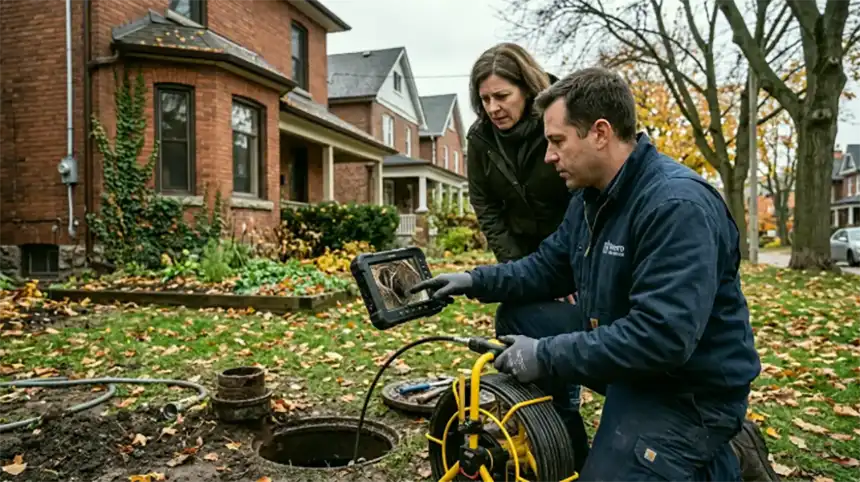
Orangeburg pipe was made of ground wood pulp fibres soaked in coal tar pitch, so some houses drain through compressed paper and tar, and the firm that used to make it shut down by 1974.
How Bad Is a Four, Exactly?
After bringing up the number, it lets you know and tells you the report about the money it earns, and it can also quietly mislead you.
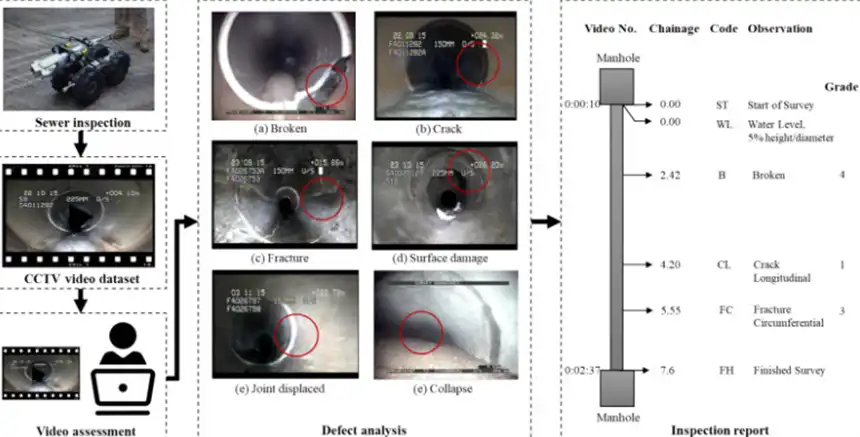
Grades are set from one to five, and five is the one you worry about. They come from NASSCO, whose certification programmes exist to keep coding consistent from one inspector to the next without letting the data get tampered with.
A single grade is still a scrap; the reason can be that overall condition tells you the intensity alongside how many defects turned up, and a report can present that three ways.
Quick Rating: The Worst Thing Down There
The Quick Rating reports what NASSCO calls “the worst-case scenario in the pipe”; this means that the peak grade is found, how often you can see it, and not more than that. It is also the number read down the phone to you.
Why the Pipe Rating Can Mislead You
The Pipe Rating multiplies intensity by how often it happens, and the arithmetic has a mannerism worth enjoying. NASSCO’s own example: nine occurrences of a grade five produce a Pipe Rating of 45, and forty-five grade ones produce 45 as well. One of those lines has nine holes in it. But the others only have some properties that damage the surface.
The Index Is the One to Ask For
The Pipe Rating Index reports the average intensity grade across the whole line, to one or two decimal places, and it is the only one of the three that describes the pipe in a simple and easy way.
Worth knowing
The programme is built for a sideways pipe, meaning the pipe from your house to the main is LACP rather than PACP. Plenty of residential reports are done to nothing, which leaves you holding an opinion with video attached to it.
The Camera Has Blind Spots, and They Are Predictable
It is very difficult for the camera to see under the water.
Wherever the line sinks, water stands in the dip, and the wall below never appears in the footage. Then a sink is also what the finding people get quoted on most confidently, and the one with the least evidence behind it. Wall thickness is invisible too, so a pipe can look sound with very little of it left.
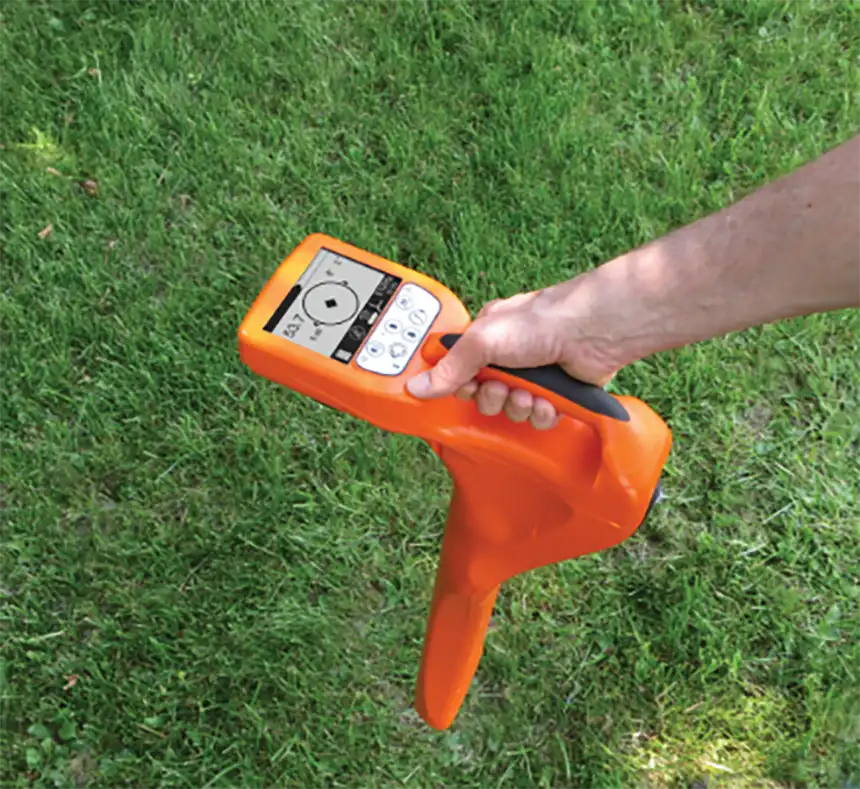
Depth does not come from the picture either. A transmitter called a sonde sits in the spring behind the camera head, which broadcasts at 512 Hz, and a handheld locator above ground reads the depth off it. That reading sets the price of digging, and it comes from a separate step.
Ask for These Before Anyone Quotes
- The raw footage as a file, with the distance counter visible.
- A written defect list where every finding carries its footage mark.
- The grading standard the report was coded to, named on it.
- The locator depth at each defect worth digging for.
- A post-repair camera run, written into the quote before work starts.

Service pages for the repair work itself, such as Sewer Line Repair San Francisco, list that last item among their standard steps, which makes it easy to ask for and awkward to refuse. The first four cost nothing.
Concluding Remarks
The footage is evidence, and evidence is worth what the reading of it is worth.
Catching a small problem early is a question of what you are handed afterwards. A grade with a position attached keeps a finding small problems which can help redesign the yard very early.
So ask for the file. Grading systems like these were written for cities managing thousands of miles of pipe, and they are only now reaching the single line under one garden.
What does a grade four or five actually mean?
Broadly, a four is serious damage and a five is failure, with one being near-perfect pipe. The grade describes a single defect, so ask how many there are.
Is a belly in the line something to fix?
Not on the strength of the footage alone. A sag holds standing water, the camera cannot see the wall beneath it, and a belly is the finding most worth a second opinion.
Do I need the video, or is a written report enough?
Take both. A report tells you what one person concluded. The footage lets a second contractor reach their own conclusion without paying for another inspection.
- NASSCO, PACP Condition Grading System – National Association of Sewer Service Companies: https://www.nassco.org/2023/07/12/pacp-condition-grading-system/
- NASSCO, PACP, LACP and MACP certification programmes – National Association of Sewer Service Companies: https://www.nassco.org/education-and-training/pacp-lacp-macp/
- 10 Steps to Easier Camera Locating – General Pipe Cleaners: https://drainbrain.com/10-steps-to-easier-camera-locating/
- Orangeburg pipe – Wikipedia: https://en.wikipedia.org/wiki/Orangeburg_pipe