TL;DR
- Soundproof wall panels mostly fix echo inside your room. They do little against noise coming through the wall.
- Blocking sound takes weight and airtight seals, not soft surfaces.
- Wood slat panels with felt backing start at about $90 for a 16 sq ft panel, often with a 15-box minimum.
- Try a clap test first. A ringing room needs panels. Hearing words through the wall needs something else.
Short version: panels make your room sound calmer. They don’t make your neighbor quieter.
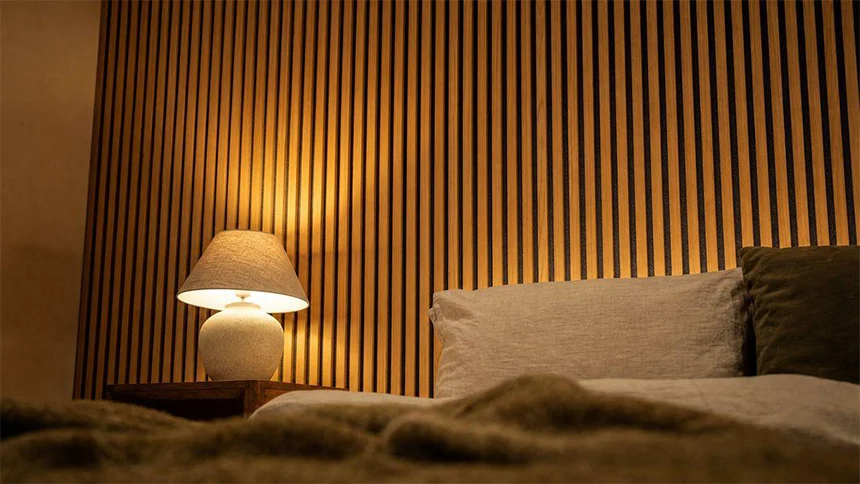
The felt between the slats does the quiet work here. It soaks up sound bouncing around the room, not sound coming through the wall.
Well, no. Soundproof wall panels are built to soak up sound that bounces every day around your house. And that’s why a home office or bare bedroom feels calmer once they go up.
Your neighbor’s TV noise reaches you in a very different way. It starts shaking the wall and slipping through gaps. But a very small and thin layer of wood cannot stop it.
So, what problems do you have, and how will you fix them? This guide will help you identify the answers to all your questions.
What Soundproof Wall Panels Are Really Good At
You shift into a new place. The walls are bare, the floor is hard, and every phone call sounds like it’s coming from a bathroom. That’s echo, and it’s exactly what panels fix.
Hard surfaces bounce sound back at you again and again. Soft, porous materials catch some of it on each bounce, so the room stops ringing. The room starts feeling less tiring to be in it, and your voice gets clearer.
Slat panels do this with a nice-looking trick. Thin wood strips sit on a thick felt backing, and the gaps between the strips let sound reach the felt. You get the look of a wood feature wall, and the felt does the work.
Most shops sell these as soundproofing panels for walls, even though echo is the key thing they fix. To give you a sense of cost, one US seller lists a 94-by-24-inch oak slat panel on recycled felt at $90, covering about 16 square feet. There’s a 15-box minimum, so plan on about $1,350 for roughly 240 square feet. That’s enough for a couple of feature walls.
They work best in rooms with lots of hard surfaces:
- A home office where your calls echo
- A bedroom with wood or tile floors
- A living room or media room where the TV sounds harsh
So why does the neighbor’s TV still come through?
Why Noise From Next Door Still Gets In
Absorbing sound and blocking it are two different jobs, and one material can rarely do both well.
Sound-absorbing stuff like felt, foam, and fabric works by letting sound travel into it, where some of the energy fades away as a tiny bit of heat. Cornell’s building acoustics notes describe exactly that. It’s great inside a room. But a material that sound passes into easily is also one that sound passes through easily.
A National Research Council of Canada digest on building acoustics makes the same point plainly. Absorbing sound and stopping it from traveling between rooms are two different things, measured in separate ways.
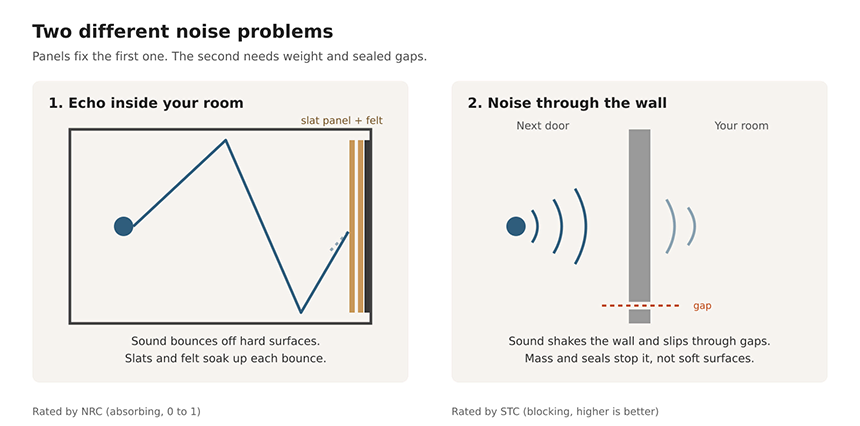
That’s where the two ratings come in:
- NRC (noise reduction coefficient) scores how much sound a surface soaks up, from 0 to 1. This is the absorption number.
- STC (sound transmission class) scores how well a wall or door stops sound passing through. Higher is considered better. This is the blocking number.
If a panel lists only an NRC, or no number at all, it’s an absorber. It will calm your room. It won’t seal it.
If you’d rather see it than read it, the independent Soundproof Guide channel runs a simple and easy test on cheap acoustic foam and shows why it doesn’t block sound:
| Video embed: https://www.youtube.com/watch?v=1lZYwW6vj1UPaste this URL on its own line in the CMS, and it will turn into a player. |
What Actually Blocks Sound Through A Wall
Blocking sound comes down to three things: weight, airtightness, and separation. Here’s what that looks like at home, roughly from cheapest to biggest job.
Seal the gaps first. Sound pours through tiny openings. Run acoustic caulk around outlets and trim on the shared wall, and fit a seal and sweep on the door. It’s cheap, and it usually helps more than you can think.
Add weight where you can. A full bookcase against the shared wall adds mass. So does a heavy, solid-core door in place of a hollow one.
Go inside the wall if you’re serious. Dense insulation in the cavity, an extra layer of drywall, and clips or channels that separate the drywall from the studs all cut sound passing through. If you’re opening the wall anyway, YourHomify’s guide to the insulation types that make the biggest difference notes that mineral wool is dense and also helps with sound.
None of this looks as nice as a slat wall. That’s fine. It lives behind the wall, and the panels can still go on top.
The Two-Minute Test Before You Buy Anything
You don’t require any gear to work out which issues you have.
- Clap once in the middle of the room. If you hear a ring or a fluttery echo, panels will help.
- Stand by the shared wall at night. If you hear a bass thump or can make out words, that’s a blocking issue.
- Got both? Fix the gaps and the wall first, then add panels for the echo.
Before you order a full set, get a sample. Samples often cost a few dollars, and wood tones look different under your own lamps.
Buy Panels For The Room You’re In
Soundproof wall panels are worth it for one thing: making your own room sound softer, calmer, and easier to live in. That’s a real upgrade, especially in a bedroom or home office. Just purchase them for that job. If the noise is coming from next door, the fix begins with the wall, not the decor.
FAQs
Do soundproofing panels actually work?
No, soundproofing panels cannot cancel out all the noise coming from the outside, but they can fix the echo in your home.
Why don’t panels block noise?
Blocking sound needs mass and airtightness, and panels are lightweight, designed to soak up, not block. Noise from the next room travels through the gaps in walls.
What can help block the neighbor’s noise?
Sealing gaps around doors, windows, and sockets; using solid, heavy doors; and adding door seals can block the neighbor’s noise.