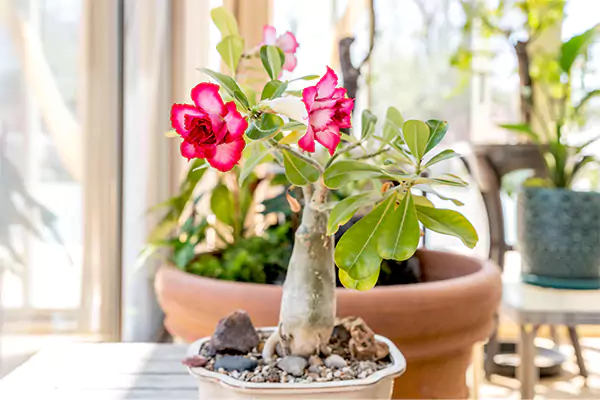
When I first saw Desert Rose, I thought it was a type of cactus that could be grown indoors. Little did I know that this ornamental desert plant would become an aesthetic addition to both my garden and living space.
The thick trunk, vibrant blooms, and delicate leaves of the genus make it a special succulent plant. I initially thought it was a bonsai with bold and blooming red flowers, and its unique shape instantly caught my attention.
Moving further, in this blog, I have shared my personal experience growing this water-storing plant, along with some key features and taxonomy. Let’s explore everything you need to know about the Desert Rose plant.
Desert Rose: A Brief Overview – Key Features and Benefits
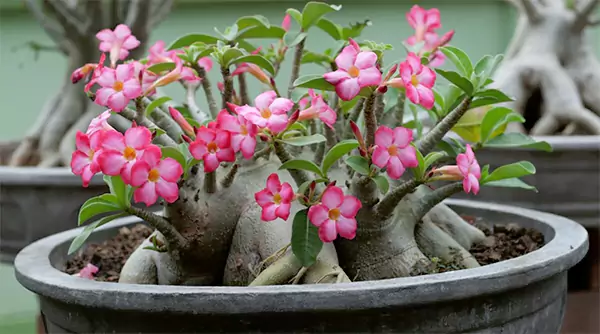
The desert rose is a hardy terrarium plant known for its thick succulent trunk and delicate leaves. It is often grown as an indoor or outdoor bonsai plant and can be a perfect centerpiece for any living space.
Here are some features about the genus that fascinated me and motivated me to grow this botanical marvel in my garden.
- Botanically called Adenium Obesum, the Desert Rose plants are slow-growing and low-maintenance. With minimal upkeep, it can enhance the vibe of any garden or living space.
- The elegant pink flowers of Desert Rose create a stunning contrast with its glossy green leaves. Additionally, this ornamental plant is best planted in the spring and can die if exposed to freezing temperatures.
- Its branches and trunks contain a milky white sap, which can cause skin irritation or serious gastrointestinal distress if ingested by humans, cats, or dogs.
- Apart from adding a dramatic look to any corner, many believe that growing Desert Rose plants symbolizes resilience, endurance, and prosperity.
- Its versatility instantly caught my attention. I tried growing this genus in ceramic planters for my front lawn and in containers as an indoor bonsai plant, and it has performed exceptionally well both times.
The only drawback that this plant has is its toxicity to humans and pets. My dog, Coco, loves sniffing the blooms of the Desert Rose, but I try to keep him away from the plant.
Desert Rose Plant- Taxonomic Overview and Morphology
Before stepping into Desert Rose plant care, I feel it is ideal to understand the plant’s botanical background. Knowing its root and structure can make the growing journey exciting and rewarding.
| Kingdom | Plantae |
| Clade | Tracheophytes |
| Clade | Angiosperms |
| Clade | Eudicots |
| Clade | Asterids |
| Order | Gentianales |
| Family | Apocynaceae |
| Genus | Adenium |
| Species | A. obesum |
| Botanical Name | Adenium obesum |
| One of the unique and defining features of the Desert Rose plant is its thick/swollen base, also known as Caudex, which is a succulent stem that stores water. |
| The leaves of this houseplant are mostly fleshy or leather-like and are arranged in a spiral pattern, forming a cluster at the tip of the branches. |
| Known for its attractive trumpet-shaped flowers, this genus produces blooms that range in color from dark pink to red, with some having a slight orange hue and a white center. |
| Due to the deciduous nature of the Desert Rose plant, the genus sheds its leaves to conserve water, and the water-storing ability of the thick caudex allows it to survive in arid and sandy conditions. |
Desert Rose Care – Ideal Growing Conditions for the Plant
In my research, I noticed many novice plant lovers seeking care tips for Desert Rose on various forums. Therefore, I have curated a detailed care guide that has worked well for my houseplant.
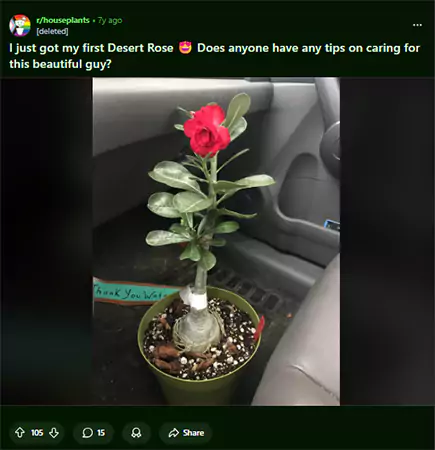
- Pot Selection: Make sure to choose a pot that is slightly larger than the root ball of the plant. Containers that allow air circulation and help prevent excess moisture are the best for this succulent.
Ensure that the pot has several drainage holes to avoid waterlogging and root rot.
- Soil Requirement: I prefer using a specialized succulent potting mix for my Desert Rose. The genus also grows best in a mix of sandy or loamy soil. A slightly acidic to neutral pH level of the soil is ideal for optimal growth of the plant.
Bonus Tip: Mix 2 parts of potting soil, 1 part perlite, 1 part coarse sand, and your very own potting mix for Desert Rose is ready!
- Watering Schedule: During the growing season, water the plant generously whenever the top layer of the soil feels dry. Make sure that the soil is evenly moist and the water drains efficiently.
Adjust the frequency during the dormant season. Only water when the soil and the roots of the plant are completely dry and pour directly on the base, avoiding the leaves or flowers.
- Sunlight Requirement: Desert Rose is a sun-loving plant. If you are planning to grow this beauty outdoors, make sure that it gets a minimum of six hours of direct sunlight.
I have mostly grown this exotic bloom indoors. Consider placing the pot near a south-facing window where it can get bright light. If natural sunlight is not sufficient, you can also use grow lights.
- Temperature and Humidity: The plant thrives in 65*F – 90*F. It cannot survive in freezing temperatures and prefers low to medium humidity for optimal growth. Make sure that you provide the plant with good air circulation, as excess moisture can damage the roots.
The fertilizer needs of the plant are not very complex. I always use a balanced, water-soluble NPK fertilizer in the ratio 10:10:10 for my plants. Try spraying it every 4-6 weeks, especially during the growing season, for overall development.
Common Pests and Diseases That Affect Desert Rose
Like most desert plants, the Desert Rose is also hardy and pest-resistant. If you do not provide the succulent with ideal growing conditions, it may become susceptible to pests like mealybugs, spider mites, or aphids. Let’s discover how to manage these in detail.
- When I first started growing the Adenium Desert Rose plant, I noticed small, white, cotton-like insects on the thick trunk of the succulent. Little did I know that these were mealybugs!
Spraying a strong stream of water and rubbing horticultural oils on the leaves and branches of the Desert Rose prevented mealybugs.
- Yellowing of the leaves is the most common issue faced by this desert plant, which mostly happens due to overwatering. If you notice the roots turning mushy and slightly black, cut them right away using a sharp knife.
Excess watering can cause fungal infections that can kill the roots. Consider using a fungicide as per the instructions given on the back of the packet.
- One of my gardening friends noticed blister-like spotting on the upper surface of the leaves and complained about the distorted growth of the plant. This generally happens when any plant is affected by powdery mildew.
Slightly mist the leaves and remove the powder spots using a damp cotton. Prune the branches that are dead or damaged and apply a fungicide.
- Another common issue that I have noticed during Desert Rose cultivation is sticky larvae/residue on the leaves of the plant. This is generally because of the Oleander caterpillar, and manual removal is recommended.
Use organic sprays or natural oils to remove them completely. Be sure to isolate the affected plant to prevent the issue from spreading to others.
If you feel the plant is heavily infected, it is better to isolate it and repot. Prepare a fresh potting mix, and once the plant is rid of all the insects, place it in the new container and keep it under direct sunlight for a few days.
Word of Caution!
Always wear gloves and a mask whenever dealing with plants affected by a certain pest or disease. Direct contact with any fungal bacteria or fertilizer can cause serious skin issues.
Potting, Repotting, and Propagating Desert Rose Plant
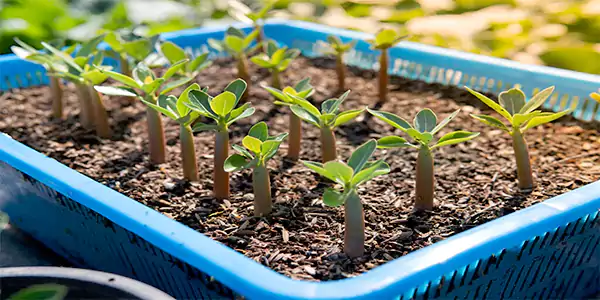
Using the right potting and repotting techniques for the Desert Rose plant is essential to maintain its overall health. Whenever I feel that the roots of the genus are overgrown, I make sure to repot it to avoid any kind of damage.
- Potting or Repotting: Ensure to use ceramic containers or plastic pots with ample drainage holes. Prepare a succulent potting mix with extra perlite and gravel.
The best time to repot Adenium Desert Rose is in late winter or early spring, during the onset of active growth. Make sure to check every 1-2 years. If the roots feel suffocated, it’s time to repot.
- Propagating Desert Rose: If you are wondering how to propagate a succulent, then let me tell you that the steps are effortless. The Desert Rose can be further cultivated using different methods. Stem cutting, water propagation, and seed propagation are some of them.
I make sure whenever I repot or propagate this succulent, I do not overwater. Gently mist the pot and allow the soil to settle on its own.
Research, Case Studies, and Findings
In this section, I have reviewed several research papers and case studies conducted on Desert Rose to gain a deeper understanding of the plant’s demands.
Year of Study: 2024
Source: Science Direct Research Paper
Aim: To see if natural fibers from the Desert Rose plant can be used to clean up oil spills and remove oil from dirty environments like oil-contaminated water.
Findings: The Desert Rose fibers can absorb oil very well. Moreover, the plant fiber was found to absorb approximately 49 grams of oil per fiber. It proves to be a simple, low-cost, easily available, and biodegradable method, causing no secondary pollution.
Year of the Study: 2014
Source: American Society for Horticultural Science
Aim: How do different amounts of light and fertilizer affect the growth and flowering of Desert Rose plants?
Findings: 30% shade and high fertilizer gave the most flowers and the best overall appearance of the plant, while the plants under direct sunlight were smaller and had fewer blooms. Hence, the genus grows best when given enough fertilizer and moderate shade.
Conclusion
I used to think that Desert Rose was just another flowering plant, but the more I researched the genus, the more fascinating it became. Its unique structure, water-storing strength, and alluring blooms remind me that even in harsh conditions, something beautiful can bloom.
The fact that it does not require much care, and with some basic growth support, they can flourish into such stunning centerpieces, still amazes me!
FAQs
Is Desert Rose poisonous to humans?
All parts of the plant, if ingested by humans, cats, or dogs, are poisonous. It can cause vomiting, diarrhoea, gastrointestinal issues, or even an irregular heartbeat.
Is the Desert Rose plant hard to care for?
Not really! The plant is absolutely low-maintenance and requires minimal upkeep. By providing it with the ideal growing conditions, you can have a flourishing Desert Rose plant.
Where is the best place to put a Desert Rose?
The Desert Rose plant can be grown both outdoors and indoors. For outdoor spaces, place the pot in direct sunlight for at least 6 hours. For indoors, it is best to position the pot near a south-facing window.
What is the botanical name of the Desert Rose plant?
The botanical name of the Desert Rose plant is Adenium Obesum. It is an evergreen succulent shrub belonging to the Apocynaceae family.
How many colors does Adenium Obesum come in?
The Adenium Obesum, also known as Desert Rose, is widely popular for its trumpet-shaped flowers and comes in a range of colors, from white to red, pink, yellow, and off-white.
- Desert Rose Adenium – NC State Extension Research Paper
- Desert Rose Gardening Solutions – University of Florida Magazine
- How to Grow and Care For a Desert Rose– BBC Gardeners’ Magazine