


Have you ever seen mould in your home and wondered how long it had been there before you noticed it? Mould doesn’t give you a heads up. It grows quietly where we seldom look—behind walls, under floors, in crawl spaces, and by the time you see it, it’s usually been there for weeks or months.
The good news is that new smart sensor technology is changing this altogether. Homeowners can now look out for the conditions that cause mould, and act before it ever shows up, instead of finding mould after it’s already there.
Key Takeaways
- Understanding why mould detection starts with environmental monitoring
- Exploring what smart sensors actually monitor
- Analyzing how smart sensors help prevent mould problems early
- Assessing integration with smart home systems
Why Mold Detection Starts With Environmental Monitoring
Mould doesn’t grow haphazardly. It requires three things: moisture, a food source (most building materials offer this), and the right temperature. The only variable that can practically be monitored and controlled is moisture. The risk of mould is much higher in areas where moisture is above normal and stays for more than 24 to 48 hours.
Old school mould detection is reactive. You see or smell mould and react. Smart environmental monitoring is proactive. You monitor the conditions that lead to mould growth and take action before the growth occurs. The results are quite different.
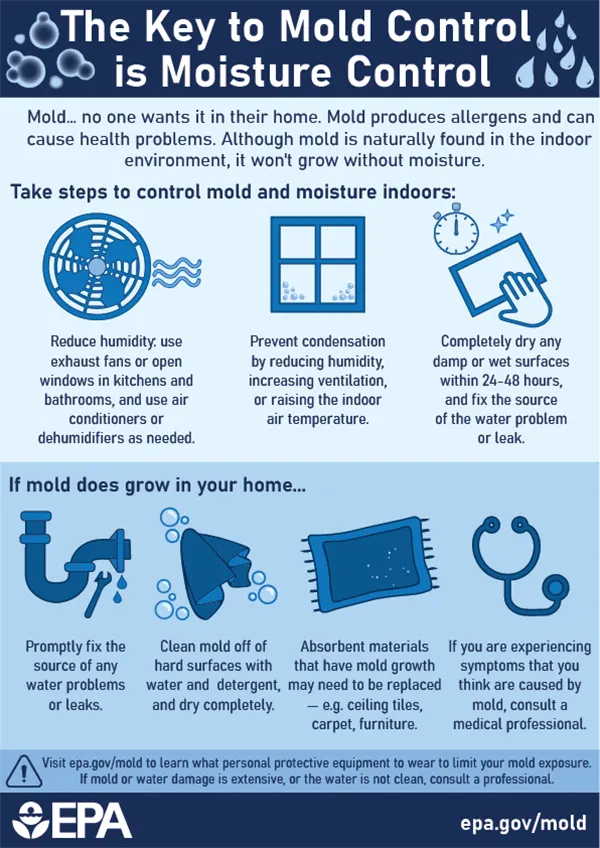
Explore this infographic for further details about mold control:
What Smart Sensors Actually Monitor
Smart home sensors designed for mold risk monitoring track the environmental variables that matter most:
- Humidity levels: relative humidity above 60% creates conditions where mold can establish. Sensors that track humidity continuously, not just when someone checks, provide the kind of ongoing oversight that periodic manual checks can’t.
- Temperature: mold thrives between 20°C and 30°C (68°F to 86°F). Sensors tracking temperature alongside humidity provide a more complete picture of mold risk than either measurement alone.
- Moisture in surfaces: More sophisticated sensors can detect moisture content in walls, floors and ceilings, identifying water intrusion that has not yet manifested itself in visible signs.
- Air quality: some sensors detect increased spore counts or volatile organic compounds associated with mould activity which can be an early indicator that growth may already be taking place in an unmonitored space.
Choosing the Right Sensor System
Not all smart environmental sensors are equal in their accuracy, reliability, or integration capability. When evaluating options, look for:
- Humidity sensors with documented accuracy specifications
- Extended battery life or wired power options for continuous deployment in inaccessible locations
- Smartphone alerts that tell you immediately when limits are exceeded
- Historic logging that exhibits trends not just current conditions
- Integration capability with existing smart home platforms
Visiting sensorahome.com provides a useful starting point for understanding the range of smart environmental monitoring options available for home mold risk management, with products designed specifically for the residential monitoring context rather than industrial applications adapted for home use.
How Smart Sensors Help Prevent Mold Problems Early
Mould thrives in hidden places, like behind walls, under sinks, or in damp areas that are not routinely inspected. By the time it becomes visible, the damage can already be expensive to fix.
Smart sensors help by continuously monitoring moisture, humidity, and temperature levels, allowing problems to be detected earlier and managed before mold has a chance to spread.
1. Early Warning Prevents Costly Remediation
The financial argument for early detection is straightforward. Depending on how big the problem is, mould remediation can cost anywhere from a few hundred dollars for a surface issue in one contained room to tens of thousands for structural remediation where walls need to be taken out and rebuilt.
According to the EPA’s guidance on mold prevention and remediation in buildings, controlling moisture is the single most effective strategy for preventing mold growth, and early detection of moisture problems is the most practical mechanism for keeping control before growth begins. Smart sensors make that early detection continuous and automatic rather than dependent on periodic inspection.
2. Monitoring High-Risk Areas Around the Clock
The places most likely to have mould growth are often the places least likely to be inspected. Walls and ceilings in bathrooms. Below the kitchen sinks, basements, and crawlspaces, areas surrounding windows and exterior walls in humid climates. Attics with inadequate roof ventilation.
Smart sensors placed in these areas monitor conditions 24/7, alerting homeowners if humidity, temperature or moisture levels enter the danger zone. This continuous monitoring closes the gap left by the periodic inspection, the time between the last check and the next one when conditions can change significantly.
3. Integration With Smart Home Systems
Environmental sensors today are often part of an overall smart home system, connected to the HVAC controls, the ventilation system and the humidity control system to automatically react to conditions as they develop. The sensor in the bathroom detects humidity above a threshold and automatically turns on the ventilation fan. Basement sensors detect high moisture levels and turn dehumidifiers on automatically.
This integration converts monitoring from a passive alert system into an active management system, one that doesn’t just tell you about problems but begins addressing them immediately.
Final Thoughts
Smart sensors don’t eliminate mold, they eliminate the conditions that allow mold to establish undetected. Continuous monitoring of humidity, temperature, and surface moisture turns mold risk management from a reactive problem-solving exercise into a proactive maintenance practice.
For homeowners who have dealt with mold or who want to avoid the experience, smart environmental sensors are one of the most practical and cost-effective home technology investments available.
FAQs
Is there a sensor that detects mould?
The Biomatrix mould monitor is more than the most technologically advanced smart home mould detector on the market.
Why are smart sensors important and adopted?
These sensors are important for things like the Internet of Things (IoT), smart cities, automated industries, and healthcare innovations.
Which light detects mould?
UV light can help detect black mold, but it doesn’t guarantee 100% accuracy. Mold spores often fluoresce under UV light, making them more visible in dark areas.
What are the benefits of smart sensors?
This advantage allows businesses and users to continuously track conditions such as temperature, motion, or pressure and respond quickly to changes.