
“If you think hiring a professional is expensive, wait until you hire an amateur.” — Red Adair (Oil Well Firefighter)
Hiring a broker to rent or sell one of your biggest assets demands some thought. At last, he/she is representing you in front of the other party.
Making a wrong choice here comes with a lot of financial risk. So, work with estate agents who possess considerable knowledge of buyer behaviour and rental yields.
This guide helps you find that right estate agent, whether you’re selling your family home or just renting out a spare apartment of yours.
What a Good Estate Agent Actually Does for You
Besides putting that “For Sale” board outside your house, the agent:
- Values the property
- Arranges photography and floor plans
- Lists it across property portals
- Manages viewings
- Negotiates on your behalf right through to completion
It’s one of the best ways to make home selling easier.
For landlords, the job looks different but is just as involved. A letting agent finds and references tenants, drafts the tenancy agreement, collects rent, and coordinates repairs, giving you a single point of contact for almost everything that comes up during a tenancy.
Start With Local Market Knowledge
A broker who knows the locality would certainly market and negotiate your property better. They will know:
- Which streets attract families
- Which flats suit young professionals
- How quickly comparable homes have moved in recent months
This is especially true in a county like Cambridgeshire, where the market varies sharply between a Cambridge city flat and a village property near Peterborough. Local estate agents who work across the whole region tend to have a broader view of where demand is strongest.
House prices in the area have grown steadily thanks to strong transport links, while the university feeds a reliable stream of student tenants. An agent with genuine local roots can explain how these factors affect your specific property, not just quote a generic regional average.
PRO TIP
Ask any shortlisted agent how many properties they have sold or let within your specific postcode this year, not just across their wider coverage area.
Compare Fees Before You Commit
Broker fees vary a lot. For sellers, the average UK estate agent fee sits around 1.42% including VAT, though rates commonly range from about 1% to 3% depending on location and contract type.
Landlords face a different structure. Tenant-find-only services typically cost 8% to 12% of the first year’s rent as a one-off charge, while full management runs 10% to 15% of the monthly rent plus VAT.
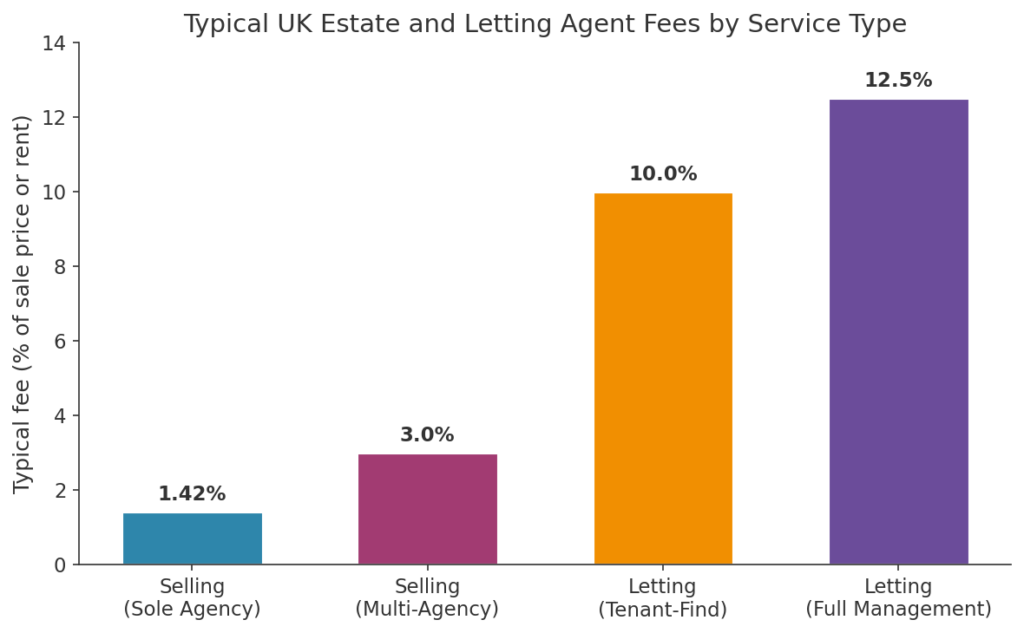
A high fee is not proof of a better service. Always weigh an agent’s track record, not just the percentage on the quote, before deciding.
Get quotes from several agents and ask each one to justify their figure with recent, comparable results rather than a headline percentage. For more detail on how UK selling costs break down, the HomeOwners Alliance fee guide is a useful independent reference.
Check Marketing Quality and Property Presentation
No buyer or tenant quickly connects with the agent. They research for a long period before doing that. So, the quality of photography, floorplans and written descriptions matters enormously. Scroll through an agent’s current listings and judge them as a buyer would.
Look for professional photography, clear floorplans with room dimensions, and descriptions that highlight genuine features rather than filler text. Rushed or poorly lit listings are usually a preview of how your own property will be presented.
Presentation cuts both ways. A well-styled interior and tidy exterior help any agent do their job better. If you’re weighing up which upgrades are worth the effort, this guide on outdoor design and property value is a helpful starting point, alongside this piece on dealbreakers buyers notice on a second walkthrough.
Confirm Legal Compliance and Redress Scheme Membership
This is one of the most overlooked checks, yet arguably the most important. Every letting broker operating in England must, by law, hold membership with either The Property Ombudsman or the Property Redress Scheme.
| Feature | The Property Ombudsman (TPO) | Property Redress Scheme (PRS) |
| Legally required | Yes, for all letting and property management agents | Yes, as an approved alternative to TPO |
| What it covers | Complaints about agent conduct, fees and communication | Complaints about broker conduct, fees and communication |
| Penalty for non-membership | Up to £5,000 fine from the local council | Up to £5,000 fine from the local council |
Before signing anything, ask which scheme your agent belongs to and confirm it independently on the scheme’s own website. Shelter’s guide to letting agent redress schemes explains exactly what you can and cannot complain about.
WARNING
Councils can fine an agent up to £5,000 for skipping a redress scheme, and membership gives you a genuine route to complain if something goes wrong.
Sole Agency vs Multi-Agency Agreements
For sellers, the type of agreement you sign affects both cost and how hard a broker works for you. A sole agency deal gives one agent exclusive rights to sell your home, while a multi-agency deal lets several agents compete at once.
| Feature | Sole Agency | Multi-Agency |
| Number of agents | One | Two or more |
| Typical fee | Around 1% to 1.8% plus VAT | Around 2.5% to 3.6% plus VAT |
| Exclusivity | Only that agent is paid if they sell | Only the broker who finds the buyer is paid |
| Best for | Typical residential sales | Slow markets or harder-to-sell properties |
Sole agency works well for most sellers, since a single agent has every reason to prioritise your listing. Multi-agency can generate more interest, but the higher fee only pays off if it genuinely speeds up your sale.
Questions to Ask Every Shortlisted Agent
Most probably, you won’t find answers to all your queries on the website. Hence, ask each shortlisted broker the following:
- How many properties like mine have you sold or let in the last 12 months?
- What does your fee actually include, and what costs extra?
- Which redress scheme are you a member of?
- How will you keep me updated once the property is listed?
- What happens if I want to end the agreement early?
How an agent answers often says as much as the answers themselves. One Progressive Lets tenant described their property manager as consistently polite and quick to resolve issues during the tenancy, a good example of the ongoing communication worth asking about upfront.
Red Flags That Signal a Poor Fit
Watch for warning signs before you sign a contract, not after.
Be cautious if an agent:
- Gives a valuation noticeably higher than every other agent you have spoken to, with no comparable evidence to back it up
- Cannot clearly explain what is and is not included in their quoted fee
- Is vague or evasive when asked which redress scheme they belong to
- Pressures you to sign sole selling rights, rather than sole agency, on the first visit
None of these signs is automatically disqualifying on its own, but two or more together are worth taking seriously.
Conclusion
Finding the right agents is not that difficult. Just check their local knowledge, transparent fees, verified redress scheme membership, and evidence of solid marketing. None of these takes long to confirm, and doing so before you sign anything can save real money and stress later on.
First home sale or rental portfolio, take the time to compare a few options properly rather than going with the first name that comes up in a search. Once the deal is done, it’s also worth revisiting your cover, since comparing home insurance quotes is one of the easier ways to avoid overpaying once you have moved.
FAQs
How many estate agents should I get valuations from before choosing one?
Most guidance recommends inviting three or more agents to value your property. This gives you a realistic price range, lets you compare fees and marketing approaches side by side, and makes it easier to spot a broker who is overvaluing simply to win your business.
Is it better to use a sole agency or multi-agency agreement?
For most standard sales, sole agency offers the better balance of cost and commitment. Multi-agency tends to suit slower markets or properties that have struggled to attract interest, where the extra exposure can justify the higher combined fee.
What happens if my letting agent is not part of a redress scheme?
Operating without a redress scheme is against the law in England, and the penalty can reach £5,000 per breach. If you cannot confirm an agent’s membership, treat that as a serious red flag rather than an oversight.
Can I negotiate estate broker fees?
Yes. Fees are rarely fixed, and getting competing quotes puts you in a stronger position to ask for a lower rate. Many sellers successfully negotiate a small reduction simply by asking directly.
Do I need a different agent for selling and for letting?
Not necessarily. Many agencies handle both sales and lettings, though it is worth confirming they have genuine experience in whichever service you need rather than treating it as a secondary offering.