

Forty percent of homeowners who took on an outdoor project do the whole thing themselves, including the labor and materials both. That’s a big share than the people who hired a professional for the entire job.
It says something useful about where character comes from on a house. Mostly decisions, and only partly money, which is why two homes on the same street with the same budget can end up looking completely different.
The things that follow cover the cladding, the proportions, the small hardware, and the ground around the house, which are the four things that actually shape how it is different from the streets There’s a short walk in the middle that shows you which one yours is getting wrong.
The Cladding Decides More Than the Color
Paint is the change people want to do first. and it’s the one that matters least. A front of the house looks better when the surface does with light, and that’s a function of profile depth, not color.
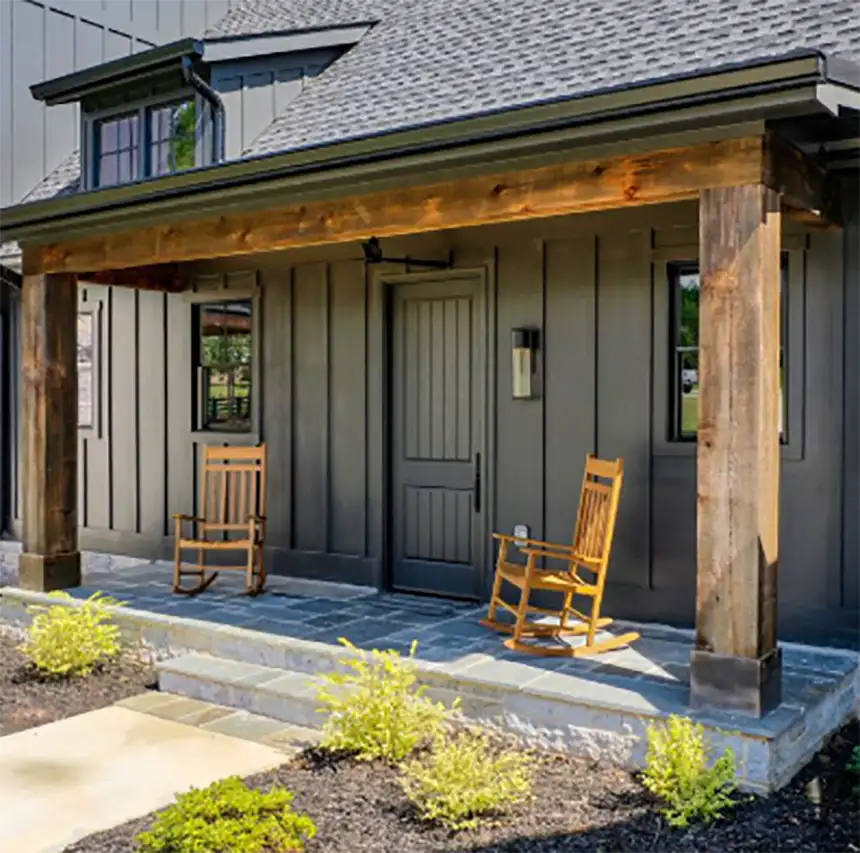
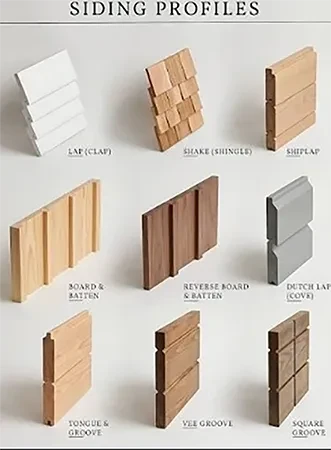
The plank and all the wooden works run wide boards with narrow strips covering the seams, which gives you a strong vertical rhythm and a shadow every few inches. Slope siding runs narrow things across each board so the overlap throws a horizontal line. Channel profiles set a hollow groove between boards and read deeper again.
Stand in front of any of them at four in the afternoon and the difference is obvious. At noon it nearly disappears. This is the detail I find genuinely satisfying about cladding, and the reason I’d pick a profile by walking a street in low evening light rather than by scrolling a supplier’s catalogue.
Material carries its own timeline too. Western Red Cedar left unfinished weathers to a silvery gray rather than failing, and properly installed cladding of that kind can run thirty to fifty years. A painted board asks for a decision every eight.
Proportion Is the Part People Skip
Look at the garage door of the house on most of the house it is the only door or the flat surface that is facing the street. This means that the dated and the scratched surface of the house is at the only door that is facing the street and is the opening of the house towards it.
The trimming of the window is a similar kind of thing, just on a smaller scale. Trim draws a clean line around an opening and tell the people where the architecture actually is, and shutters (when they’re sized as though they could really close) add it also adds a rhythm across the front that a wall without anything don’t have.
A door that’s too small for its surround looks very bare and faded . A garage that’s too loud doen’t let anything ele around it shine. Getting the relative sizes right costs nothing at the design stage and is nearly impossible to fix afterward.
A Ten-Minute Walk Will Tell You Most of It

- Stand at the far end of the driveway, late afternoon, and photograph the front.
- Look at the photo rather than the house, because the camera makes everything smooth and shows you what a passer-by actually sees.
- Name the largest surface, then decide whether it deserves to be the largest surface.
- Check whether the hardware matches: house numbers, handles, light fixtures, letterbox.
- Follow the path from the street to the door and note anywhere you’d have a problem.
- Glance at it until the detail drops out, and see what shape is left.
Two problems come up most. The first one is that something is the wrong size, and the metal doesn’t match.
That second one is the cheapest fix in exterior design. House numbers, a door handle, a porch light and a letterbox in coordinated finishes read as a decision; the same four in brass, black, chrome and whatever came with the house read as an accident.
What the Yard Does to the House
Landscaping is mostly discussed as decoration, which is the wrong thing to project entirely, because everything you put in the ground either directs a visitor toward the front door or gets and grabs the attention of them.
The structure should always come first. The paths and zones need some planning before anything goes deep inside the ground. The reason behind this is that a route the eye can follow does more for a face of the building than any individual bush or plant. Screening matters as much: a boundary that gives privacy without completely making a wall stand and making the place look ugly takes deliberate design rather than a row of fast-growing hedging.
Lighting is where this either comes together or falls apart. Fixtures chosen together and aimed at the things worth seeing, whether that’s the door, a tree or the texture of that cladding, create one coherent scene after dark. A scattering of solar spikes creates several competing ones.
NOTES
Energy-efficiency savings calculators for solar panels or heat pumps use idealized baseline utility rates and perfect architectural orientation. A single mature oak tree shading your roof or a local utility company that doesn’t offer net metering will significantly alter your actual monthly savings and prolong your payback period.
Agents back this up, which is unusual for something this subjective: 92% say they advise sellers to improve curb appeal before listing.
Concluding Remarks
You should pick one thing and do it properly rather than four things sufficiently. One well-chosen cladding profile on the front elevation will change more than a new door, new numbers, new lights and fresh mulch combined.
The first thing that you should do is take the walk around. Homeowners in that outdoor-projects when researched have an average joy score of 9.7 out of 10, which is high for building work, and I suspect the ones scoring it that way knew what their problem was before spending anything.
FAQs
Q1. Does exterior character depend on the style of the house?
Ans: It depends on being consistent with it. A modern profile on a Victorian cottage reads as a mistake, while the same board on a new build reads as a choice.
Q2. What’s the cheapest change that actually makes a difference?
Ans: Matching your exterior metals. Numbers, handle, light, and letterbox in one finish cost very little and pull the whole entry together.
Q3. Is cladding worth it if I’m selling soon?
Ans: Probably not for the return alone. Do it because you want to live with it, and treat any recovery at sale as a bonus rather than the reason.
- Beere Timber, “Western Red Cedar Siding & Cladding” — board and batten cladding, siding profiles, shadow characteristics, weathering behavior and service life
- YourHomify, “8 Exterior Enhancements That Instantly Elevate Your Home” — exterior details that elevate curb appeal, garage door scale, trim and shutters, coordinated hardware finishes
- National Association of REALTORS®, “Remodeling Impact Report: Outdoor Features” — landscaping improvements, DIY share, curb appeal advice rates, joy score and survey methodology
- YourHomify, “How Outdoor Kitchens and Thoughtful Landscaping Work Together” — landscaping that shapes backyard character, path and zone planning, privacy screening, coordinated outdoor lighting