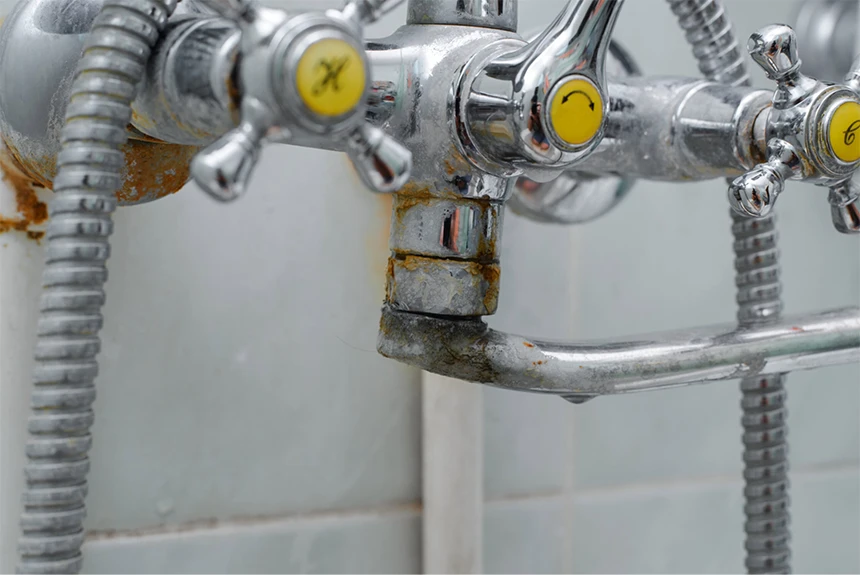
Have you noticed some kind of white residue around your bathroom faucet and think it’s just a cleaning nuisance? But if you’re noticing it regularly, that’s a sign of hard water in your home.
Hard water actually has a significant amount of naturally occurring minerals, primarily calcium and magnesium. These minerals can leave deposits behind as water evaporates or gets heated. And if left untreated, these deposits can also affect the appearance of the sink and many more things. Faucets may start delivering less water, valves can become harder to operate, and appliances may need more maintenance than expected.
Where Does Mineral Buildup Come From?
Water collects minerals as it travels through soil and rock before reaching a home’s plumbing system. The amount differs depending on the local water source and geology.
When hard water dries on a surface, some of those dissolved minerals stay behind. That’s what creates the familiar white, crusty deposits around faucet openings, showerheads, and sink fixtures.
Heating water can make the issue more noticeable. Under certain conditions, dissolved minerals form solid scale that pile on the inside of pipes, heating elements, and other surfaces.
A little residue on a faucet isn’t necessarily a severe problem. However, repeated accumulation in narrow openings or mechanical components can actually interfere with how they work.
Why Faucets May Lose Water Flow
One of the first places homeowners notice hard water issues is at the faucet.
Most modern faucets have an aerator at the outlet that helps regulate the water stream. Its small openings can slowly collect mineral deposits, restricting the amount of water passing through.
You might notice that the water stream looks uneven, splashes in multiple directions, or seems weaker than it used to.
Showerheads can develop identical problems when scale collects around individual spray openings.
Fortunately, these issues don’t always require replacing the whole fixture. Removing and cleaning a clogged aerator or showerhead may restore normal flow.
However, if deposits are collected deeper inside the faucet, cleaning the outlet alone may not solve the problem. A worn or obstructed cartridge could also need attention.
Hard Water Can Make Valves Harder to Operate
Valves control water flow in a home’s plumbing system, from the shutoff valves beneath sinks to the internal mechanisms inside faucets.
Several contain moving parts, seals, and relatively small passages. Mineral deposits can collect around these components, especially where water regularly sits or evaporates.
Over time, buildup may contribute to stiff handles, reduced movement, or valves that no longer run smoothly.
For instance, a shutoff valve beneath a bathroom sink might go untouched for several years. When someone eventually needs to turn it off for a repair, the handle may be unusually difficult to move.
Hard water isn’t the only possible reason. Corrosion, aging seals, and ordinary wear can produce similar symptoms.
Forcing a stuck valve can damage its internal components or cause a leak, so it’s usually better to have a plumber assess a valve that won’t operate normally.
When parts are too worn or damaged to run reliably, replacing the affected components may make more sense than repeated cleaning. Homeowners and contractors can explore suitable plumbing valves and fittings from PlumbingSell when planning repairs.
What Mineral Deposits Mean for Plumbing Connections
Hard water can also distribute visible deposits around threaded connections, faucet bases, and other areas where moisture collects.
A white crust near a connection doesn’t automatically show a failing pipe. Sometimes it’s simply residue from splashing water that has dried on the surface.
But persistent deposits concentrated around a joint may suggest a small leak, particularly if the area stays damp after the surrounding surfaces have been dried.
Inside plumbing, long-term scale accumulation can narrow passages and add to reduced flow. The severity relies on water hardness, temperature, pipe conditions, and how long the system has been exposed.
It’s important to differentiate mineral buildup from other plumbing problems. Rust-colored staining, for example, may involve iron instead of the calcium and magnesium responsible for water hardness.
If staining appears alongside active dripping, corrosion, or reduced water pressure, a closer inspection is worthwhile.
Water Heaters and Appliances Can Be Affected Too
Mineral deposits don’t stop at leaky faucets.
Water heaters are especially susceptible because heating encourages certain dissolved minerals to form scale. Deposits can settle inside storage tanks or collect on heating surfaces, potentially minimizing efficiency and contributing to maintenance issues.
Dishwashers might leave cloudy spots on glassware, while washing machines can struggle with detergent performance in hard water.
Coffee makers, kettles, and other appliances that repeatedly heat water can also collect scale.
The effects differ with the hardness of the water and the equipment involved. Not every appliance exposed to hard water will experience severe damage, but households in areas with very hard water may notice that cleaning and descaling become regular maintenance jobs.
Following the manufacturer’s maintenance recommendations can help avoid buildup from becoming more difficult to remove.
Cleaning Mineral Deposits Before They Become a Problem
Routine cleaning is usually enough to manage light hard water deposits on accessible surfaces.
For compatible fixtures, a mild vinegar solution or manufacturer-approved descaling product may help dissolve calcium-based buildup. Removable faucet aerators can sometimes be cleaned easily, making it easier to reach deposits inside their small openings.
However, acidic cleaners aren’t good for every surface. Certain decorative finishes, natural stone countertops, and fixture components can be damaged by the wrong cleaning products or prolonged exposure.
Always check the manufacturer’s care instructions before using a descaler.
Drying faucets and shower surfaces after use can also minimize visible spotting because less water remains behind to evaporate.
These habits won’t change the hardness of the water itself, but they can make everyday maintenance more manageable.
When Is Water Treatment Worth Considering?
If mineral deposits return quickly despite regular cleaning, checking the home’s water hardness can help determine whether treatment makes sense.
Water hardness is mostly measured in grains per gallon or milligrams per liter, expressed as calcium carbonate.
A basic water test can show how hard the water is and offer a useful starting point for comparing treatment options.
Traditional ion-exchange water softeners minimize hardness by replacing calcium and magnesium ions with sodium or potassium ions. These systems can reduce scale formation in the household plumbing system.
Other products, sometimes marketed as salt-free conditioners, aim to minimize scale formation without actually eliminating hardness minerals. Their effectiveness and suitability depend on the technology and water conditions.
Standard sediment filters and activated carbon filters often don’t remove dissolved hardness minerals, so installing an ordinary water filter may not resolve scale issues.
Before investing in treatment equipment, homeowners should think about the test results, maintenance requirements, installation costs, and the issues they’re trying to address.
Keeping Plumbing in Good Working Condition
Hard water is often more of a household maintenance concern than a drinking water health issue. Still, its effects on plumbing can become irritating when mineral deposits repeatedly clog fixtures or interfere with moving parts.
The best approach isn’t necessarily replacing every affected component or installing a costly treatment system immediately.
Begin by identifying where deposits are forming, maintaining fixtures according to manufacturer recommendations, and checking whether reduced flow or stiff valves have other causes.
If problems keep returning, a plumber or qualified water treatment professional can help decide whether cleaning, component replacement, or water softening is the most practical solution.
A little attention to mineral buildup early can help keep faucets, valves, and water-using appliances working as intended for years to come.
FAQs
What type of faucet is best for hard water?
A solid brass faucet combined with brushed nickel and a ceramic disc is considered best for hard water.
What taps are best for hard water?
Solid brass and stainless steel are best for hard water.
Which company’s taps are best quality?
Grohe and Hansgrohe are considered good companies for the best taps.