

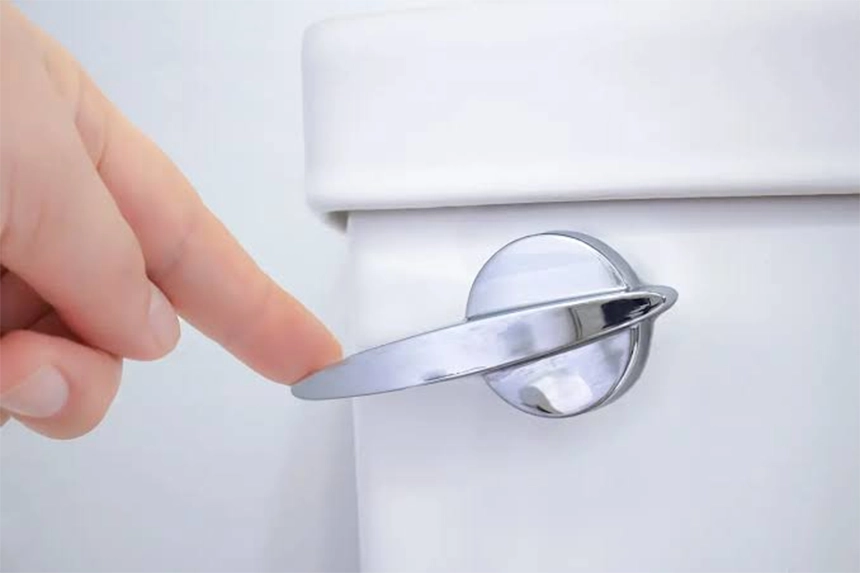
The flush handle gets touched the most, and in higher-end remodels it is starting to vanish from all the hardware in bathrooms.
Commercial restrooms dropped it years ago. Sensor valves in airports and offices made people comfortable with a toilet that flushes on its own. The same idea is now coming in residential toilets, answering how to modernise your bathroom, built into the toilet or the bidet seat rather than bolted on.
What Automatic Flushing Actually Does at Home
On a residential smart toilet, the flush is tied to the seat. TOTO defines it plainly on its NEOREST pages: there is “no need to touch a button or handle,” and the flush happens “after each use.” The same page pairs it with a lid that opens as you walk up and closes when you are done.
In practice, that means three things change. Nobody forgets to flush. The handle stops collecting fingerprints. And the lid closes automatically, so it’s down far more often than in a house that relies on people remembering, which matters more than it sounds.
That last point comes from a 2022 study at the University of Colorado Boulder. Researchers used green lasers to film the spray from a lidless flush and found particles rising about five feet (1.5 meters) within eight seconds.
Their test used a commercial toilet with no lid and didn’t test a closed one, so it doesn’t establish that a lid stops the plume. It does show what happens when there isn’t one, and a lid that closes itself takes the human habit out of the equation.
Not Every Toilet Can Do This
This is where expectations require adjusting. You generally can’t buy a sensor and stick it on an old two-piece toilet, and anyone selling a universal stick-on flush sensor for a home toilet is selling a gadget, not a plumbing enhancement.
The flush mechanism has to be built to take an electronic signal, which is why the options are narrower than homeowners expect.
There are two routes:
- Integrated smart toilets, where auto flush, the lid motor, and the bidet functions are one unit. Nothing to add later.
- Add-on kits for specific seat and bowl pairings. TOTO sells auto-flush kits for some WASHLET+ toilets, but each kit is matched to a flush volume (a 1.28-gallon version, a dual-flush version, and so on) and only works with compatible bowls and auto-flush-ready seats. Some of these kits are already discontinued at retailers, so check before you plan around one.
Both routes demand an electrical outlet near the toilet. If your bathroom doesn’t have one there, the electrician’s visit is part of the project, not an afterthought.
The Water Question
Automatic doesn’t mean wasteful. The latest smart toilets are built around the same low flush volumes as standard models.
Interesting Fact
According to the EPA’s WaterSense program, toilets account for nearly 30 percent of an average home’s indoor water use, and WaterSense models use 1.28 gallons per flush or less. That’s 20 percent below the federal standard of 1.6.
An auto flush triggers once per use at the toilet’s rated volume, so it doesn’t add flushes or water to the day’s total, and if anything, it removes the “double flush just in case” habit.
Where the Handle Is Disappearing First
You can see the shift most clearly in three spaces.
Wall-hung and in-wall tank setups already hide the cistern, leaving only a flush plate on the wall. Once the plate is the only visible control, removing it completely is a small step.
In recent builds and full remodels, TOTO automatic WC units from Majestic Flush are quietly replacing manual flush plates, and the hardware question becomes whether you want a button at all.
Next comes the shared family bathroom. Kids forget to flush. Visitors hesitate over unfamiliar buttons. An automatic system solves both without anyone needing to learn it.
Less talked about are bathrooms curated for aging in place. A lever on the side of a tank is an awkward reach for someone with arthritis or limited grip, especially from a seated position. A toilet that flushes when the user stands, paired with a seat at comfort height and a lid that lifts itself, removes many small strains from a task people repeat all day.
Designers working on accessible bathrooms tend to list grab bars and curbless showers first. The flush is worth including on that list.
When You Should Keep a Manual Option
While searching for which bidet setup works best for your bathroom, not every household benefits, and pretending otherwise doesn’t help anyone planning a better bathroom.
Power outages are the obvious concern. Check how a model flushes by hand before you buy it. On some, it’s a small button on the side of the seat or a remote instead of a lever, so find it before you need it.
Homes with very young children who like to sit and stand repeatedly can trigger extra flushes on some setups, and a few people simply choose control over when the toilet flushes.
If any of that defines you, an integrated toilet with a manual override, or a seat where auto flush can be switched off, is the sensible middle ground.
One practical step before buying: write down the exact model number of your bowl. Compatibility between seats, bowls, and auto flush kits is model-specific, and that number answers most of the confusion before a plumber ever arrives.
Frequently Asked Questions
Does an automatic toilet still flush during a power cut?
It depends on the model. Read the manual for a manual flush button or battery backup before you buy.
Can I add auto flush to my existing toilet?
Only if the bowl and seat are on the manufacturer’s compatibility list for a kit. Older standard toilets generally can’t be converted.
Does auto flush use more water?
No. It flushes once per use at the toilet’s rated volume, which on current models is usually 1.28 gallons or less.