


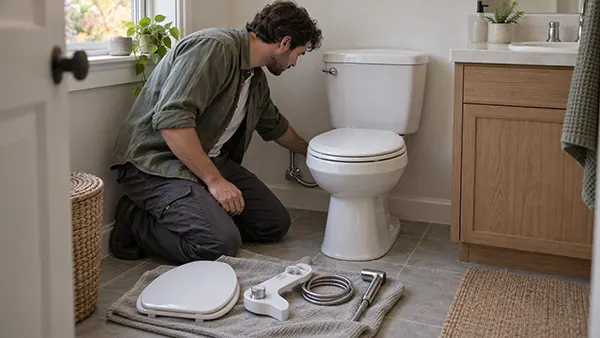
The first step to installing a bidet is knowing your toilet and bathroom setup. Choosing an incorrect bidet can cause issues like lack of space, incorrect water inlet connections and unanticipated electrical work.
There are two types: attachments that attach to your existing toilet seat and new bidet seats, which have extra features such as warm water, pressure and heated drying.
Handheld sprayers give you full control. If you are renting, you may want to go with the non-electric option, but if you have a grounded GFCI outlet, an electric seat may be suitable.
You should know the shape of the toilet, shut-off valve, space, water line and electrical needs.
Compare the Three Retrofit Setups Before You Buy
You’re weighing configurations here, not ranking precise products. The choice isn’t an easy issue of bidet installation vs. bidet attachment. Installation is the process; an attachment is just one type of retrofit fixture. Look down at the bowl from above to see whether it’s round or elongated. Find the seat bolts, then check whether the tank and bowl are individual pieces.
| Setup | Mounting method | Water connection | Electrical need | Space and fit | Removal | Everyday operation |
|---|---|---|---|---|---|---|
| Bidet attachment | Sits beneath the existing seat | Typically uses a T-valve at the toilet supply | Usually none for a basic cold-water model | Needs bolt-slot and nozzle clearance | Generally straightforward to reverse | Fixed nozzle with side or dial controls |
| Replacement bidet seat | Replaces the existing toilet seat | Typically uses a T-valve at the toilet supply | Relies on whether the seat is electric | Must match bowl form and rear clearance | Removable, although bulkier to hold | Built-in controls and a fixed seat position |
| Handheld sprayer | Uses a tank-mounted or wall-mounted holder | Typically linked through a T-valve | Usually none | Needs room for the hose and holder | Tank mounting is easier to reverse than drilled wall mounting | Manual aiming and trigger control |
Keep in mind that some replacement seats need electricity. An attachment supports your current seat, but its extra layer can alter the seat’s height or angle. Handheld sprayers take practice.
Once you’ve settled on a configuration, installation usually follows this sequence: shut off the water, drain, mount, fit the T-valve, reconnect, slowly restore pressure, and check for leaks. This guide walks through each step in order, covering washer placement and thread-tightening rules that vary from fixture to fixture.
Which Setup Fits Your Bathroom?
Standard Two-Piece Toilets
Most conventional two-piece restrooms leave the seat bolts and tank store available, so all three setups may work when the proportions match. Check the bowl shape and bolt spacing against the product’s drawing. Rear clearance and access to the fill-valve connection deserve a look as well. Shut off the existing supply before you start. Fit the specified T-valve, reconnect the hoses, and test the joints.
Tight Rooms and Unusual Toilet Shapes
In a compact room, side controls may have little space to work with. One-piece and corner toilets call for model-specific checks, and skirted bases can hide the water line. A French-curve tank can block a substitute seat before it ever slides fully onto its mounting plate. A sprayer still requires somewhere secure to store the hose, well away from your feet. Measure the space behind the seat bolts.
Bidet Installation for Renters
A basic attachment or tank-mounted sprayer is often the easiest rental choice: it uses the current supply and can be removed later. Approval still counts. Your lease and building rules control what’s authorized, so get written permission before drilling. Photograph the existing plumbing, and keep the removed seat with its hardware.
Bathrooms Without a Grounded Outlet Nearby
If you’re deciding how to install a bidet without a nearby outlet, a non-electric model avoids permanent electrical changes. If there is no suitable outlet nearby, choose a non-electric attachment or seat, or a handheld sprayer.
Create With Rise’s electric bidet seat installation guidance requires a nearby GFCI-protected outlet. Some models may require a reliable circuit, depending on the manufacturer’s specifications. Don’t use an extension cord as a permanent bathroom solution. Retain a licensed electrician for any new outlet or circuit.
How to install a bidet once you choose a setup
Shut off and Reconnect in Sequence
- Read the fixture manual and confirm compatibility with your toilet.
- Close the toilet shutoff valve. Flush and wash out the remaining water as directed.
- Place a towel or small container beneath the supply connection.
- Remove the existing seat if your setup requires it.
- Mount the designated fixture without pushing its hardware into position.
- Install the specified T-valve, then reconnect the toilet and bidet supply.
- Restore the water slowly before working the fixture.
The manual specifies the assembly order and washer placement. Don’t overtighten moldable threads or add thread tape unless the instructions precisely require it.
Check Every Connection for Leaks
Dry every fitting before gradually opening the shutoff. Examine each connection, then run the bidet at low pressure and touch dry tissue to the joints to reveal small beads of water. Check again after several minutes and after normal use. If moisture returns, shut off the supply before adjusting anything. Call a plumber for persistent leaks or damaged threads. A seized valve or suppressed supply also warrants professional help.
Protect the Water Supply and Control Temperature
The 2024 specialty-fixtures plumbing guidance calls for backflow protection and limits water delivered by a bidet fitting to 110°F. Follow the product instructions and guarantee local requirements, especially when a spray outlet could touch polluted water. Don’t assume a basic T-valve supplies the required backflow guard.
What Changes in Everyday Use?
Spray Control and Routine Cleaning
Fixed nozzles offer repeatable positioning, while handheld units let you modify the aim and distance. Start with gentle pressure. Rinse before drying, then pat rather than rub with a little paper or a washable cloth. When cleaning, reach beneath an attachment’s extra layer. Some replacement seats separate from a mounting plate so you can tap the porcelain around the bolts. Store the hose somewhere dry.
Water Use In Context
The 2023 editorial The dermatologists’ case for the bidet, in the International Journal of Women’s Dermatology, cites Scientific American’s 2009 article Wipe or wash? Do bidets save forest and water resources? Calculated that producing one toilet paper roll requires about 36 gallons of water, compared with roughly one-eighth of a gallon per bidet use. Those figures compare different units, not equivalent bathroom visits. They don’t establish household savings, particularly if you still use paper or wash drying cloths.
Common Questions Before Installation
Can You Install a Bidet Yourself?
Yes, a careful DIYer can usually manage a compatible retrofit with accessible plumbing and a working shutoff. If you’re wondering, “Do you require a plumber to install a bidet?”, usually not, unless the plumbing is damaged, unavailable, or leaking. Stop if an oxidized valve won’t close fully or a link won’t discharge. Don’t force it with pliers.
Can You Add One to an Existing Toilet?
Usually. Retrofit models are prepared to work with an existing toilet rather than require a separate fixture. Before ordering, compare your toilet’s model number with the bidet manufacturer’s compatibility guidance.
Should You Wipe Before Using a Bidet?
No preliminary wiping is required. You can wipe first if you prefer. Keep the routine comfortable and use your chosen paper or cloth for drying.
Will a Bidet Fit Every Toilet?
No. Even a broadly consistent product needs measurements that match your particular toilet. Check the manufacturer’s fit drawing rather than relying on an online photograph of a similar bowl.
What is the Biggest Downside of Adding a Bidet?
No preliminary wiping is required. You can wipe first if you prefer. Keep the routine comfortable and use your chosen paper or cloth for drying.
What Might a Plumber Charge?
There’s no reliable universal price. Request a written quote covering the service-call minimum and labor, plus any valve restorations or adapters. A plumber should tolerate damaged or inapproachable plumbing and any unresolved leaks. Include any necessary backflow work in the quote. Have an electrician expense permanent electrical differences separately.
Choose for the Room You Actually Have
An attachment is often easy to remove, while a replacement seat makes sense after fit and power checks. A handheld sprayer may fit you if manual aiming feels comfortable. Choose for the room you have instead of a feature you can’t use. Before composing, measure the toilet, check the shutoff, and locate the closest suitable platform.