Did you know?
According to the World Health Organization, household air pollution was estimated to cause 3.2 million deaths in 2020, including over 237,000 deaths of children under the age of 5.
The above report is really concerning because the pollution is rising every year. Out of all types of pollution, air pollution remains inescapable; it is the deadliest one that causes severe harm to young ones, asthma patients, and elderly people.
Even homes are no longer a safe place to breathe in freely. Most obviously, it is due to compact, closed windows through which pollutants get trapped inside.
Not sure how? Don’t worry, this article will specifically describe how windows play a role in air quality and smart ventilation systems.
Just read till the end and grasp the knowledge!
KEY TAKEAWAYS
- Windows are the primary movable barrier that helps maintain indoor air quality.
- High-quality windows withstand every changing environment, shielding against outdoor pollutants.
- Whether it is natural ventilation or mechanical ventilation, in both cases, windows are an essential framework.
- Always check window materials, such as paper filters, to maintain continuous filtration and freshness.
- There are smart windows integrated with smart home systems to automatically open/close.
Understanding the Connection Between Windows and Indoor Air Quality
As mentioned above, windows are the main gateway of a home to the outside world. An open window not just lets a breeze in, but also engages in actively processing natural ventilation. This includes the entry of oxygenated air and the pushing of stale, polluted air containing CO2, volatile organic compounds, and other indoor pollutants out.
Sometimes this can reverse, allowing outer pollutants like dust, pollens, and smoke to sneak into your home.
Why Smart Ventilation Systems Depend on High-Quality Windows
High-quality windows always ensure the effective functioning of smart ventilation systems. In the process, it blocks dust particles from outside, allowing ventilators to remove the existing pollutants from inside.
Then, on a clean day, an open window becomes a gateway to bring a fresh breeze inside. Besides that, you can contact a window company in Southern California for installing high-quality windows at home.
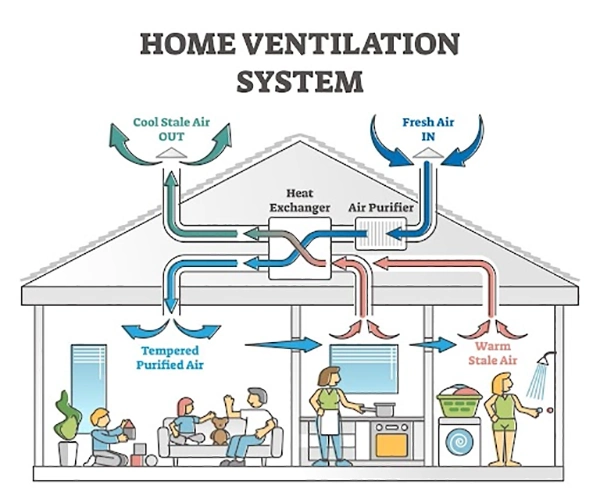
To give you a better idea, here is what an ideal home ventilation system should look like:
Natural Ventilation vs. Mechanical Ventilation: The Window’s Role
Natural ventilation depends on passive airflow through a window or other small openings. On the other hand, mechanical ventilation relies on equipment like fans to maintain the air quality.
In both systems, a window works as a primary or supportive gateway. Let’s understand it:
Natural Ventilation
- Act as a primary source of fresh air intake.
- Works as an exhaust.
- A bigger size has a bigger effect.
- Example–Cross-ventilation system.
Mechanical Ventilation
Used in conjunction with mechanical systems to allow for natural air. Example–Exhaust fan in bathroom setup on a small window.
How Window Materials Impact Air Filtration and Freshness
Indeed, every material has a different capability, so do windows made from them. This is how each window material impacts air filtration and freshness:
- Glazing: Double/triple-pane glazing maintains insulation very well, minimizing the air pollutants and allergens from entering the home.
- Window Frames: Properly sealed frames that are made from durable materials can prevent cracking for a longer time, reducing air leaks.
- Window screens: Fiberglass, aluminum, or nanofiber screens work as a filter that blocks pollutants and permits oxygenated air.
- Paper Filter Windows: These are the specially made filters on windows that help reduce indoor-generated CO2.
Window Placement and Design for Optimized Air Flow
Almost half of the role is done based on the window placement and design. Placing a window on the opposite adjacent walls creates a cross-ventilation through which stale air can flow away, and fresh air can enter.
In fact, different designs like casement, awning, as well as tilt-and-turn are offering multiple functionality along with airflow balance. The overall approach ultimately helps mitigate indoor CO2 levels and increase O2 levels.
FUN FACT
In 1696, England introduced a window tax based on the number of windows in a building.
The Influence of Glazing Technology on Indoor Environments
Glazing technology can significantly impact indoor environments. For example, single-pane glass can work in homes with a natural atmosphere. On the other hand, only a double or triple glass pane can act as an insulating shield against harmful pollutants from entering homes in metropolitan cities.
These window glazings with low-e glass not only improve the indoor air quality index, but also block harmful UV rays.
How Smart Windows Enhance Ventilation and Air Monitoring
Smart windows, when integrated with a smart home system, are equipped with sensors that detect the atmosphere and automatically control opening and closing. Additionally, some smart windows have a built-in micro-ventilation feature that allows air passage even when windows are completely closed.
Overall, this real-time data utilization to assess air quality and monitoring parameters like CO2 levels can help regulate and enhance indoor ventilation.
The Relationship Between Air Leakage and Health Risks
Air leakage is just not about losing or gaining hot or cold air; it has a direct connection to health risks. Poorly sealed windows bring air contaminants such as pollens, dust, and even other harmful gases that can worsen allergies and asthma.
What’s more dangerous is that the humidity from the air, harmful gases, and other trapped elements can create a perfect environment for mold growth.
In the end, windows play an extremely important role in maintaining natural air ventilation while integrating with a smart system. Homeowners just need to choose the right materials and proper planning for window placement. In the rest, they can enjoy clean air inside the home!
How do windows contribute to IAQ?
Windows act as a passageway for fresh air to come into the home and polluted air to exit.
What are the different ways of window placement?
Tilt-and-turn, casement, and awning are some common ways of window placement.
What can do smart ventilation system sense?
A smart ventilation system can sense CO2, temperature, volatile organic compounds (VOC), and particulate matter (PM2.5 and PM10).
Which window can offer 100% ventilation?
Casement windows have an accurate placement and opening, so they can provide 100% ventilation.