


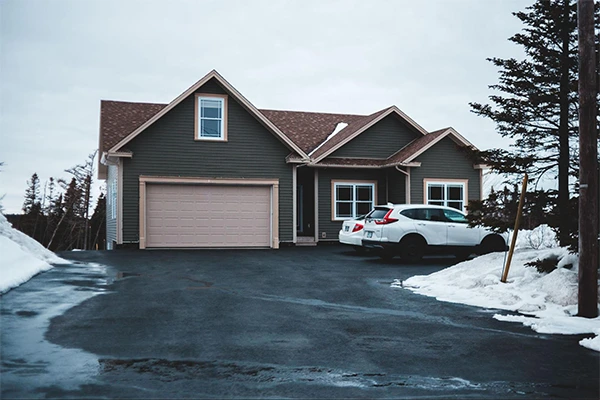
A driveway that looks slightly worn now can become dangerous in a couple of months if left unrepaired. Concrete degrades faster in the winter. Gaps wider than a coin (1/4 inch) let water enter and split the slab when freezing. So, it’s better to be prepared for winter and diagnose things beforehand.
Even the FHWA says that concrete with air content less than 4-6% is highly vulnerable to freeze-thaw damage.
For regions that have to survive through a chilly winter every year, knowing all this is a matter of losing the driveway.
How Freeze-Thaw Cycles Accelerate Concrete Damage
Concrete doesn’t fail because of a single dramatic event. It fails because small, existing weaknesses like hairline cracks, surface pitting, and poor drainage get exploited repeatedly by the freeze-thaw cycle every time temperatures swing above and below freezing. Each time, a small amount of water seeps deeper into the concrete, and each freeze expands that water and widens the damage a little further.
This is why a driveway that looked stable in September can develop serious structural cracking by January; the damage was already present, and winter simply accelerated it. Understanding this timeline is what makes pre-winter inspection genuinely useful rather than a formality.
Warning Indicators Your Driveway Shouldn’t Be Ignored
A driveway doesn’t fail without warning; it just doesn’t announce the warning very loudly. Long before a slab becomes unsafe or unusable, it sends a handful of specific signals: widespread or vertically shifted cracking, extensive surface pitting or scaling, standing water that never quite drains, and sections that have visibly settled or heaved. Each of these points to something happening beneath the surface, not just cosmetic wear on top of it, and recognizing them early is what separates a manageable repair from a driveway that fails entirely once winter sets in.
1. Widespread Cracks Are Becoming More Noticeable
Not all cracking is the same. Learning to tell the difference matters. Hairline surface cracks, isolated and consistent in depth, are often still repairable with sealant or patching. Widespread cracking that spans large sections of the slab is a different story, and cracks that have shifted vertically, where one side sits visibly higher than the other, are the clearest sign of trouble.
This vertical shift indicates movement beneath the surface rather than simple surface wear, typically soil settling or heaving under the slab, a structural issue no amount of surface patching can correct. When this pattern appears across multiple areas of a driveway, it’s a strong signal that replacement, not repair, is the realistic path forward.
2. Large Areas of Concrete Are Chipping or Flaking
When chipping or flaking spreads across extensive areas of a driveway rather than staying isolated to a small patch, it usually signals that the damage has moved past what surface-level fixes can address.
- Surface scaling and spalling : small chips and flaking patches that expose the concrete’s underlying aggregate, a sign the top layer has already begun breaking down
- Exposure to moisture and road salt: both accelerate this deterioration significantly, penetrating the concrete’s pores and weakening its structure from the inside out
- Accelerated deterioration during winter : freeze-thaw cycles turn existing chips and flaking into larger areas of damage far faster than the same concrete would deteriorate in a milder climate
- When resurfacing is no longer effective: once scaling and spalling cover a large enough portion of the slab, a thin resurfacing layer won’t bond properly or last, making full replacement the more realistic option
At this stage, the visible damage is usually a sign that the concrete’s structural integrity, not just its appearance, has already been compromised.
3. Water Pools on the Driveway After Rain
Water that pools on a driveway instead of draining away is one of the more overlooked warning signs, largely because it seems like a minor inconvenience rather than a structural threat. In reality, pooling water sits directly on the surface through repeated freeze-thaw cycles, accelerating damage exactly where it collects, meaning drainage problems don’t just inconvenience you, they actively concentrate the freeze-thaw damage in specific, predictable locations.
Recognizing the signs you need a new concrete driveway early, including this one, allows homeowners to address drainage before it accelerates existing cracking into a much larger problem. CK Services regularly identifies drainage-related deterioration during driveway assessments across West Virginia, distinguishing between issues correctable with regrading and those that indicate the slab itself needs replacing.
FUN FACT
Freeze-thaw expands the concrete volume by approximately 9%
4. The Surface Is Uneven or Beginning to Sink
When sections of a driveway notably rise or sink relative to the foundation slab, the problem has moved well beyond the flooring itself and into the base material underneath. Heaving typically occurs when water lying underneath the slab freezes and expands, physically pulling sections of concrete upward; settling happens when the base material compacts or erodes incorrectly over time.
Both scenarios share a common decision: resurfacing alone cannot fix a problem that started in the base beneath the slab. Managing uneven settling or heaving properly involves addressing what’s happening below ground, which in most cases means full replacement rather than patching the outward surface.
Also, explore essential tips to maintain your asphalt driveway.
5. Frequent Repairs Are No Longer Cost-Effective
Homeowners often default to patching visible cracks as a first step, and for minor, isolated damage, this can genuinely help prolong a driveway’s life. But patches on a slab with widespread cracking or base movement will generally fail within one to two winters, since they address the visible issue without correcting what’s happening structurally beneath the surface.
Any one of the signs above, seeming in isolation, may still be repairable. Several showing up together is usually a clear signal that the slab has arrived at the end of its useful life and that continued patching is simply holding back an inevitable replacement at a higher eventual total price.
To avoid all this hassle, consider driveway designs that survive freezing winters.
Tips to Prepare a Driveway for Winter
For driveways that aren’t yet at the point of replacement, a few defensive steps meaningfully extend the waiting period before winter damage sets in.
- Sealing the concrete every two to three years: a penetrating sealer blocks moisture from reaching the pores where freeze-thaw damage begins
- Addressing hairline cracks before the first freeze: rather than holding out until spring, this prevents a small, cut-rate fix from becoming a much larger repair
- Avoiding chemical deicers, particularly rock salt and calcium chloride: defends the surface from rapid deterioration, especially on driveways less than a year old
- Clearing standing water and optimizing drainage around the slab: reduces the amount of moisture available to freeze and move in the first place
Taken together, these tips cost far less than a full replacement and can considerably extend how many winters a driveway endures before major work becomes necessary.
For better efficiency, explore snowmelt systems for the driveway.
Conclusion
At the end of the day, a driveaway does not commonly fail without showing any warning signs. Cracks, water collection in the lower areas, and sections that seem to be uneven are all common signs that you need to consider that the driveway might not support you for the upcoming season.
Here, what is most important is to react on time. It will help to deal with the situation practically and secure the property, while ensuring the driveway also remains safe for many years to come.
FAQs
What are the common signs that a driveway needs replacement?
In case you witness cracks, severe drainage issues, and the need for frequent repairs, it is better to consider it properly.
How does water pool on a concrete driveway?
It simply happens because of a poor drainage system. When the water does not pass properly, it begins to collect.
How often to seal the driveway?
It is advised to consider it every two to three years, based on the traffic it has to deal with. More traffic means early sealing needs.

A Guide to Floor Grinding: Selecting the Right Equipment
[…] in places you will not think to wipe for another six weeks, which can be dangerous considering concrete dust can have multiple side effects. Meanwhile, the floor has a shallow dish worn into it where […]