“The best rooms have something to say about the people who live in them.”
David Hicks (British interior designer)
Gone are the days of sterile and Instagram-ready rooms that you are afraid to actually sit in. As we move into 2026, the global shift toward hybrid work and environmental consciousness has fundamentally rewritten the rulebook of interior design.
We are not just looking at the four walls and a roof of our house anymore; we are looking at a place that thinks, breathes, and adapts with us.
Check out the roadmap to navigate the latest shifts in home aesthetics, ensuring that your space is not just a place to sleep, but a high-functioning masterpiece of personal expression.
Key Takeaways
- Every room must have at least two functions.
- Go organic and replace plastic-based materials with stone, wood, or cork.
- Use smart tech to save energy in your home.
- Blur the lines by using glass and greenery to bring the outdoors in.
Why Home Design Trends Are Evolving in 2026
The change in design trend is about moving away from ‘clutter for the sake of status’ towards a home that is actually for your well-being.
As the cities are getting more crowded, it is no longer possible to have dead zones in the houses. Every corner needs to be utilized, whether that’s a window nook that can double as a storage bench or a hallway that could be transformed into a library.
Beyond just saving space, now design focuses heavily on how a room makes you feel. We are using technology to mimic natural cycles, like smart lighting that dims to a warm sunset glow in the evening, which helps your brain to decompress.
By blending the elements like natural light and raw materials with invisible and high-tech systems, we are creating environments that can lower our stress levels significantly. Your home is finally becoming a place that recharges your batteries instead of just a place where you store your things.
Trend 1: Multi-Functional Living Spaces
The era of a formal dining room with dust 364 days a year is officially over. In 2026, versatility is the ultimate luxury! You will see a rise in transformable furniture, desks that tuck into wardrobes, and kitchen islands that expand into banquet tables.
To master this completely, you need to focus on security and safety features that integrate smoothly into these flexible zones, like hidden locks for home offices or child-safe sensors for folding partitions. When your living room doubles as a gym or a boardroom, peace of mind becomes part of the floor plan naturally.
You can think of it as giving your home a brain and a backbone. You are basically making the most of the space in your home. Your rooms can be used for different things at different times. By hiding the technology inside smart, multi-purpose furniture or surfaces, your home stays neat and stylish.
Did You Know?
The concept of ‘Biophilia’ is now a standard requirement for many high-end architectural certifications all around the globe.
Trend 2: Sustainable and Eco-Friendly Materials
Selecting materials today is about much more than just taking a ‘look,’ the focus is on choosing a story that lasts. By picking up the right elements, you ensure that your home is as kind to the planet as it is to you. Here are some of the top choices for 2026:
Hempcrete
It is a mix of fibers and lime and is carbon negative. It is naturally breathable and regulates humidity so that your home never feels stuffy.
Reclaimed Timber
Instead of new wood, designers are getting beams from old barns and faculties. This wood is often denser and stronger because it comes from old-growth trees, giving you shelves or flooring a unique grain and history that new lumber simply can’t match.
Cork Flooring
It is naturally antimicrobial and feels incredibly soft underfoot, making it perfect for kitchens or playrooms for kids.
Recycled Glass Countertops
If you don’t want to use stone, this is the best alternative. These turn colorful bottle fragments into sleek and heat-resistant surfaces. They are virtually impossible to stain and turn yesterday’s waste into a stunning centerpiece.
Bio-Reflective Paints
The advanced coating maintains indoor temperature control that helps you save energy by 15%.
By making these choices, from the cushiony feel of cork to the temperature-saving power of smart paint, you create a home that looks high-end while leaving a smaller footprint.
Trend 3: Smart Home Integration for Daily Convenience
Smart homes have grown up. It is no longer about asking a speaker to play a song; it is about ‘Predictive Living.’ In 2026, your home anticipates your needs, adjusting lighting based on your movement or pre-heating the shower when a smaller watch detects that you have woken up.
The primary objective of this system is to achieve maximum operational efficiency. Technology in 2026 maintains 24-hour operational capability through its automated climate control system and AI leak detection system, which functions without user awareness.
The purpose of this technology is much more than just creating appealing devices; it is also used to enhance your safety and comfort, which you will experience without active awareness.
Trend 4: Minimalist Interiors with Natural Elements
How will you feel walking into a room that feels like a warm hug rather than a cold museum? You’ll surely like it! This is the essence of ‘Warm Minimalism. We are moving away from those sharp and clinical white spaces and trading them for a home that is filled with life and texture.
The goal for 2026 is to create a tactile house, a place where the materials are so alluring that you actually want to run your hands over the stone counters or walk across the floor in bare feet. It is all about making a space feel cozy and lived-in without the mess.
Fun Fact: Houses with natural greenery can improve your cognitive function and increase focus by up to 20%.
Instead of shiny, fingerprint-prone surfaces and pointy furniture, we are opting for soft, rounded edges and matte finishes that will help you relax the moment you sit down. You can get this look easily by layering up different fabrics.
Simple and earthy touches, like putting up a knit blanket over a smooth leather chair, adds os much character and calm to a room, making it feel complete without even feeling crowded. It is not about having less just for the sake of it; it is about ensuring that every piece of your home feels good enough to touch and brings peace to your daily life.
Trend 5: Indoor-Outdoor Living Design Concepts
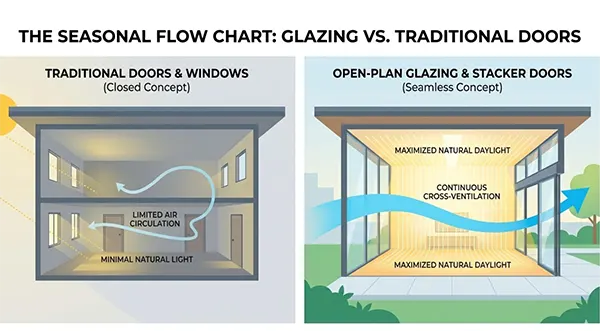
The wall between your living room and backyard is basically disappearing! People are loving huge glass windows and doors that make the outdoors look like a giant, live picture on your wall.
Here is why this trend is quite so popular:
- Sliding Glass Walls: Using large, energy-saving stacker doors with glazing is the best way to do this. You can slide them completely open to connect your living room right to your courtyard.
- Weather-Proof: When they are closed, they keep out the cold, wind, and rain. You get access to a beautiful outdoor view without feeling a draft while sitting on your couch.
- Bigger and Brighter: This setup brings lots of natural sunlight and a fresh outdoor vibe inside, which makes your whole house feel much bigger.
Have a look at the comparison below to see who replacing solid walls with large glass doors brings in what for more light and fresh air than a normal house setup.
How to Apply 2026 Design Trends Without Major Renovation
You don’t need to tear down walls or do major construction to make your home feel modern. A high-end look can easily be achieved by making a few smart, budget-friendly updates. You can begin adding artificial materials to natural fabrics such as organic cotton or cozy wool.
You can also add a few large indoor trees to get that fresh, outdoor feeling inside without having to hire a builder. Another simple trick you can try is to take off the plastic light switch covers and replace them with some nice metal or wood. If you want to separate spaces in a big room, you can create a workspace in your living room, and you can use open bookshelves instead of building solid walls.
This will divide the room perfectly, but still allow the sunlight to shine all the way through. These small and easy changes will change your home into a stylish home with just a few details without spending a fortune.
Ques: Is it expensive to maintain smart homes?
Ans: While the initial setup has a cost, it later pays for itself through reduced utility bills.
Ques: Is minimalism going out of style?
Ans: No, it is just evolving and is becoming slower and warmer. It is becoming more about having things that matter.
Ques: What is the most popular color for 2026?
Ans: Deep Forest Green and Terracotta Earth are the top choices of individuals.