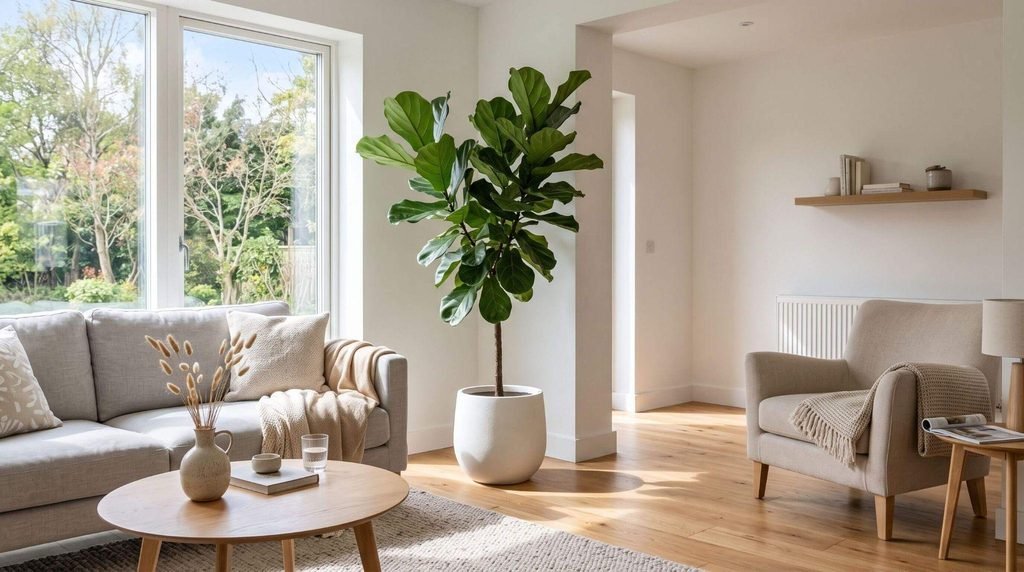
If you’re planning to put a large plant in your house, then it needs a spot planned before putting it into your house. A large pot will need a large space, but perfect planning can give it enough space without disturbing the furniture.
Here, two measurements decide which place should be a good fit for the large flower pot. This article will guide you properly on where to put it in your house.
Quick Answer: Place a large pot within about 5 feet of a bright window, beside the glass so it doesn’t block the view. Measure the leaf scatter at its widest point and keep at least 36 inches of clear floor between the leaf tips and the nearest furniture on any path people walk.
Where Should A Large Houseplant Go In A Room?
A large flower pot should sit close to the window wall, normally to one side of the glass. Indoor light falls fast with distance. According to Iowa State University Extension, the light right inside a sunny south-facing window is about 700 foot-candles, and only 70 foot-candles five feet back from the same window. A foot-candle is a unit of brightness, approximately the light of one candle held one foot away. Many indoor plants need 50 to 300 foot-candles to grow expertly.
That makes the empty corner through from the window, the spot most styling suggestions point to, the darkest place in many living rooms. A corner works when it sits on the window wall or adjacent to it. A corner 12 feet from the glass needs a grow light.
Window direction transformation: the math. South and west windows give the most light, so sun lovers belong right alongside one. A plant like bird of paradise needs 6 to 8 hours of bright light a day, and our advice to growing bird of paradise indoors covers how to keep it flowering once it’s in place. If your only window faces north, choose from the plants that thrive near a north-facing window and keep them within a few feet of the glass.
Measure The Canopy Before You Place The Pot
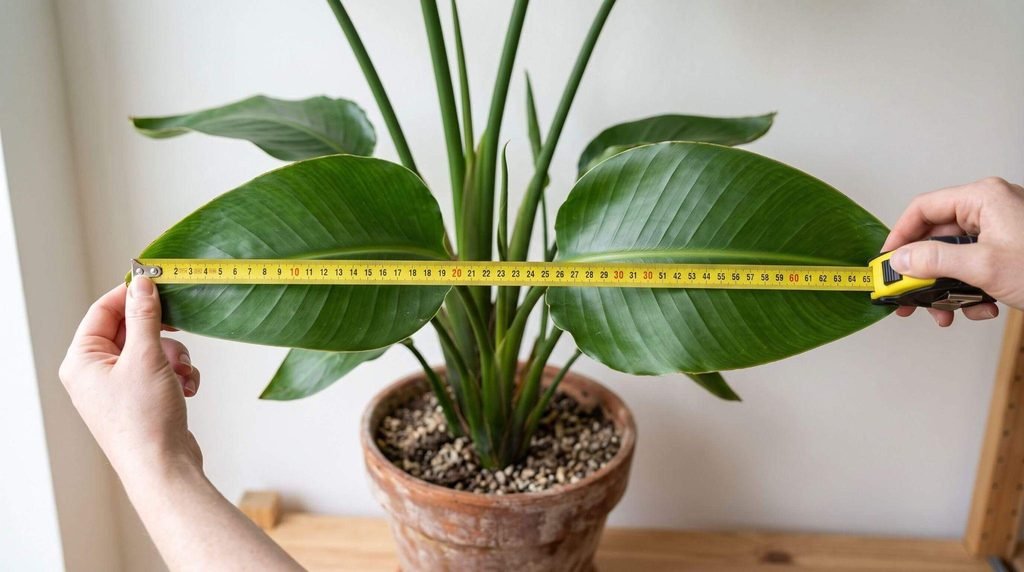
Most arrangements that fail were drawn around the pot. The canopy is the full spread of leaves at the broadest point, and on a mature floor plant it can be twice the width of the pot or more. Tinker leaf fig leaves grow up to 18 inches long, and bird of heaven leaves reach about a foot long on stalks of 1 to 2 feet. A plant like that can extend 2 to 3 feet out from its stem on each side.
Here is how to scale a plant before you draw it into a plan:
- Measure the awning width at the widest leaf tips, then again at a right angle. Few plants grow equally round.
- Criteria the height from the floor to the top leaf, pot included.
- Check how tall the plant can get indoors. A potted leaf fig can reach 3 to 10 feet and an umbrella tree 6 to 12 feet.
- Use the awning size in your plan, and treat the pot as the smaller circle inside it.
How Much Walking Room Does A Big Plant Need?
Keep 36 inches of obvious floor between the leaf tips and anything else along a path people use. ADA clear pathways guidelines in the US set 36 inches as the minimum clear width for a walking path, and they don’t let objects projecting into the path decrease it. Private homes don’t have to meet ADA rules. Still, a width designed for a wheelchair user leaves an adult conveying a laundry basket a lot of room.
Leaves at arm height cause most of the banging. A fiddle leaf fig often has a bare lower trunk and wide upper leaves, so take the pathway measurement at the height of the spacious leaves.
Check two more sanctions. Keep the canopy outside the swing of every door, including closet and terrace doors. Leave enough room beside the pot to reach the soil with a gardening can and give the pot a residence turn every few weeks so the plant grows evenly.
Test The Layout Before You Move A Heavy Pot
A floor plant in a large pottery pot full of wet soil is hard to shuffle around, and dragging it scrapes floors. It’s easier to try the spot in a 3d room planner first, this tool belongs to Arcadium 3d, where you can draw the room to scale, set doors and windows where they really are, and add a plant model at the awning width and height you considered. Then check these points:
- Measure the gap from the leaf boundary to the nearest sofa arm or chair.
- Preview the room in morning light, at golden hour, and after dark. Look at where the sun lands and whether the plant shades a scrutiny chair or blocks the TV.
- Walk through the room at eye level and check the view from the entrance and the sofa.
A transform preview shows where sunlight falls. It doesn’t measure brightness. For a foot-candle reading, hold a light meter app at leaf height in the spot you picked, around noontime.
A Worked Example: One Fiddle Leaf Fig, Two Possible Spots
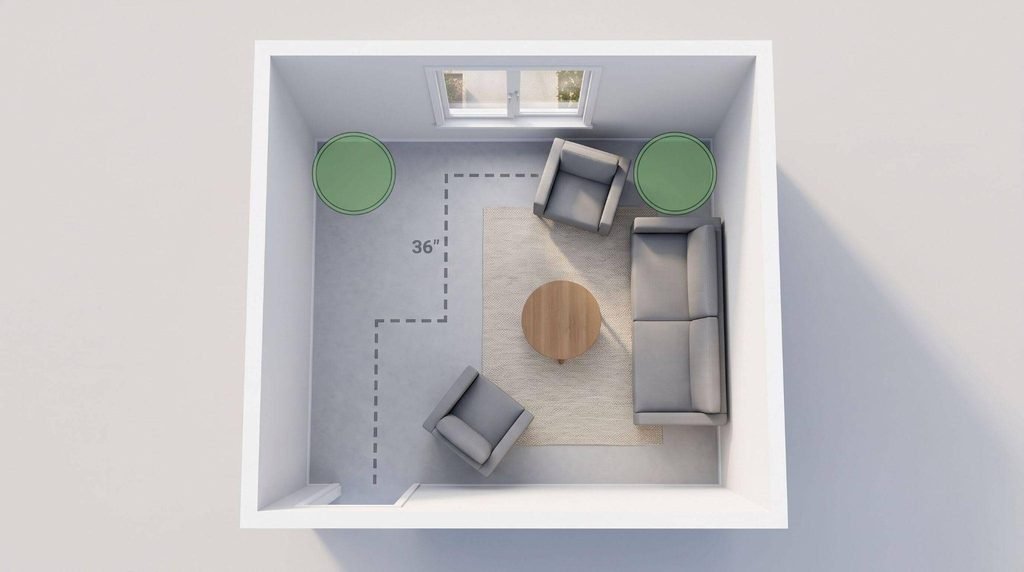
Take a 12 by 15-foot living room with one 6-foot south-facing window balanced on the short wall. The plant is a 6-foot pottered leaf fig in a 16-inch pot with a 30-inch canopy.
| Details | Plan A: Back Corner | Plan B: Beside the Window |
| Distance to window | About 13 feet | Under 2 feet |
| Gap to nearest chair, measured from the pot | 40 inches | 45 inches |
| Gap to nearest chair, measured from the leaf tips | 33 inches | 38 inches |
| Covers the window? | No | No. The canopy stops 3 inches short of the frame |
On paper, Plan A looks good because the pot leaves 40 inches of floor. Measured from the leaves, the walkway decreases to 33 inches, below the 36-inch mark. The plant also sits more than twice as far from the glass as the 5-foot point where light has already decreased to a tenth. Plan B keeps the plant in the brightest zone, leaves a 38-inch pathway, and stays clear of the window frame.
Can A Large Plant Work As A Room Divider?
Yes, in an open-plan room, the divider place still gets window light and leaves 36 inches of pathways at each end. Upright growers suit the job better than wide ones. A bird of heaven or a tall snake plant takes less floor space than a Serangium Wood, which climbs and spreads with long aerial roots as it matures. Two plants in matching pots read as one screen.
How Do You Plan For Growth And Ceiling Height?
Pick the spot for the size the plant will attain in the next two to three years. Floor plants keep growing indoors, and a potted leaf fig that arrives at 5 feet can get close to an 8-foot ceiling. Keep the awning clear of ceiling fan blades and heating vents. When the plant outgrows its spot, trim it back or redraw the layout.
Final Works
Tonight, measure your largest plant’s leaves scattered in two directions and the distance from its pot to the nearest window. If the leaves cut a pathway below 36 inches, or the pot sits more than 5 feet from the glass, move that plant first.
Frequently Asked Questions
Can I put a large plant in a dark corner?
Only with a grow light. Most indoor plants need at least 50 foot-candles, and a corner far from the window can fall below that. Keep the grow light 4 to 6 inches above the top of the plant and run it 12 to 16 hours a day.
How far from a window should a fiddle leaf fig be?
Keep it within a few feet of a bright east, south, or west window. It needs moderate to bright indirect light, which fades quickly as you move back into the room.
Do large plants make a small room look smaller?
A tall, narrow plant uses only the floor space of its canopy. In a small room, choose height over spread and keep the plant on the window wall, where it doesn’t cut through the middle of the floor.