Floor grinding is more about the aftermath than it is about the process. The grinder that is used will go back to the hire shop on Monday morning, but the dust will not.
It will accumulate in places you will not think to wipe for another six weeks, which can be dangerous considering concrete dust can have multiple side effects. Meanwhile, the floor has a shallow dish worn into it where the machine sat still for four seconds too long.
In this article, we will look at what these machines are for, why the dust matters more than the grinder does, and how to work out whether this particular job is yours to do or hiring a specialist would be the right decision.
What a Floor Grinder Is Actually For
Mostly, a floor grinder is used to lift the old adhesive pieces that are left after the tiles are removed. These machines then proceed to flatten high spots, roughen concrete, and sometimes even polish the floor.
However, the part most people overlook is roughening a floor. Research published in various online platforms like the Coatings Trade Press states that roughening a floor is the hardest part of the job because this is exactly the step that decides whether a coating will succeed or not. Roughening a floor helps in preparing the surface for all the upcoming renovations on it.
Most things don’t stick to a floor that’s sealed, polished, or dusty. No matter how expensive a product is, like resin, epoxy, or microcement, none of them bond to a surface that hasn’t been toughened properly. So, in order for coatings to work properly, floors need tooth, and grinding is how you do it.
A floor that looks beautifully smooth is often the worst possible surface to coat.
The Dust Is the Real Problem
Most people assume that both concrete dust and the dust left behind after renovations are the same thing. Unfortunately, it’s not, and not knowing the difference could cost you heavily. Understanding what Concrete dust is before hiring anything changes the entire equipment list and the process rather than just the cleaning-up afterwards.
According to HSE, the workplace exposure limit for grinding concrete is set at 0.1 mg/m³ that is averaged over an eight-hour period. This limitation is also regulated strictly by the COSHH.
See, grinding concrete can be adversely harmful as it releases crystalline silica. Its particles are so fine that they can reach the deepest part of our lungs without any problem and can cause silicosis, which is an irreversible health condition. One must be very careful when working with such machines.
Which brings up the thing nobody puts on the poster. The grinder is the boring half of this purchase.
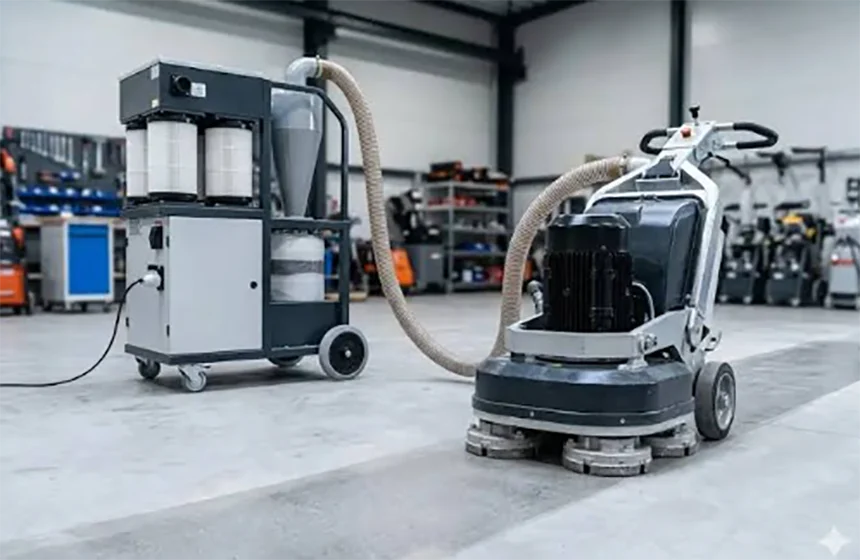
The thing you’re actually choosing for the grinding is the vacuum. An M-class or H-class dust extractor, which is connected directly to the machine’s shroud and runs the entire time when the job is being done, is what sets a controlled job and a house you cannot live in apart. However, this doesn’t mean that you replace these with domestic vacuums that you use for regular cleaning in your house. Those vacuums do not have the occupational capacity to carry out this task and will be destroyed in about ten minutes.
Water suppression works too, on machines built for it. It also produces concrete slurry, which is its own miserable afternoon.
What You Are Choosing Between
Instead of wasting your time and money on getting the wrong equipment which won’t work for your home requirement, here’s a few options that you can get based on the job.
Hand-Held Grinders
Hand-held grinders which are fitted with a diamond cup wheel and are small, angle-grinder-shaped are a good option for grinding. This equipment particularly suits edges, corners of your house, or when you have to work with small patches of adhesive.
This is also a budget-friendly option as it is very cheap to hire. However, if you plan on doing extensive work that requires a heavy workload to be carried, then this might not be the go-to option because, due to its small size, it makes it almost impossible to keep it flat across a big area.
Walk-Behind Grinders
These are the bulkier and bigger machines. With one or more rotating heads attached under a weighted frame, these machines make an arm-like structure which helps in cutting rather than you having to do the manual part of the job.
Floor grinder hire, however, is a versatile equipment and covers both sizes, along with concrete polishing machines, and the listings run to single-head and multi-head models on either 110-volt or three-phase supply.
Read that last part again. Three-phase power is not something an ordinary house has, and a 110-volt machine needs a transformer. That’s why it’s always advised to check what the machine actually plugs into before you book it, because plenty of homeowners have collected a grinder they had no way to switch on.
Handing It Over
Always consider hiring a specialist for the job if the grinding needs a full renovation instead of just some upgrades here and there.
A large open-plan ground or a slab with a serious problem is not something a hire-shop run can fix. Some floors require more effort and expertise than that. So anything where a coating is going down afterwards and the finish has to come out right the first time, always hire a specialist for the job.
Before You Book Anything
Work through this standing in the room, not sitting at a laptop.
- Always measure the area to be ground honestly, and then double your time estimate to give you a realistic overview of how much time you’ll spend on this project.
- Always make sure your machine matches the equipment requirements in terms of whether it will start and work in your home or not.
- Price the extractor and the diamonds separately — they are not included, and the consumables can cost more than the machine hire.
- Ask what the floor is. Old adhesive, paint, and screed all grind differently, and some pre-2000 adhesives may contain asbestos, which stops the job entirely until it is tested.
- Decide where the dust is going before you make any.
That asbestos point is not scaremongering. It belongs with the rest of the decisions you should make before renovation, floor grinding very much included.
Grinding Is a Means, Not a Weekend
Nobody grinds a floor because they want a ground floor. They do it because something else is going on top, and that something else is the part that has to look right in five years.
So judge the job by what follows it. If the finish is forgiving — a garage slab, a workshop, a utility room — hire the machine and enjoy yourself. If it is a resin floor in the room you actually live in, the grinding is not really the job you are buying.
Pay someone to get the surface right. Spend your own weekend on something that shows.
FAQs
Can I use my home vacuum with a floor grinder? Can I use a normal vacuum with a floor grinder?
No, home vacuums do not have the workload capacity to carry out such heavy tasks. You will need more professional equipment to do this, like an M-class or H-class extractor rated for fine dust.
How much time will grinding an entire floor take to do, if I decide to do it myself?
If it’s your first attempt, then you’re probably going to take far more time than what you expect. Edges and corners especially take far more time than any other part of the floor since they require years of experience to get good at.
Does grinding a floor also help in leveling the floor?
Grinding can definitely help in taking the high spots down, though to level the floor completely, you will need to fill the hollow parts with a leveling compound afterwards.
Is hiring equipment and doing the work myself cheaper than paying a contractor?
Hiring the equipment is 100% cheaper, but after hiring the equipment, you also need to calculate the cost of adding the extractor, diamond tooling, transformer, and your own time. The gap after all these calculations narrows considerably on anything larger than a single room.
- Health and Safety Executive, “Control of exposure to silica dust” (INDG463) — workplace exposure limit for respirable crystalline silica, and the COSHH framework