A box spring used to be an almost automatic part of purchasing a mattress, but this is no longer the case. Modern memory foam, latex and hybrid mattresses usually require a unique type of support than traditional innerspring models.
The right choice for the foundation is based on how the mattress is constructed, the spacing of your bed frame and the manufacturer’s demands. A perfect base can help to prevent sagging, provide reliable support and keep the queen size mattress valid.
Keep reading to learn if you need a box spring for a queen-size mattress.
What Exactly Is a Box Spring?
A box spring is a wooden or metal frame covered with fabric, having a strong support structure inside. Its job is to raise the mattress to a defined height, absorb shock, push forward the movements and evenly distribute the surface for the mattress to rest on. It is between 5 and 9 inches high, though some versions are 4 inches for overall low bed height.
It’s worth noting that a box spring is not the same thing as a “foundation.” A foundation looks similar from the outside — a rectangular frame the same size as the mattress — but instead of internal springs, it usually contains a rigid grid of wooden slats or a solid deck. Foundations are stiffer and offer less give than true box springs, which makes them a better match for many of today’s mattress types.
Does Your Mattress Type Actually Need One?
This is the question that matters most, and the answer depends almost entirely on what’s inside your mattress.
- Innerspring mattresses are the traditional combination for box springs. As both of them depend on coil systems, they distribute weight and bear shocks together. Various innerspring warranties were mentioned with this pairing in mind, and using a box spring can avoid the coil structure over time.
- Memory foam and latex mattresses generally should not sit on a traditional box spring with internal springs. These materials need firm, even support across their entire surface. A springy base can cause the foam to flex unevenly, leading to premature sagging, indentations, or soft spots. Instead, foam and latex mattresses perform best on a solid platform, a slatted foundation with slats spaced no more than about 3 inches apart, or a low-profile rigid foundation.
- Hybrid mattresses, unite coils with latex comfort layers, sit in a gray area. Some hybrids are made to work with a sturdy box spring, while others need a strong foundation. Here, checking manufacturer’s specs matter, as the coil guuage and construction vary greatly.
- Adjustable bases sidestep the box-spring question altogether. These motorized frames let you raise the head or foot of the bed, and mattresses designed for them — usually memory foam, latex, or flexible hybrids — are built to bend without the need for a separate spring layer.
Also, learn how to design a home that supports better health and wellness.
A Quick Comparison Table
Remembering all of this might be a bit confusing. Here is a quick comparison table for quick comparison:
| Support Base | Typical Height | Best Paired With | Notes |
| Traditional box spring | 5–9 in | Innerspring mattresses | Adds bounce and shock absorption; not ideal for foam |
| Low-profile box spring | 4 in | Innerspring, some hybrids | Lowers overall bed height |
| Slatted foundation | 3–4 in | Memory foam, latex, hybrids | Slats should be 3 in apart or less to prevent sagging |
| Solid platform | 2–4 in | Foam, latex, most hybrids | Very stable; minimal airflow unless vented |
| Adjustable base | Varies | Flexible foam, latex, hybrids | Requires a mattress rated for flexing |
| Bunkie board | 1–2 in | Any mattress on a frame with wide slats | Thin, rigid board that closes gaps in slatted frames |
Visualizing the Options
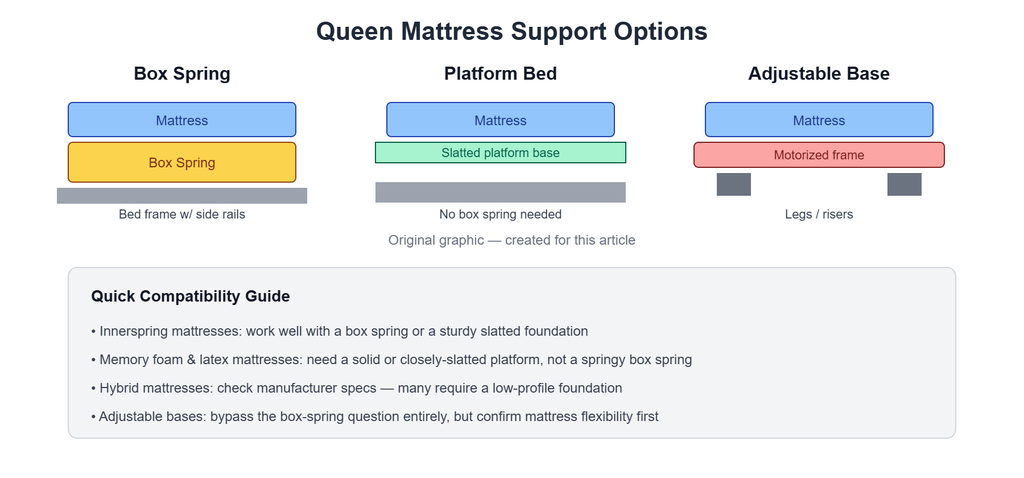
The below diagram shows how a traditional box spring manages with a platfrom bed and manageable base setup. All with easy compatibility guide for checking mattresses types to the suitable base.
What Happens If You Skip the Box Spring Entirely?
Simply removing a mattress from its box spring and placing it directly on a bed frame with wide-set slats is one of the more common mistakes shoppers make. Without adequate support beneath every section of the mattress, gaps between slats can cause the mattress to sag into those spaces over time, particularly with foam and latex constructions.
If your current frame has slats spaced, a bunkie board placed between the frame and mattress might be the solution without the bulk or cost of a complete renovation.
Placing a mattress directly on the floor is another workaround some people try, especially in small apartments. While this won’t damage most mattresses in the short term, it does restrict airflow underneath, which can contribute to moisture buildup, mustiness, or mold in humid climates. It may also affect ventilation-related warranty terms on certain mattress models, so it’s worth checking the fine print before making the floor a long-term solution.
Warranty Considerations Worth Checking
Mattress warranties share the type of base needed to keep the warranty valid. Using an improper base – for instance, and old box spring with a new foam mattress can be basis for manufacturer to day no to warranty claims connected to sagging.
Before finalizing a purchase, it’s worth spending a few minutes reading the warranty documentation based on bed dimensions, which is usually available on the manufacturer’s website or included with the mattress packaging. Keep the purchase receipt, mattress law tag, and any documents showing that the support system meets the manufacturer’s requirements, as these may be requested during a warranty claim.
Also, learn what to do when your mattress gives up overnight.
Making the Right Call for Your Bedroom
In the end, you do not simply require a box spring for a queen-size mattress. Traditional innerspring mattresses might serve well with one, while memory foam and latex mattresses require a firmer, more evenly supported foundation. Hybrids may change, so the manufacturer’s demands are also required.
Before installing the mattress, check the suggested base type and the spacing of your bed frame’s slats. Taking a few minutes to confirm compatibility can help you save your mattress and avoid issues.
Frequently Asked Questions
Can I place a memory foam mattress on an old box spring?
It’s generally not planned. Older box springs, especially ones with worn or weakened internal springs, can create uneven guidance that leads to premature sagging in foam mattresses. A slatted foundation or platform is a safer option.
Do adjustable bases function correctly with a queen-size mattress?
Yes, as long as the mattress is precisely rated for flexing, which several modern memory foam, latex, and hybrid mattresses are. Go through the product listing or manufacturer specs to verify its authenticity before purchasing.
How do I figure out if my current frame needs a bunkie board?
Measure the area between the slats on your bed frame. If they’re installed more than about 3 inches apart, a bunkie board or plywood panel is prescribed to prevent the mattress from sagging into the holes over time.