Interior design is evolving. Homeowners, architects, and designers in Colorado are becoming increasingly interested in limewash, concrete-inspired, and mineral plasters.
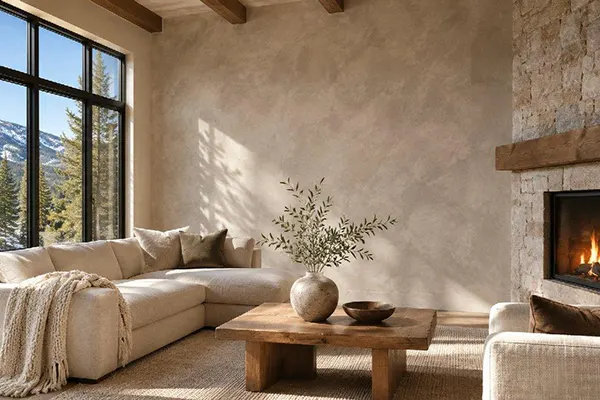
Limewash can give a beautiful depth to any space by changing subtly throughout the day depending on the sunlight hitting it.
This gives a bespoke feel and works great with the intense sunshine, dry climate, and natural elements found in Colorado. With the popularity of earth tones and textures, these finishes are becoming more common in bespoke homes and luxury renovations.
Choosing the right finish is not as simple as finding a picture online and copying the look.
The substrate, preparation, drying conditions, use of the room, maintenance, and system will all have an impact on how the finish looks.
A well-thought-out finish should complement the architecture and lifestyle of the home.
A Growing Interest in Handcrafted Surfaces
According to the installation experience of Colorado-based wall finishing company Enjoy The Wall, queries about decorative mineral finishes have been growing.
Within the company’s recent decorative finish proposals, limewash accounts for approximately 60%, while concrete-inspired finishes represent around 30%. Wood-effect finishes are also beginning to attract awareness. These are observations from the company’s own customer inquiries, instead of statistics for the wider Colorado market.
One noticeable characteristic of these tasks is the scale of the surfaces concerned. Clients are not necessarily peeking for a little decorative component. They often want large, uninterrupted walls where texture becomes a critical architectural characteristic.
Unlike wallpaper, where even carefully matched seams stay part of the installation system, a properly performed decorative plaster makes a steady surface without the replicated design or panel joints associated with many other materials.
The effect is closer to a handmade artwork than a traditional wall remedy.
Why Homeowners Choose Limewash
The appeal of limewash begins with its material character.
Traditional mineral limewash is based on lime and mineral stains, giving it a distinctly different impression from ordinary artificial wall paint. Its soft, matte surface and slight tonal activity can create depth without relying on bold patterns or pronounced relief.
Natural light plays a significant role in this effect.
As sunlight travels through a room, divergences in color and texture can become more or less perceptible. Large windows, changing daylight, and carefully prepared artificial lighting can make the same wall seem to be distinct throughout the day.
Another appeal is continuity. A large limewash wall can read as one complete composition rather than a cluster of individual decorated spaces.
For many homeowners, that continuity creates the understated, sophisticated impression they want.
Natural mineral components are another reason for limewash’s popularity. Not every product marketed as limewash has an identical formulation, and environmental performance, durability, and supervision requirements should always be assessed using the manufacturer’s specifications.
These finishes also tend to attract clients working with architects or skilled interior designers, especially in custom and higher-end residential properties.
Limewash, Venetian Plaster, and Marmorino Are Not Interchangeable
Although these materials are sometimes discussed together, they do not necessarily produce the same architectural impact.
Limewash is often selected for its relatively soft visual movement and understated character. It can complement interiors where the purpose is to create atmosphere without introducing a strongly defined texture.
Venetian plaster offers a different set of possibilities. Depending on the product and application technique, it can create layered depth, smooth or textured surfaces, and finishes ranging from fine to highly polished.
Some Venetian plaster systems involve countless application stages. Multiple coats, intermediate smoothing or burnishing, drying periods, and protective treatments may all be needed. Certain systems use wax or specialized sealers as their final protective coating.
Marmorino, another standard mineral plaster family, can gain a refined stone-like formation. Depending on the finish, color, and lighting, it may introduce cooler, more architectural qualities into an area.
None of these materials is universally superior.
A glossy Venetian finish that looks impressive in a classical interior may feel unsuitable in a minimalist modern room. Conversely, a restrained limewash finish may function beautifully where a more elaborate texture would compete with the furniture and architecture.
The decision should be guided by the entire composition, not simply by the popularity of a particular material.
Why Surface Preparation Matters
Premium mineral finishes require careful attention to the underlying wall.
Different products have different requirements for substrate condition, primers, moisture, application temperature, drying time, and finishing methods.
Some systems also involve multiple application stages, each dependent on the condition of the previous layer.
At Enjoy The Wall, the installation team chooses to handle surface preparation directly whenever possible. With general contractors who have operated with the company on previous projects, preparation requirements can also be coordinated before decorative work starts.
This approach helps build uniform conditions for application.
There is no universal preparation method that works for every mineral finish. The manufacturer’s technical documentation and the actual wall conditions must determine the installation procedure.
A premium material alone cannot compensate for an inappropriate substrate or an incorrectly performed application system.
Colorado’s Climate and the Importance of Drying Conditions
Colorado’s relatively dry climate and strong sunlight make environmental conditions an essential concern during installation.
In particular, large south-facing windows may expose areas of a wall to considerable solar heating. Under certain circumstances, this can accelerate drying and interfere with the intended application process.
For some plaster systems, excessively rapid or irregular drying can contribute to defects, including cracking.
Interior temperature, ventilation, humidity, and the manufacturer’s defined curing conditions therefore deserve attention before work initiates.
High-end mountain residences often incorporate refined heating, ventilation, and humidity-control systems that maintain relatively stable indoor conditions.
These systems can help build predictable conditions, but proper exterior preparation and material-specific application requirements remain essential.
The goal is not simply to apply a decorative coating. It is to supply the conditions in which that coating can serve as intended.
The Architectural Advantage of Concrete-Inspired Plaster
Decorative finishes can also solve issues that stretch beyond look.
Consider a fireplace feature wall in a mountain residence. An architect or designer may envision a substantial concrete surface reaching toward a high ceiling.
A genuine concrete element could introduce significant dead load, depending on its thickness, dimensions, and construction. That load must be considered by the structural design team.
In some projects, a decorative concrete-effect plaster applied over an appropriately designed drywall assembly provides a more practical choice.
Enjoy The Wall has worked on projects where this approach allowed the design team to achieve the desired visual character without presenting the weight associated with a significant concrete slab.
The surface can reproduce aspects of concrete’s color variation and visual texture while remaining part of a substantially lighter wall-finishing assembly.
It is not structurally equivalent to real concrete, nor is every decorative coating appropriate for every fireplace or high-temperature application. Material compatibility, fire-clearance requirements, and the underlying assembly must still be affirmed.
Nevertheless, this type of solution indicates why decorative finishes should be assessed during the design phase rather than treated as an afterthought.
The Pinterest Problem: A Beautiful Finish in the Wrong Room
One of the most common misinterpretations enveloping decorative finishes begins with an inspirational photograph.
A homeowner sees a dramatic limewash or concrete-effect wall in a beautifully photographed residence and desires to replicate the same appearance at home.
But the original photograph may show a room with twelve-foot ceilings, extensive glazing, abundant daylight, and carefully chosen furniture.
The homeowner’s actual room may be much smaller, with a north-facing window and limited natural light.
The same finish will not necessarily create the same experience.
A visually heavy concrete effect can make a close room feel more enclosed. A slight mineral texture may lose much of its character when there is inadequate directional light to reveal its variations.
Scale matters. Light matters. The relationship between the wall, furniture, ceiling height, and adjacent materials matters.
A texture needs room to be appreciated.
Sometimes a single accent wall or fireplace attribute is more practical than covering every wall in a room. In other cases, a continuous treatment throughout a large living area creates exactly the calm, unified atmosphere the designer planned.
The correct answer depends on the architecture.
The Value of Professional Design and Installation
Decorative mineral finishes are among the more challenging options in superior wall finishing.
Specialized materials, extensive preparation, skilled application, and multi-stage installation can make them significantly more costly than traditional painting. Depending on the project, wallpaper may offer a more economical option.
That does not make one alternative inherently better than another.
For homeowners exploring limewash wall finishes in Colorado, the most useful first step is understanding how the selected material will function within the actual space.
An architect or interior designer can assess the overall arrangement, while experienced finishing specialists can assess the substrate, application system, technical constraints, and installation essentials.
The strongest results come when these judgments are made together.
A successful decorative wall is not simply a surface that looks attractive in a photograph. It is a surface that belongs to its architecture, responds naturally to the available light, and stays visually legible with the surrounding interior.
That is what gives handmade mineral completes their long-lasting attraction.
Frequently Asked Questions
Is limewash suitable for use in Colorado homes?
Limewashes can be used due to the low humidity in Colorado. You will need to ensure you are following the manufacturer’s guidelines for temperature, humidity, sun exposure, and cure times.
Can limewash be applied to standard painted drywall?
Not normally. Most limewash systems will need a compatible mineral primer or undercoat applied to drywall or film-forming paints. Please check the data sheet for the product you are using.
Is Venetian plaster the same as limewash?
No. Limewash is a thin coating applied by brushing, whereas Venetian plaster is a multi-layered plaster system that can be compacted or polished to create a denser surface.