The removal of a tree would free your backyard, provide extra sun, and give the opportunity to do some additional gardening. However, the task might not be over once the tree is taken away. A large stump of an old tree can still take up space on a valuable piece of land and create confusion about how to get rid of it when access to your garden is limited.
Limited access can be caused by small gates, difficult passages, or corners, making it hard to bring heavy machinery to your garden. Nevertheless, there is no need to think that stump grinding is impossible if you have such problems.
Compact machines may be suitable for smaller spaces, provided there’s enough room to maneuver and operate safely. Understanding the access requirements beforehand can help you plan the job without unnecessary garden damage or surprises.
The Tree Is Gone, but Getting to the Stump Is Another Problem
The tree may be long gone, but removing the stump is not always easy if it is located behind a narrow gate or passage in the garden. Sometimes getting the necessary tools to the backyard is as difficult as removing the stump.
Why Backyard Access Matters More Than Homeowners Expect
Removal of the tree and stump grinding use different equipment needs. A tree removal crew may cut down and carry away a tree in sections without bringing large machinery through the garden gate. Stump grinding usually requires a machine to reach the remaining wood, which may be difficult through a narrow entrance.
Consider a backyard accessible only through a side passage. The gate opens into a small paved area, followed by a sharp turn between the house and a flower bed. Beyond that, the lawn slopes toward the back fence.
While the stump may not be large, moving and positioning the grinder along that path can be the more difficult task. Ask the contractor to assess the approach, the turns, and the space around the stump before scheduling. A machine that fits the gate might still be unable to navigate the slope.
The Gate, Fence, and Garden Features That Can Block Equipment
Fence posts can reduce the usable width of an entrance. Hinges, latches, and gate stops may project into the opening. A gate that swings only halfway because of nearby landscaping restricts access further.
Once past the entry point, raised garden beds, stones, hanging branches, stairs, and retaining walls may complicate equipment handling.
Homeowners should also consider the condition of the ground. Soft soil, recently installed turf, or a steep slope may affect how safely a machine can travel.
Before scheduling, walk the route from the driveway to the stump. Note tight points, turns, steps, and traction hazards. The first turn after the gate may be more restrictive than the opening.
Not Every Stump Grinder Fits Through a Standard Garden Gate
Not all stumps require stump grinders that can easily fit into a garden gate. It is wise to determine the width of your garden gate first so as to save time and avoid inconveniences.
How Different Grinding Machines Handle Limited Spaces
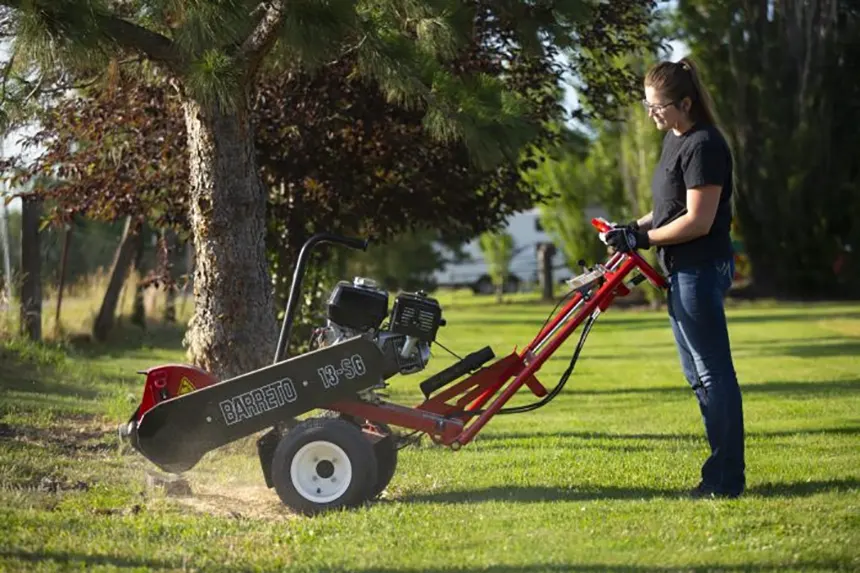
Stump grinders vary considerably in size, power, and maneuverability. Large equipment can be appropriate for wide-open spaces with easy access by vehicles. Compact models are intended for tighter spaces, including some residential backyards.
For example, Vermeer lists its SC292 stump cutter as 35 inches wide with its dual wheels removed, versus 49.8 inches with them installed. These are equipment dimensions, not a guarantee that either configuration can use your access route.
The amount of space that would be left for the 35-inch-wide machine going through a 36-inch opening is just one inch. Hinges, uneven ground, or slight changes in position could use up that margin. The operator must determine what clearance is safe.
Tracked models and other compact designs may offer different maneuvering options, but a narrower footprint alone does not establish suitability for a particular yard.
The appropriate choice depends on the property. A smaller machine may offer better access, but it must still be capable of grinding the stump effectively and operating safely in the available space.
Why Measuring the Gate Alone Doesn’t Tell the Whole Story
Suppose your garden gate measures 38 inches between its posts. The opening may look generous enough, but the next turn could be the limiting point. If the gate opens into a narrow passage, the operator may not have room to turn. A protruding drainpipe or raised garden border could create another obstruction.
According to Vermeer, the length of the SC292 is 110 inches; hence, its width alone will not be enough to determine if it will make a corner or not. The space for the cutting wheel is another issue altogether.
With the gate fully open, measure between the closest fixed obstacles rather than relying on its advertised size. Record the narrowest passage and any steps, low branches, sharp corners, slopes, or protruding fixtures.
Send the contractor photos of a tape measure across the opening, the first turn, the whole route, and the stump beside nearby structures. These show access problems before a visit.
Ask whether the contractor can confirm access from those details or needs a site visit. Pictures cannot be used to determine safe operating clearance where clearance is very minimal.
What Happens When the Stump Is Too Close to a Fence or Wall
If the stump is located near the fence or wall, there might not be enough space to operate the machine effectively. Care should be taken not to damage any adjacent buildings, and there may be some areas of the stump that will be hard to reach.
Understanding the Clearance Needed Around the Cutting Wheel
The transport of the grinder to the yard is just one step, as there must be room for the cutting wheel to move around the stump.
Stump grinders use a rotating cutting wheel to break down wood into smaller pieces. The wheel must be positioned and moved according to the manufacturer’s operating instructions.
If the stump sits against a fence post, wall, or other fixed structure, some wood may be difficult to reach without risking damage.
The operator may be able to change the approach or use equipment suited to restricted spaces. In some locations, however, complete grinding may require additional access or changes to the surroundings.
For properties with complicated layouts, homeowners searching for stump grinding Asheville NC can ask a qualified local contractor to assess equipment access before removing fence panels or disturbing established landscaping.
Also consider if the stump wood strip will stay near the fence, at what depth the stump can be ground down, and if the fence needs to come down at all.
Protecting Fence Posts, Pavers, and Nearby Garden Structures
Grinding can throw wood chips, stones, and other debris even without the machine touching a fence. Nearby windows, decorative features, and outdoor furniture may be exposed if precautions aren’t taken.
According to the Tree Care Industry Association, it is necessary for viewers to be at least 75 feet away from the rotating cutting wheel of the stump grinder.
For a small backyard, that recommended separation may extend well beyond the fence. The operator must decide whether people can be kept out of the hazard area before work starts.
A qualified operator should assess guards, debris barriers, and any alternative work arrangement under the machine’s instructions. Protective screening is not, by itself, proof that an otherwise cramped setup is safe.
Homeowners should avoid standing nearby to watch, even if the operation appears controlled. Children and pets should remain well away from the work area.
Protecting the garden involves thinking beyond physical structures as well. Irrigation components, underground cables, and roots from nearby living trees may require special attention.
Preparing a Small Backyard Before Stump Grinding Begins
Before grinding the stump, ensure that all obstacles are out of the way and clear from the backyard. This involves checking underground utility lines, sprinkler lines, and the entire irrigation system to prevent any damage while doing the work. Even a tiny line could cause major problems later on.
Checking for Underground Utilities and Irrigation Lines
Although a garden stump seems as if it consists of just a piece of timber, buried irrigation piping, lighting cables, drainage pipes, and many other such services can pass by the stump. These features aren’t always visible.
Before grinding or digging, ask the contractor how buried-line hazards will be checked. Depending on the state and the work involved, disturbing soil may trigger an excavation-notification requirement; calling 811 is a sensible precaution even when no notice is legally required.
For example, North Carolina’s Underground Utility Safety and Damage Prevention Act requires the person responsible for covered excavation to give NC811 at least three full working days’ notice before starting. Some excavation done personally by a single-family homeowner is exempt, depending on easements and equipment; hiring a contractor does not qualify as owner-performed work. Other states have different rules.
Not every buried line is necessarily identified with an 811 request. NC811 states that utility companies locate their own utilities but not necessarily every customer-owned one. Privately installed sprinkler systems, electrical lines to outdoor lighting, and some other connections may need a separate private utility locator.
Tell the contractor about known underground installations, even if they seem far from the stump. Before work begins, confirm who is submitting any required 811 request, who is checking its response, and who will arrange a private locator if needed. Never assume a shallow grinding depth means buried lines are out of danger.
Moving Planters, Garden Furniture, and Other Obstacles
Once underground hazards have been considered, clear portable planters, lightweight furniture, watering equipment, and other movable objects from the access route and work area.
Established shrubs beside the gate may need temporary protection. Garden edges will hinder equipment movement, while low-hanging branches will hinder headroom.
Avoid removing plants or dismantling garden structures before discussing the access plan with the contractor. Some obstacles may be manageable without permanent changes.
It is also necessary to examine the state of the lawn. Equipment moving over saturated or soft ground may leave ruts, so the contractor may recommend waiting for firmer conditions or taking suitable ground-protection measures.
Preparation reduces unnecessary disturbance, although no equipment-based landscaping work can be guaranteed to leave every surface untouched.
When Limited Access Changes the Stump Removal Plan
If getting into the backyard is difficult, stump grinding may require some additional planning. The professionals will examine the gates, small pathways, fences, surrounding buildings, and available space for maneuvering the equipment. This information will be used to select the appropriate equipment and prevent damage to the yard.
What Professionals Assess Before Bringing Equipment Into the Yard
A stump-grinding assessment should consider the entire work area, not just the stump’s diameter. The machine itself should be identified along with its travel mechanism, determine whether it can maneuver the path, and provide an explanation of how the cutter will move without coming into contact with surrounding structures.
Important considerations include gate width, turning space, ground stability, obstacles, utility locations, and intended grinding depth. The assessment should distinguish what is confirmed from what still requires an on-site check.
What you plan to do with the space afterward also matters. If you’re reseeding, grinding below the surface may leave room for fresh soil. A new patio, fence footing, or other structure may require further evaluation of remaining roots and ground conditions.
Generally, stump grinding does not remove the stump from below ground level and does not involve digging out all the roots. It shouldn’t be confused with complete removal of all underground wood.
Where clearance is insufficient, the contractor may propose narrower equipment, temporary gate-panel removal with permission, another method, or postponement. Do not dismantle structures before agreeing on a plan.
Ask the contractor to explain what can be removed safely and to identify any stump wood that would have to remain.
What Homeowners Should Expect From Grinding and Cleanup
Even after the stump has been ground, the location is not guaranteed to look like an unaltered patch of lawn. Grinding produces a mixture of wood chips, soil, and fragmented wood. Some of this material may remain in a depression where the stump previously stood.
Whether the contractor removes those grindings, redistributes them, fills the depression, or supplies replacement soil depends on the agreed scope of work.
Before work begins, make sure the estimate states the grinding depth, whether accessible surface roots are included, who removes wood chips, and whether soil and lawn repair are included.
If you intend to grow grass in the same location, excess wood chips may need to be removed and suitable soil added before reseeding. Remaining underground roots can also decay over time, potentially contributing to settling.
For a new planting bed, the site may require varying preparations based on what will be planted there. These details determine whether the space will be ready to use afterward, not merely free of a visible stump.
A narrow garden entrance doesn’t automatically make stump grinding impossible. Compact equipment can reach some restricted yards, but access and working clearance must be assessed together.
Before confirming your booking, please provide us with your gate dimensions and access pictures, and also confirm whose responsibility is to check the underground cables. Ask the contractor to distinguish a confirmed access plan from a preliminary estimate based only on photographs.
FAQs
Is it possible for a stump grinder to pass through a narrow garden gate?
Yes, some stump grinders are compact enough to pass through certain narrow gates. But the contractor will also have to consider turns, surface conditions, and clearance space around the stump.
Is it possible for stump grinding to damage fences or garden landscaping?
Yes, flying particles, limited space for maneuvering, and inadvertent contact between the machine and the fence can cause damage.
What will happen to the ground after stump grinding?
The stump will be ground beneath the surface; therefore, it will create a depression filled with wood chips that could require more soil fill-in. It also depends on whether additional services include soil filling and lawn leveling.
Is it necessary to take down my garden gate before stump grinding?
Not really. Some compact equipment will easily get through the existing gate. In case you have to take it down, consult with the contractor before dismantling any parts.