

Flow meters are widely employed for various purposes, ranging from watering a garden using a garden hose to the management of water in huge agricultural and industrial networks. But not all of them are alike since the choice of a meter depends on its intended use and location.
Some flow meters are developed for measuring the water flow from a garden hose, while others can cope with larger pipes in challenging environments. The differences lie in the methods of sensing the flow rate, the mounting, and the information delivered by the meters.
In this article, we explore seven popular kinds of water flow meters and their practical use.
How Are Water Flow Meters Classified?
Water flow meters may be classified based on their mode of operation, measurement technology, and display.
Some meters use mechanical components to detect water movement, while others use electromagnetic or ultrasonic sensing technologies. Turbine, paddle wheel, and variable area meters are examples of specific measurement designs.
Digital, however, generally describes how measurement data is processed or displayed rather than a standalone measurement principle. A digital flow meter may use a turbine, paddle wheel, or another sensing mechanism to measure water flow.
Understanding this distinction makes it easier to compare flow meter types based on their actual operating principles rather than treating every label as a separate measurement technology.
1. Mechanical Water Flow Meters
Mechanical water flow meters use moving components to respond to the movement of water. The water may act upon an impeller, turbine, or any other mechanical device depending on how the meter is designed.
The movement of the internal component is then used to determine the flow rate.
Key Characteristics
- Simple mechanical construction
- Moving internal components
- Available in different sizes and configurations
- Suitable for straightforward flow measurement
- Does not necessarily require advanced electronics
Common Applications
The use of mechanical flow meters is applicable in residential, irrigation, agriculture, and other systems where simplicity of measurement is necessary.
They can be useful when the main goal is to monitor water flow without advanced digital monitoring or remote data access.
Potential Limitations
Because mechanical meters contain moving parts, wear and debris can affect performance over time. The suitability of a particular mechanical meter also depends on water quality and operating conditions.
Best suited for: Basic flow measurement where a simple mechanical design is preferred.
2. Digital Water Flow Meters
Electronic water flow meters operate electronically by measuring the presence of moving water and showing the results in digital form.
Depending on the model, a digital flow meter may provide information such as:
- Real-time flow rate
- Water consumption
- Total water usage
- Average water usage
- Gallons or liters
- Smart monitoring data
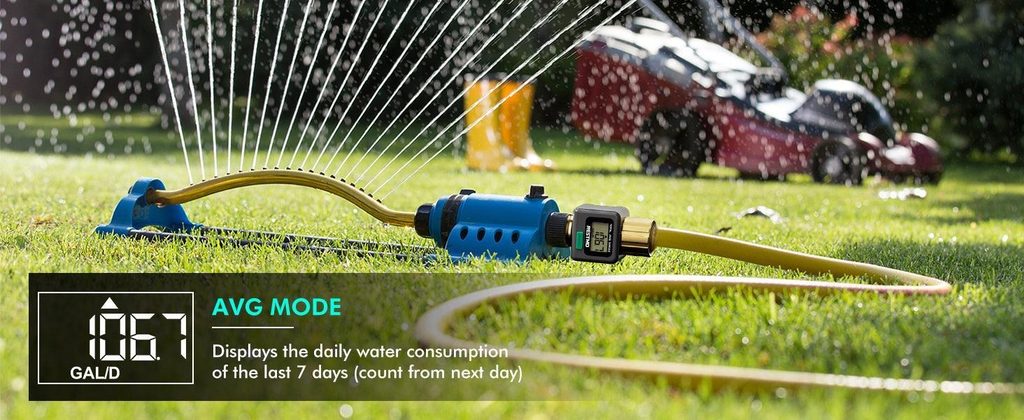
Unlike a traditional mechanical readout, digital meters can make water usage easier to monitor while watering.
Common Applications
Digital water flow meters are particularly useful for:
- Garden hose watering
- Lawn irrigation
- Garden irrigation
- Sprinkler systems
- RV water tank filling
- Outdoor water monitoring
For homeowners and gardeners, a digital meter can make it easier to see how much water is being delivered during a watering session instead of estimating usage based only on how long a hose or sprinkler has been running.
Why Digital Flow Meters Are Useful for Outdoor Watering
The flow rate of outdoor irrigation devices varies based on the type of hose, nozzle, sprinkler, pressure, etc.
A digital flow meter allows users to measure those differences directly.
For example, a homeowner may use a digital meter to determine how much water a sprinkler delivers during a specific watering session or compare the water consumption of different watering methods.
RESTMO’s outdoor water flow meters are designed for these types of applications, including garden hoses, lawn watering, irrigation, and other outdoor water monitoring needs.
Best suited for: Garden hoses, lawn and garden irrigation, outdoor watering, and users who want easily readable water-use information.
3. Turbine Flow Meters
Turbine flow meters measure water flow using a rotating turbine or rotor positioned in the water stream.
As water passes through the meter, it causes the turbine to rotate. The rotational speed is then used to determine the flow rate.
Key Characteristics
- Rotating turbine or rotor
- Suitable for many clean-water applications
- Available in different flow ranges and pipe sizes
- Can provide useful flow-rate measurements
Common Applications
Turbine flow meters are commonly used in applications such as:
- Irrigation systems
- Water distribution
- Agricultural water systems
- Commercial water systems
- Process water
Potential Limitations
Turbine meters being mechanical instruments, solids suspended in the fluid may affect the working of the inner workings. They may therefore be less suitable for water containing significant amounts of particles unless the system is designed to handle them.
Best suited for: Clean-water applications where turbine-based flow measurement is appropriate.
4. Paddle Wheel Flow Meters
A paddle wheel flow meter consists of a small paddle that is situated within the flowing liquid.
When the water flows past the paddle, it turns. A sensor is used to measure this motion and give the reading of flow rate.
This design is commonly used in water and irrigation applications where the meter can be installed within the flow path.
Key Characteristics
- Paddle or rotor positioned in the water stream
- Electronic sensing is commonly used
- Suitable for many water applications
- Available for different pipe configurations
Common Applications
Paddle wheel meters can be used for:
- Irrigation
- Agricultural water systems
- Landscaping
- Water treatment
- General water-flow monitoring
They can prove useful especially in instances when the water is flowing through a pre-existing pipeline, since it becomes possible to install the flow meter according to its specifications.
Potential Limitations
Installation conditions matter. Pipe configuration, flow profile, and water quality can affect measurement performance.
Best suited for: Irrigation, landscaping, and other water systems where an inline or insertion-style flow measurement solution is appropriate.
5. Electromagnetic Flow Meters
Electromagnetic flow meters, also known as magnetic flow meters, utilize electromagnetic techniques to monitor the flow of conductive fluids.
Unlike mechanical meters, they do not require a rotating turbine or paddle in the water stream.
Key Characteristics
- No conventional moving measurement parts
- Suitable for conductive liquids
- Can provide stable flow measurement in appropriate systems
- Commonly used in larger water and process applications
Common Applications
Electromagnetic flow meters are often used in:
- Municipal water systems
- Wastewater treatment
- Industrial water systems
- Agricultural water management
- Process applications
They can be useful when long-term measurement and reduced mechanical wear are important considerations.
Potential Limitations
The liquid must have sufficient electrical conductivity for the meter to operate correctly. These systems can also require more specialized installation than a typical garden hose flow meter.
Best suited for: Industrial, municipal, agricultural, and other larger-scale conductive-water applications.
6. Ultrasonic Flow Meters
Ultrasonic flow meters use sound waves to determine how water is moving through a pipe.
Ultrasonic waves can travel either through the water or through the pipe depending on the system design. The meter analyzes changes in the signals to determine flow.
Because there are no conventional moving measurement components, ultrasonic technology can be useful where non-mechanical measurement is preferred.
Key Characteristics
- Uses ultrasonic signals
- No conventional rotating measurement parts
- Available in inline and clamp-on configurations
- Suitable for various water measurement applications
Common Applications
Ultrasonic flow meters are commonly used for:
- Commercial water systems
- Industrial water monitoring
- Building water management
- Large irrigation systems
- Temporary or non-invasive flow measurement
Clamp-on ultrasonic meters can be particularly useful when cutting into an existing pipe is undesirable.
Potential Limitations
Ultrasonic meters can be more expensive or technically complex than basic outdoor flow meters. Installation conditions, pipe material, pipe size, and water characteristics can also affect performance.
Best suited for: Commercial and industrial water systems where non-mechanical or non-invasive measurement is valuable.
7. Variable Area Flow Meters
Variable-area flowmeters determine flow measurement based on the location of the float in a conical tube.
As water moves through the tube, the float rises until the upward force of the water balances the weight of the float. The position of the float corresponds to the approximate flow rate.
These meters are also commonly known as rotameters.
Key Characteristics
- Simple visual design
- Easy-to-understand flow indication
- No electronic display required
- Available for relatively low-flow applications
Common Applications
Variable area flow meters can be used for:
- Laboratory applications
- Equipment testing
- Low-flow water systems
- Process monitoring
- Simple flow indication
Potential Limitations
They generally provide a more basic form of flow indication than modern digital meters. The orientation and conditions under which the instrument is used may also have an impact.
Best suited for: Simple visual flow monitoring and lower-flow applications.
Water Flow Meter Types Compared
Different water flow meter types are designed for different operating conditions. The following table provides a quick comparison.
| Flow Meter Type | Measurement Approach | Common Applications | Main Strength | Water Quality Considerations | Installation Considerations |
| Mechanical | Moving mechanical components | Residential, irrigation, basic water systems | Simple construction | Debris may affect moving parts | Depends on meter design |
| Digital | Electronic sensing and digital display | Garden hoses, irrigation, outdoor watering | Easy monitoring | Depends on the underlying sensor technology | Often simple for compatible hose connections |
| Turbine | Rotating turbine | Clean water, irrigation, water systems | Practical flow measurement | Generally better suited to relatively clean water | Requires appropriate pipe configuration |
| Paddle Wheel | Rotating paddle and sensor | Irrigation, landscaping, water treatment | Suitable for many water systems | Debris may affect the rotating paddle | Requires suitable installation and flow conditions |
| Electromagnetic | Electromagnetic measurement | Industrial, municipal, agricultural | No conventional moving parts | Suitable for conductive liquids; solids tolerance depends on design | Requires appropriate pipe installation |
| Ultrasonic | Sound-wave measurement | Commercial, industrial, larger water systems | Non-mechanical measurement | Depends on the measurement technology and water conditions | Some models offer clamp-on installation |
| Variable Area | Float position | Low-flow and process applications | Simple visual indication | Depends on float and tube design | Usually requires correct orientation |
The table also shows why there is no single water flow meter type that is ideal for every application.
A small digital meter would perhaps be suitable for an individual measuring water using a garden hose, but a completely new technique of measurement could be needed for an urban or industrial setup.
When comparing flow meter types, consider more than the measurement principle. Water quality, suspended solids, pipe size, flow range, installation space, and maintenance requirements can all affect which meter is suitable for a particular application. A meter that works well with clean garden water may not be the right choice for an agricultural system using untreated surface water.
Water Meter vs. Water Flow Meter
The terms water meter, flow meter, and water flow meter are sometimes used interchangeably, but they can describe different products depending on the application.
A traditional water meter generally measures the amount of water consumed through a property or water supply connection.
A flow meter focuses on measuring the movement of water through a particular pipe, hose, or system.
The water flow meter has the capacity to give data related to the present flow rate as well as the quantity of water passing through it.
For outdoor watering, a garden water flow meter can be installed on a specific hose or irrigation setup. This allows users to monitor water used for a particular task instead of measuring the total water consumption of an entire property.
For a more detailed explanation of the basic function and measurement capabilities of these devices, see our guide to what a water flow meter is and how it works.
Traditional residential water meters are commonly classified by their measurement mechanism. Positive displacement meters measure water by repeatedly filling and emptying a defined chamber, while velocity-based meters measure water consumption based on the speed of water moving through the meter. Velocity-based designs include different configurations, such as turbine and multi-jet meters.
These conventional water meters are generally used to track water consumption at a property or supply connection, while inline flow meters can be used to monitor water movement and usage in a specific hose, pipe, or irrigation system.
For typical garden hose and small-scale outdoor watering applications, a compact digital water flow meter is often more practical than an industrial flow measurement system. Homeowners can choose between a basic meter with on-device readings and a smart model that provides app-based monitoring and historical water-use data.
The right option depends on whether you simply want to check water consumption during watering or also track usage patterns over time.
Which Water Flow Meter Type Is Best for Garden Hoses?
Garden hose applications have different requirements from large pipe-based water systems.
A homeowner typically needs a meter that can:
- Connect to a compatible garden hose
- Measure water flow at practical outdoor flow rates
- Display information clearly
- Track water consumption
- Handle regular outdoor use
- Operate without complicated installation
For this type of application, a compact digital water flow meter can be a practical option.
With digital meters, it is much easier to monitor flow and water consumption while working with a hose, sprinkler, or other outdoor watering devices.
For homeowners who want to monitor water use from a specific hose rather than the entire property, a garden-oriented flow meter can provide more targeted information than a traditional household water meter.
Which Type of Water Flow Meter Is Commonly Used for Irrigation?
The appropriate flow meter for irrigation depends on the size and design of the system.
Small Garden and Lawn Irrigation
For homeowners using a garden hose, sprinkler, or small irrigation setup, a digital garden hose flow meter can provide a convenient way to monitor flow rate and water consumption.
Larger Irrigation Systems
For larger agriculture or business systems, there are several types of technology that can be used, such as turbines, paddle wheels, and electromagnetic or ultrasonic technologies.
Irrigation does not automatically require one specific type of flow meter. The appropriate technology depends on the scale and characteristics of the water system.
What Flow Meter Works Best for High-Debris Agricultural Water?
Sources of water in agriculture like ponds, canals, surface water, etc., have sediments, organic matter, algae, and other impurities. These conditions can affect flow meter performance, particularly in meters that rely on moving internal components.
When selecting a flow meter for high-debris agricultural water, consider the following options:
- Electromagnetic flow meters: These meters have no conventional moving measurement parts and can be suitable for conductive water containing suspended solids. However, the meter must be properly sized and installed, and the liquid must meet its conductivity requirements.
- Ultrasonic flow meters: Some ultrasonic designs can measure flow without placing a rotating component in the water. Their suitability depends on the measurement method, pipe material, pipe conditions, water characteristics, and installation requirements. For example, transit-time and Doppler ultrasonic meters have different requirements depending on the water conditions and suspended particles.
- Turbine and paddle wheel meters: These meters can work well in appropriate irrigation systems, but suspended debris may interfere with moving components or affect measurement performance. Filtration or regular maintenance may be necessary depending on water quality and manufacturer specifications.
Prior to selecting a meter, consider the quantity and size of the suspended solids, pipe size, flow rate, water conductivity, and installation site. A meter designed for clean water should not automatically be assumed suitable for untreated agricultural water.
For heavily contaminated water, check the manufacturer’s solids-handling specifications and consider whether upstream screening or filtration is needed.
RESTMO Water Flow Meters for Garden Hoses and Outdoor Watering
RESTMO offers water flow meter models designed for garden hoses, irrigation systems, lawns, and other outdoor watering applications. The following two options target different monitoring needs.
RESTMO Water Flow Meter, Brass Inlet & Flow Rate Tracking
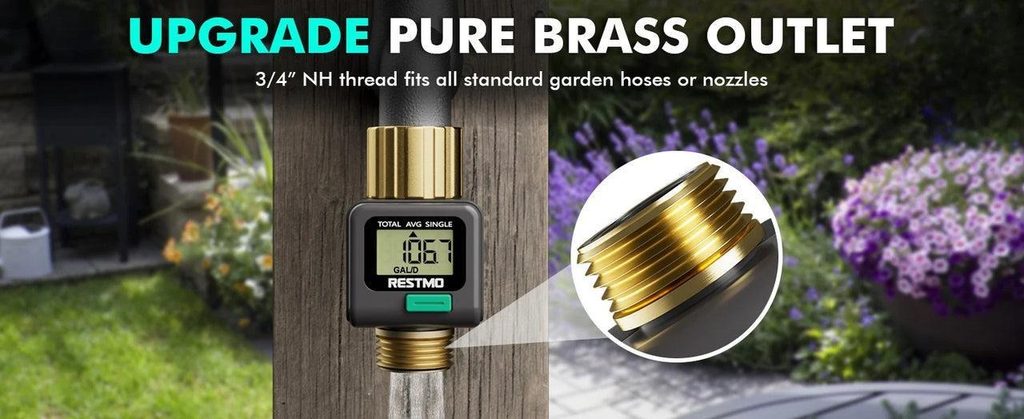
The RESTMO Water Flow Meter, Brass Inlet & Flow Rate Tracking is a straightforward option for users who want to monitor flow rate and water consumption directly from the meter without app connectivity.
Key features:
- Pure brass inlet and outlet metal threads
- Easy-to-read LCD screen
- One-touch control push button
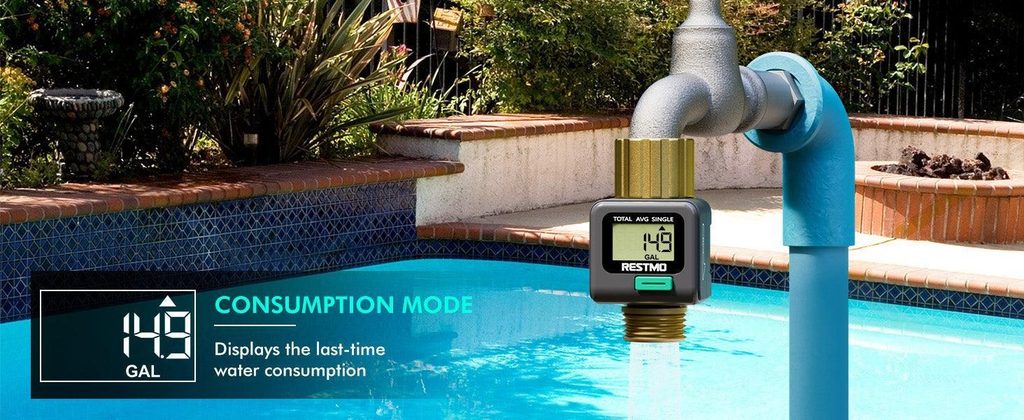
- Four Modes of Measurement: FLOW, CONSUMPTION, AVERAGE, and TOTAL
- Gallon/liter unit switching
- Built-in Hall-type sensor and IC chipset
- Measurement tolerance of less than 5%
- Heavy-duty ABS construction
- IPX6 waterproof rating
Best suited for: Users who want straightforward on-device monitoring for garden hose and outdoor watering applications.
RESTMO Smart Water Flow Meter, App Control & Tracking
The RESTMO Smart Water Flow Meter, App Control & Tracking is a device intended for people who wish to control their water consumption via their smartphones. It connects to the Smart Life app through Bluetooth and can record water usage data for up to three years.
Key features:
- Bluetooth connectivity for app control
- Smart Life app support
- Up to 3 years of water usage data
- Bright backlit display
- 180° adaptive screen orientation
- Durable brass inlet and outlet
- Four measurement modes: FLOW, CONSUMPTION, DAILY, and TOTAL
- Designed for garden watering, RV water tank filling, lawn sprinklers, and nozzle sprayer systems
Best suited for: Users who want app-based monitoring and historical water-use data for outdoor watering.
How to Choose Between Different Water Flow Meter Types
Once you understand the major types, the next step is matching the technology to your actual water system.
For example:
Garden Hose
The small water flow meter can be used in cases where one needs to measure the flow rate and water usage of a hose.
Lawn and Residential Irrigation
Digital, turbine, or paddle wheel meters may be appropriate depending on whether the system uses a hose connection or a larger fixed irrigation line.
Agricultural Irrigation
Turbine, paddle wheel, electromagnetic, or ultrasonic meters may be evaluated for larger irrigation systems depending on the system design.
Industrial and Municipal Water Systems
Electromagnetic and ultrasonic methods are often used for large systems, especially when continuous monitoring, large pipe sizes, or non-mechanical measurement is required.
If you need help comparing specifications such as flow range, connection size, accuracy, measurement functions, display, durability, and smart features, read our guide on how to choose the right water flow meter.
Final Thoughts
Water flow meters come in many forms, from simple mechanical and variable-area designs to digital, turbine, paddle wheel, electromagnetic, and ultrasonic technologies.
Each type has various strengths and is designed for different applications.
For homeowners and gardeners, digital flow meters can provide an easy way to monitor flow rate and water consumption during outdoor watering. Larger irrigation, commercial, agricultural, and industrial systems may require other measurement technologies based on their specific requirements.
Understanding the differences between these flow meter types can assist you in identifying which technology makes sense for your water system before comparing individual products.
FAQs
What are the main types of water flow meters?
Common types include mechanical, digital, turbine, paddle wheel, electromagnetic, ultrasonic, and variable area flow meters. Each uses a different sensing or measurement approach and is suited to different applications.
What type of water flow meter is best for a garden hose?
A compact digital water flow meter is often a practical choice for garden hoses because it can provide an easy-to-read flow rate and track water consumption. Compatibility with the hose connection and the meter’s operating flow range should still be checked before use.
What type of flow meter is used for irrigation?
Small residential irrigation systems may use digital garden hose meters, while larger irrigation systems may use turbine, paddle wheel, electromagnetic, or ultrasonic meters. The appropriate choice depends on the irrigation system’s size and design.
What is the difference between a turbine and paddle wheel flow meter?
Both use a rotating element to detect water movement, but their internal designs and installation configurations differ. Turbine meters use a turbine or rotor, while paddle wheel meters use a paddle positioned in the water stream.
Are electromagnetic flow meters suitable for garden hoses?
Electromagnetic flow meters are generally more common in larger water, agricultural, municipal, and industrial systems. For a typical garden hose, a compact digital flow meter is usually a simpler and more practical solution.
Do all water flow meters measure water consumption?
No. Some meters primarily indicate flow rate, while others can calculate or record water consumption. If tracking total water usage is important, choose a model that specifically provides consumption measurement.
What Are the Two Main Types of Water Meters?
Water meters are commonly grouped into positive displacement meters and velocity-based meters according to how they measure water consumption. Positive displacement meters measure water by capturing fixed volumes, while velocity-based meters calculate usage based on the speed of water flowing through the meter. Different designs are suitable for different pipe sizes, flow conditions, and applications.
What Devices Are Used to Measure Water Flow?
Water flow can be measured using several types of instruments, including mechanical flow meters, turbine meters, paddle wheel meters, electromagnetic flow meters, ultrasonic flow meters, and digital water flow meters. The right device depends on the water system, required measurement accuracy, flow range, and installation conditions.