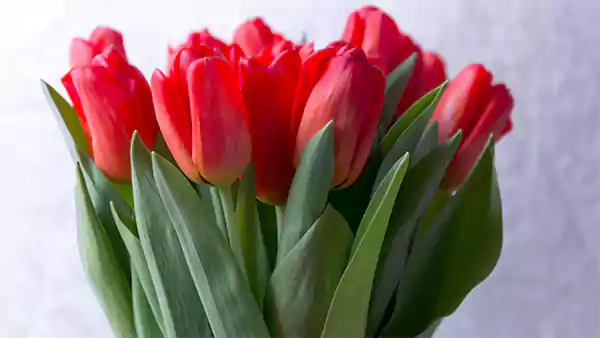
Tulips are Easter flowers that have been associated with the idea of love, rebirth and new beginnings. These cup-shaped flowers and elegant colours have a way of elevating the garden space, but their value is not just limited to aesthetic uses but also to a more profound meaning.
If you love giving and planting flowers but do not know the real meaning behind it, come along as I share with you the tulip flower meaning, with some more interesting insights.
Quick answer
The tulip flower meaning is associated with the idea of pure love, rebirth and new beginnings. Every colour stands for a different version of love and is used to convey love, passion, commitment and admiration for somebody.
What is the Tulip Flower Meaning for Different Colours?
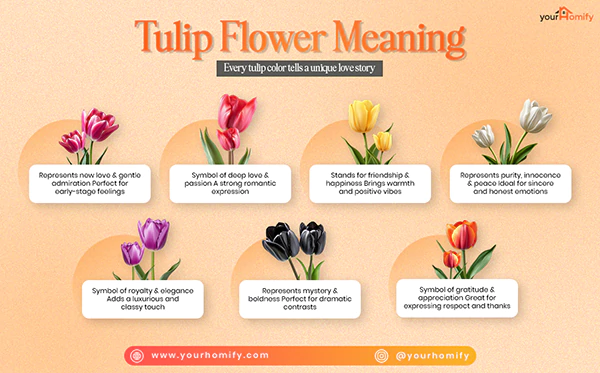
Tulip flower meaning in the language of flowers is linked to the ideal of pure love and rebirth. While all the colours of this perennial flower have different meanings attached to them, essentially gifting a tulip is a sign of affection.
Take a look at what each colour stands for so that you can choose a gift perfectly:
1. Pink Tulip
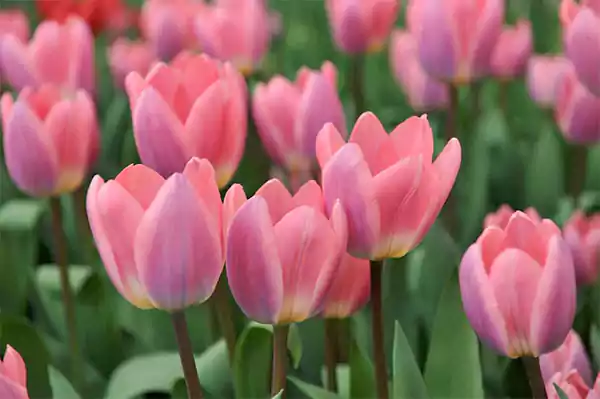
- The pink tulip flower meaning is understood as a symbol of new love and admiration for someone that has not turned into a romantic relationship.
- Victorians associated these pink flowers with the idea of friendship and care.
2. Red Tulip
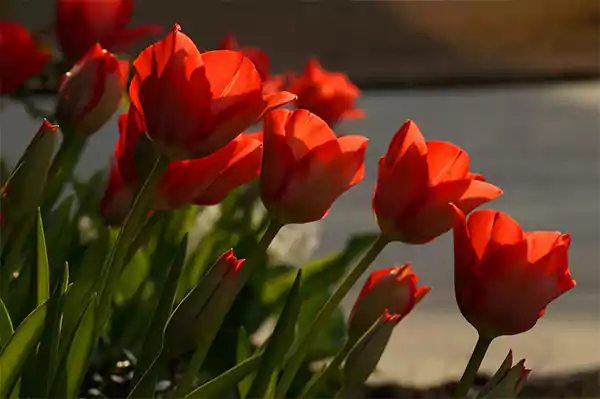
- Just like the red rose, which is the June birth flower, red tulips also stand for love, romance and passion, which is true for most of the flower species.
- According to a tragic Persian myth, a stonecutter, Farhad, falls in love with Princess Shirin, and upon hearing about her sudden death, he falls off a cliff. The first-ever tulip from this blood and, hence, association with eternal love is unquestionable.
Did you know
The red tulip is the symbol for the Parkinson’s Foundation and disease awareness.
3. Yellow Tulip
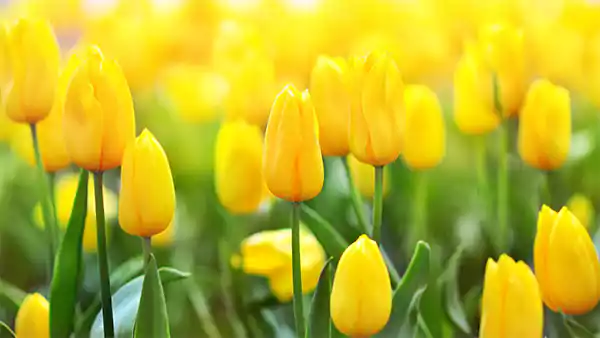
- Similar to the yellow roses’ meaning, yellow tulips stand for friendship, happiness and joy. Earlier, the yellow flower’s meaning was also associated with jealousy, but with time, this meaning evolved to a positive sense.
- Victorians believed that yellow tulips were a way of comparing someone to sunshine and a great gift for someone who has a good smile.
4. White Tulip
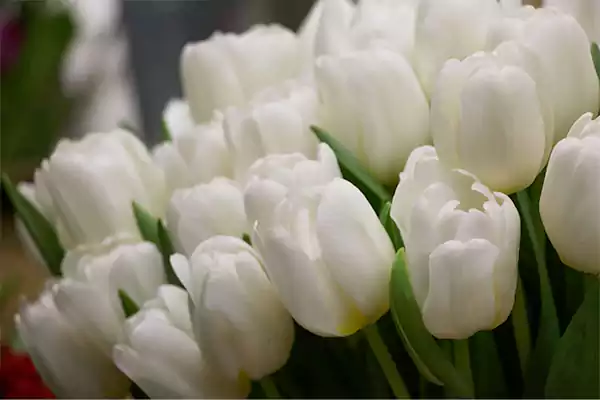
- The white tulip’s meaning is linked to innocence, purity, and hope. As white flowers are a symbol of these ideals, tulips in the colour white also propagate the same principles.
- If you want to appreciate someone’s honesty and sincerity, white tulips will do the best job in conveying that.
5. Purple Tulips
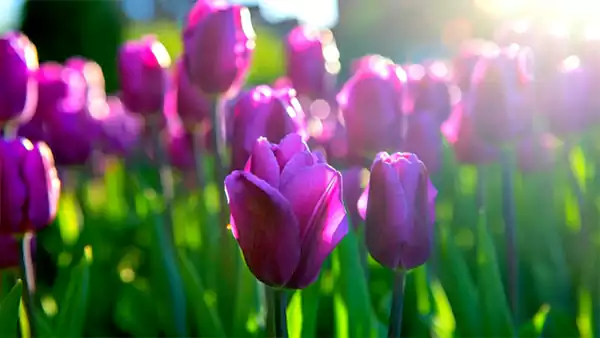
- Historically, the purple tulips were accessible to the elite class of society, and therefore, the symbolic meaning of the purple flower is associated with luxury and royalty.
- So, if you want to add a royal touch to your garden, purple tulips will never disappoint.
6. Black Tulip
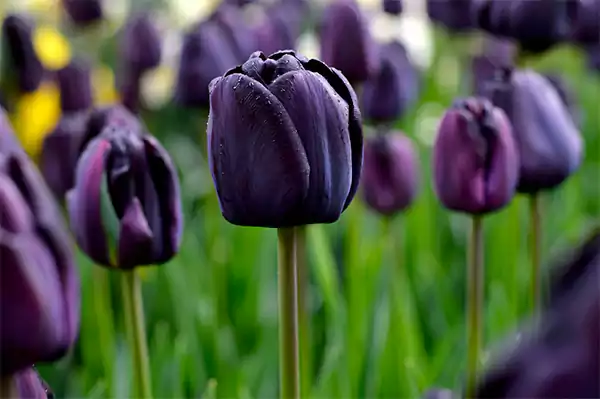
- No black tulips exist in this world; the ones labelled are the hybrid varieties of deep-red and purple tulips, which look close to the colour black under certain lighting.
- The black tulip’s meaning is associated with being bold, dramatic and mysterious. I personally love to grow black varieties, and it gives a wonderful contrast with the lighter shades, especially pink tulips for me.
7. Orange Tulip
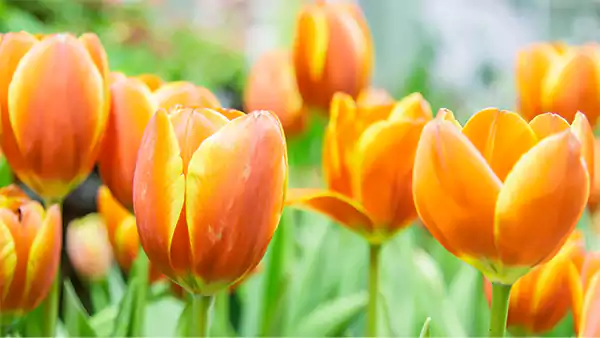
- As per the language of flowers, the orange tulips have been a symbol of appreciation and gratitude.
- So, if you want to express your deep sense of regard for someone, be it a friend, a colleague or a family member, an orange tulip will be the best choice for it.
What is the Historical Significance and Origin of the Tulip Flower?
Tulips, which are native to Central Asia, are grown extensively in the Netherlands. During the time of the Ottoman Empire, these cup-shaped flowers gained most of their popularity.
During that time, the tulip flower meaning was associated with luxury and royalty, and hence, after popularity in Europe, the first ever ‘Tulip Mania’, was introduced.
This bubble (tulip mania) made tulips expensive and reserved them for the higher classes, hence the association with royalty. Having said that, apart from this, tulips have always been linked to the idea of love and rebirth and continue to be so.
Moving further, let me take you through the different varieties of the tulips that can be gifted and planted.
Did you know?
Tulips are not the national flower of the Netherlands, unlike popular belief. Daisies have the official flower status, and tulips are just culturally more celebrated there.
What are the Different Varieties of Tulips to Gift and Grow?
There are over 3,000 species of tulips that are categorised based on flower shape, bloom time, and growing habit.
Now that the tulip flower meaning is understood, take a look at the most famous varieties of tulips to grow in your gardens so that not only colour but also the desired shape of the flowers makes a difference.
1. Species Tulips
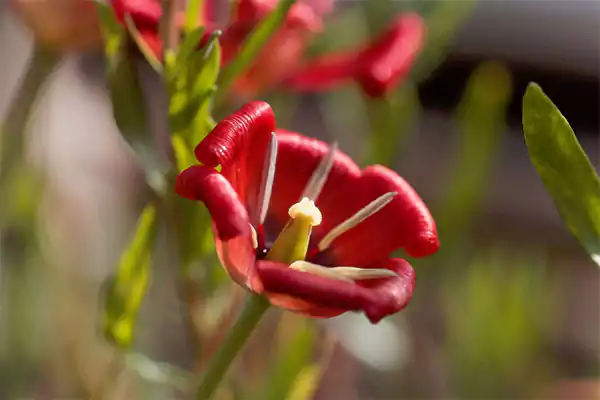
Species tulips are the naturally occurring types of tulips that have not been hybridised using human intervention. This type is identified by its star-shaped, smaller flowers that are weaker than other varieties, but come back blooming year after year.
| Botanical name | Tulipa (varies per species) |
| Native | Hybrid |
| Hardiness | USDA zones 3-8 |
| Varieties | Tulipa tarda, T. linifolia |
2. Darwin Tulips
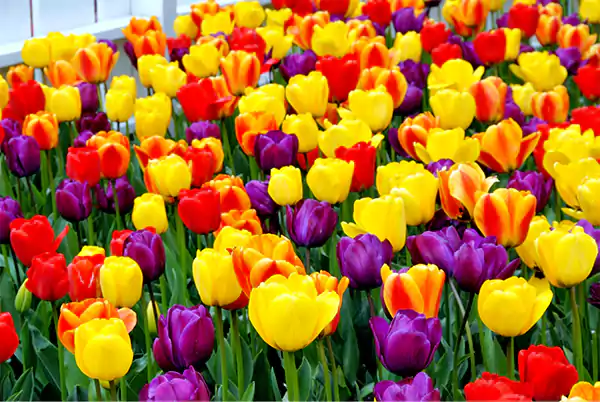
Darwin tulips are the hybrid variety named after Charles Darwin and Tulipa fosteriana (wild tulips). These varieties are known to be sturdier and are grown in colours ranging from yellow and pink to purple.
| Botanical name | Tulipa ‘Darwinhybrid’ |
| Native | Hybrid |
| Hardiness | USDA zones 3-8 |
| Varieties | ‘Novi Sun’ and ‘Apidoorn’ |
3. Triumph Tulip
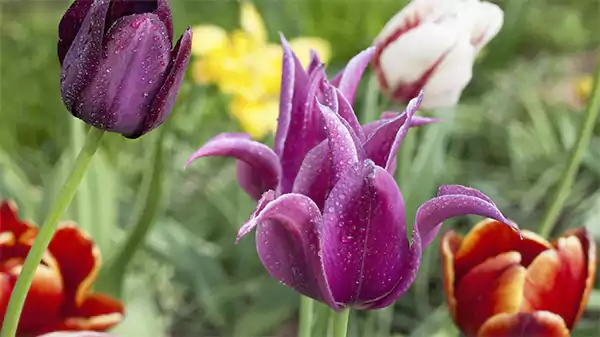
Triumph tulips are known to have a conical, pointed top along with a sturdy stem. They grow up to 2 feet tall and are quite low-maintenance, which makes them a great option for growing.
| Botanical name | Tulipa x |
| Native | Hybrid |
| Hardiness | USDA zones 3-8 |
| Varieties | Apricot beauty tulips |
4. Apricot Beauty Tulips
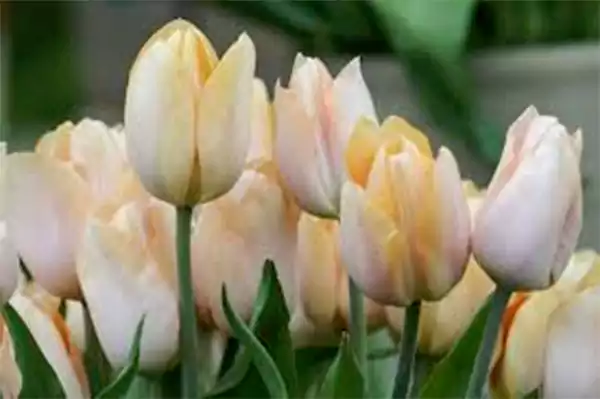
Apricot beauty is a type of Triumph tulip that features white cup-shaped flowers with soft brown edges. This white flower has delicate stems but is sweetly scented and can be perfect as cut flowers.
| Botanical name | Tulipa ‘Apricot Beauty’ |
| Native | Hybrid |
| Hardiness | USDA zones 3-8 |
| Varieties | A variety of the triumph tulips |
How to Care for Homegrown Tulips?
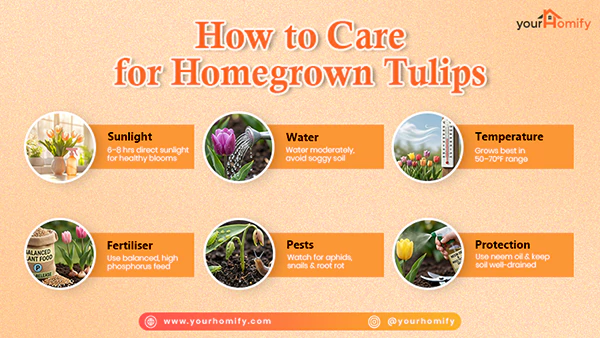
Tulips are easy to care for and can be planted without hassle. Now, if you want to grow some of these tulips at home, the following are the basic care tips that will help you have healthy growth:
- Sunlight
- 6-8 hours of direct sunlight are required for a thriving tulip plant.
- Water
- Moderately water the plant. Let the soil dry out before misting, as overwatering can lead to root rot.
- Temperature
- The tulip plant prefers hot temperatures. Anything between 50°F and 70°F is ideal for them.
- Fertiliser
- Feed the tulip plant with a slow-release, balanced fertilizer which has a high phosphorus content while planting.
- Pests
- Tulips are prone to being attacked by aphids, snails, slugs and root rot caused by overwatering.
- Treat the pest infestation using insecticidal soap or neem oil.
- Avoid overwatering and let the soil dry out before watering.
Facts About the Tulip Flowers
Apart from being the symbol of pure love and rebirth, there are a lot of important insights about tulips that do not come to our notice.
Here are some facts about tulip flowers that you must know!
- Tulips are native to Central Asia, but most tulips are grown in the Netherlands, so do not get confused.
- According to the ASPCA, tulips are considered toxic to cats and dogs. So, while tulips are edible, keep them away from your furry friends.
- Tulip mania was one of the most significant phenomena of the 16th century, making these Easter flowers more expensive than luxury houses.
- Tulips are edible and do have culinary benefits. Still, the catch here is to only consume petals and avoid flowers that have been grown for commercial purposes, as they have a high amount of pesticides.
Wrapping Up
Tulips are the symbol of rebirth and new beginnings and are used to convey feelings of love, gratitude and happiness. Since the popularisation of the flower by the Ottoman Empire, tulips have become a luxurious symbol that is a huge part of home decor and special occasions. With every flower signifying a different emotion, tulips surely have a language of their own.
So, the next time you gift someone a tulip, make sure you know the tulip flower meaning.
FAQs
What is the meaning of the tulip flower?
The main symbolism of the tulip flower is related to rebirth and pure love.
Which tulip flower symbolises gratitude?
The orange tulip flower means ‘gratitude’ and is given to someone you want to thank.
What is the black tulip flower meaning?
The black tulip, which in reality is the dark purple tulip, means ‘bold and mysterious’ and is planted for a dramatic touch in the garden.
Is tulip the national flower of the Netherlands?
No, the national flower of the Netherlands is daisies, and tulips are their ‘cultural symbol’.
What is the red tulip flower meaning?
The red tulip flower meaning is associated with love and passion. They are best given either to partners or on anniversaries.