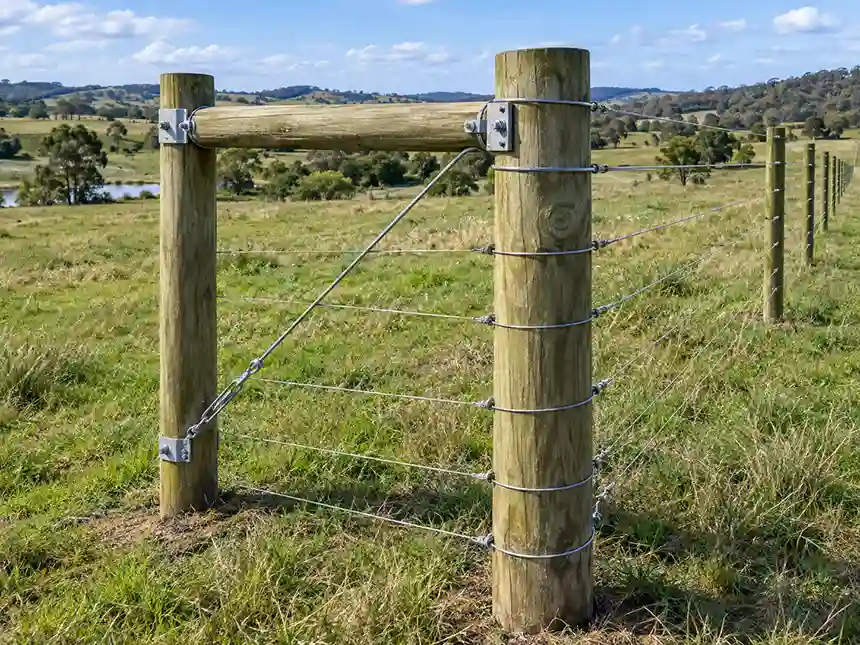
Every fence in the American countryside is losing an argument with a corner post. The wire can be tensioned correctly, the posts can be plumb, and it will still sag within a season if the corner wasn’t braced properly, because a corner post carries the pull of two directions at once and nothing else in the run does.
That’s the kind of thing you only learn after replacing a fence once.
Rural property work rewards knowing a handful of details like that before you start, rather than discovering them mid-project. It also rewards knowing which jobs are worth a Saturday and which ones need someone who does this professionally.
Here’s where to put the effort, starting with the fence line and working back toward the house.
Start With the Fence, Because Everything Else Depends on It
A fence on acreage is doing several jobs at once, and most people only plan for the obvious one.
It keeps animals contained, yes. It also marks a legal boundary, screens the house from a road, and in a lot of counties, satisfies the requirement that keeps your land classified as agricultural rather than residential for tax purposes. Skip the fence, and you’ve quietly changed your property’s tax status.
Mississippi State University’s extension guide on fencing lays out the actual engineering, and it’s worth reading even if you’re hiring the work out. It tells you what a good contractor should already know.
Square paddocks use less fence than rectangular ones. Post depth should run ten to fifteen times the post’s diameter depending on soil, deeper in sand than in clay. And high-tensile wire holds its strain far better than barbed wire when a corner post shifts, which is the failure that actually matters.
None of that is intuitive. All of it is the difference between a fence that lasts fifteen years and one you’re rebuilding in five.
| Wire Type | Strength | Best For |
|---|---|---|
| Barbed wire | Loses over 20% of tension when a post shifts ½ inch | General perimeter, lower budget |
| Woven wire | More expensive, moderate strength | Where visibility and full containment both matter |
| High-tensile | Loses roughly 10% of tension under the same shift | Long runs, rotational grazing, harsh weather |
What the Wire Actually Needs to Survive
Wire has to survive weather that hasn’t happened yet. That’s the part most first-time builders get wrong.
A fence capable of withstanding harsh weather and keeping the livestock contained needs three strands minimum on any perimeter run, solid H-bracing at every corner, and at least three ground rods driven six to eight feet deep if any of it is electrified.
Skip the grounding and the whole system delivers a weak shock that trains nothing, which defeats the entire point of running current through the wire.
Shade matters more than most fence plans account for too. Cattle with shade access show measurably better feed efficiency in hot weather, and a portable shade structure moved with the herd avoids the mud problem a fixed one creates.
Handling Equipment Is Where People Underspend
Nobody sets out to skimp on handling gear, and yet almost everyone does, because the fence and the barn eat the budget first and the chute gets whatever’s left over once the bigger jobs are paid for.
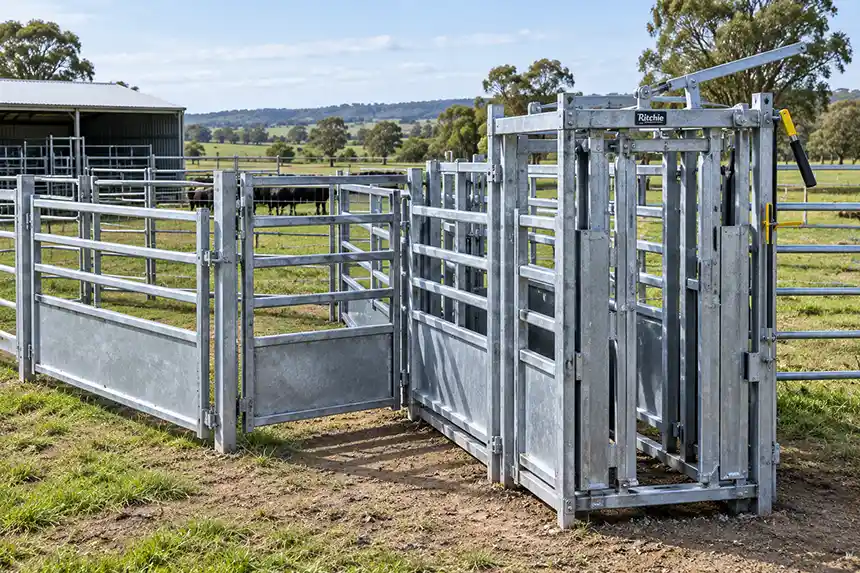
That’s backwards for one specific reason: handling equipment is what you touch under pressure, at odd hours, often alone. A gate that sticks is a mild annoyance on a calm Tuesday and a real problem when an animal is panicking at6 amm and you’re the only person on the property.
Galvanized steel earns its cost here specifically because it resists corrosion for decades rather than years, which matters more on equipment you’re leaning your weight against than on a fence post nobody touches.
I’d rather underspend on the barn and overspend on the chute. The barn just needs to keep rain off.
Interesting fact
Ramstrong sheep and goat equipment is one of the best examples in this category, because it is built around that same hot-dip galvanized logic for handling panels and feeders.
Privacy and Screening Work Differently Out Here
Suburban screening solves a sightline problem measured in feet. Rural screening solves one measured in acres, and the two jobs barely resemble each other.
A six-foot cedar fence does nothing against a neighbor’s grain bin visible from half a mile away. What actually works at that scale is layered: a windbreak of fast-growing trees planted first, a mixed hedge filling in behind it over several years, and privacy fencing reserved for the areas close to the house where you want an immediate result rather than a five-year one.
Plant the trees the same season you build the fence. The fence gives you privacy on day one. The trees are what’s actually doing the job by year ten, and most people forget to start them until the fence already feels inadequate.
The Yard Still Needs Attention, Just Less of It
Two acres immediately around the farmhouse. That’s the part of the property where a quarter-acre lot’s worth of garden care advice still applies almost unchanged.
What changes is everything past that boundary. Pasture management, not lawn care. A bush hog instead of a mower. The transition line between the two is worth marking clearly, if only so a mowing service knows where their job ends and the fencing contractor’s begins.
The Environmental Case Nobody Asks For
Rotational grazing sounds like a productivity choice, and it is one. It also happens to be one of the more genuinely low-effort ways a rural property can reduce its footprint, which is worth knowing even if nobody on the property set out looking for that.
Moving livestock between paddocks lets grass recover between grazes, which holds soil in place and cuts runoff compared with a single pasture grazed continuously into bare dirt. If reducing your property’s impact on the environment is a goal alongside the practical fencing decisions, rotational grazing gets you there as a byproduct of doing the fencing right in the first place.
Conclusion
Sequence this the way the land forces you to, not the way it’s fun to.
Fence first, because everything else waits on the boundary being settled. Handling equipment next, because it’s what fails you at the worst possible moment if it’s cheap. Screening and yard work last, because they’re the part a neighbor actually sees and the part that can wait a season without anything going wrong.
Useful Insight
Most homeowners get this order backwards, understandably, because the visible stuff feels more urgent than a fence line nobody looks at twice.
The fence is the thing holding the property together. Everything downstream of it works better once it’s right.
H2: FAQs
How deep should fence posts be set?
Roughly ten times the post diameter in clay soil, fifteen times in sandy soil. Going shallower risks the post breaking loose before it breaks.
Is electric fencing safe for livestock?
Yes, once animals are trained to it, which typically takes a few days. Proper grounding matters more than most first-time installers expect.
What’s the real difference between barbed wire and high-tensile wire?
High-tensile wire retains far more of its strength when a post shifts slightly, which is the actual failure mode fences experience over time.
Do trees really help with rural privacy?
Yes, but not immediately. A layered windbreak takes several years to mature, so plant it the same season you build any fencing meant to bridge the gap.
Mississippi State University Extension Service — Livestock Fencing Systems for Pasture Management (Publication 2538), by Rocky Lemus, Jimmy Parish and Jane Parish, for the paddock shape, post depth, wire tension-loss figures, shade structure guidance, and grounding requirements.