

Weekend are supposed to belong to take care for the garden. Many plants like roses need deadheading; tomatoes need staking, but imagine you are somewhere on the ladder, scraping sun-bleached boards along the back fence for the third summer in a row. The fresh stain becomes chalky by August, and the neighbor’s dog has found the gap by the gate.
This cycle is stopped by vinyl fencing. The best part is that it doesn’t need paint or stain; it won’t splinter or rot, and a garden hose does most of the cleaning. It also offers privacy that helps in turning a backyard into an outdoor room, a backdrop for climbing jasmine and potted citrus instead of a weekend chore.
Full Privacy Panels: Best for Complete Screening
If you want a backyard that nobody can see, then strong, tongue-and-groove privacy panels are the best choice. They have no gaps between boards, and they also block sightlines from the street and from neighboring windows.
The thing about privacy panel is it works great along with rear property lines, around a hot tub, or behind a seating area. Most of the time, homeowners choose a height of roughly 6 feet. Don’t forget to add a matching gate so the line of the fence stays unbroken.
Semi-Privacy Designs: Best for Airflow and Light
Sometimes a solid wall feels too closed in; a semi-privacy design uses slats with small gaps or a lattice band along the top. Privacy is there, but air moves through the quality fence, and some light reaches the beds on both sides.
This all makes semi-privacy a good fit for gardeners, as plants get better circulation. The fence won’t feel like a barrier but a part of the garden.
Horizontal Vinyl: Best for Modern Homes
Horizontal boards help the fence with clean, continuous lines that suit mid-century and contemporary houses. It pairs well with concrete pavers, ornamental grasses, and simple planting.
You have options to choose horizontal designs in full privacy or semi-privacy versions.
Wood-Look Vinyl: Best for Replacing an Old Wood Fence
Wood-look and textured profiles are known for their warmth of timber. The grain and color read as wood; there is nothing to seal.
If you are thinking of replacing a tired wood fence, then it’s not easy. For all of this to be done, the old boards have to come out, debris has to be hauled away, and irrigation or planting beds near the fence line may need protecting.
Also, during bids, try to ask companies to list removal, disposal, and new installation as separate items so you can compare like with like.
Vinyl Wall Toppers: Best for Adding Height to a Block Wall
For properties that have a low block wall along the boundary, a vinyl wall topper adds height and privacy. Toppers are available in options like solid and lattice styles; this can help you match the rest of the fence.
Vinyl and Aluminum Combinations: Best for Mixed Needs
Many yards require both a solid vinyl wall around the pool or patio for privacy, and an open aluminum picket along the front walk where height limits are lower. If you plan it together, it will keep post spacing and colors consistent, and the boundary feels complete instead of just a patchwork.
Who Makes the Fence Matters
The style is just half the thing. The other half depends on who makes and installs it, because fit, spare parts, and warranty support all depend on the supplier.
Most of the time, companies install panels made by someone else. A fabricator that makes its own components can solve problems faster. In Los Angeles, for example, Vinyl Fence Depot fabricates its own USA-made rigid PVC at its Van Nuys facility and then installs those same parts in local yards. The company has more than 20 years of experience and thousands of completed installations across Southern California.
Vinyl Fence Depot vinyl fabrication and fencing website screenshot
This in-house control helps when a sloped yard needs a custom run or a gate needs a replacement part, and a fabricator that keeps stocked inventory can usually turn jobs around faster than a drop-ship reseller.
It’s actually a warranty that is a useful benchmark when you compare offers: a limited lifetime transferable residential warranty, a 30-year commercial warranty, and lifetime protection against discoloration, which counts for a lot under a strong sun.
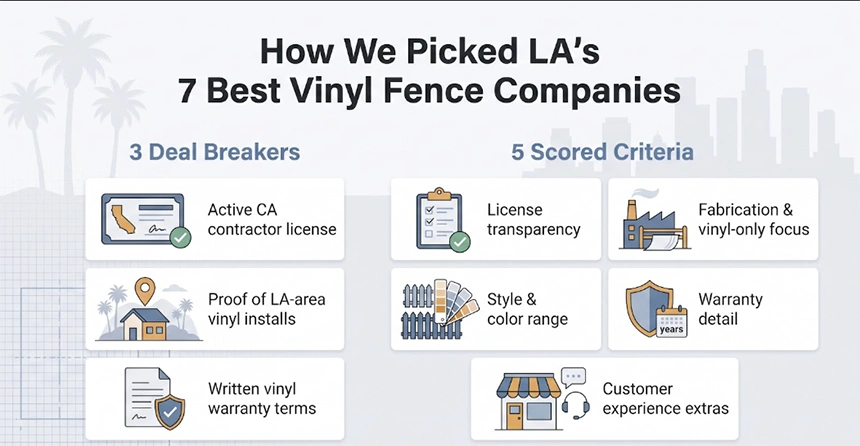
Before hiring anyone, look for three things:
- an active contractor license you can check
- a record of vinyl installs in your area
- warranty terms published in writing
Don’t forget to ask about the warranty transfers when you sell the house, and whether posts, hinges, and labor fall under the same terms.
Privacy Heights and Permits
You should also know that the fence height and permit rules change from city to city. Front-yard limits are often around 42 inches, while side and rear fences are commonly allowed up to about 6 feet, but your numbers may differ. Don’t forget to check with your local planning or building department before you finalize a design.
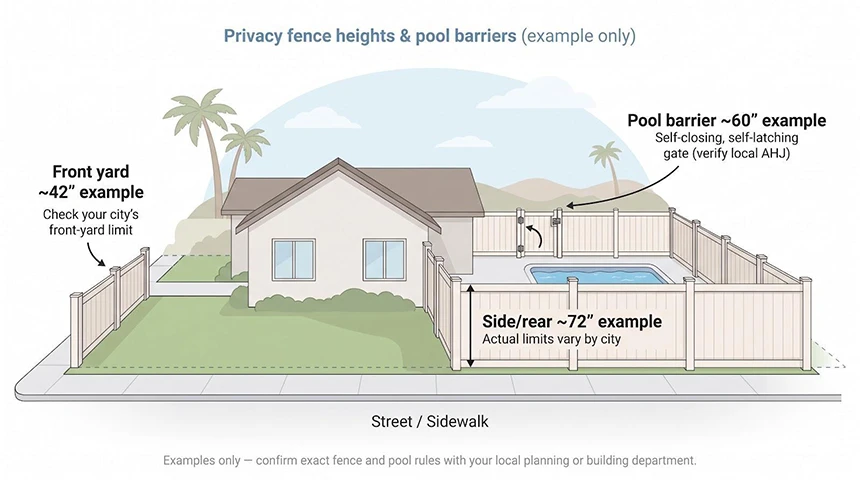
Pool barriers also have strict standards. For instance, in California, the Swimming Pool Safety Act generally calls for an enclosure at least 60 inches high with self-closing, self-latching gates, and local building departments can add requirements. Check the rules for your parcel first, then design.
How to Judge Vinyl Quality
“Made in the USA” looks good on a brochure, but the thing is, origin alone won’t tell you how a garden fence will handle a hot August or a strong wind. Try to ask whether the product meets ASTM F964, the standard specification for rigid PVC exterior fence profiles. Then check a few practical points:
- Do long runs and wide gates use aluminum reinforcement to prevent sagging?
- Can you get replacement pickets or rails locally if a panel is damaged?
- Does the written warranty spell out coverage for fading and discoloration?
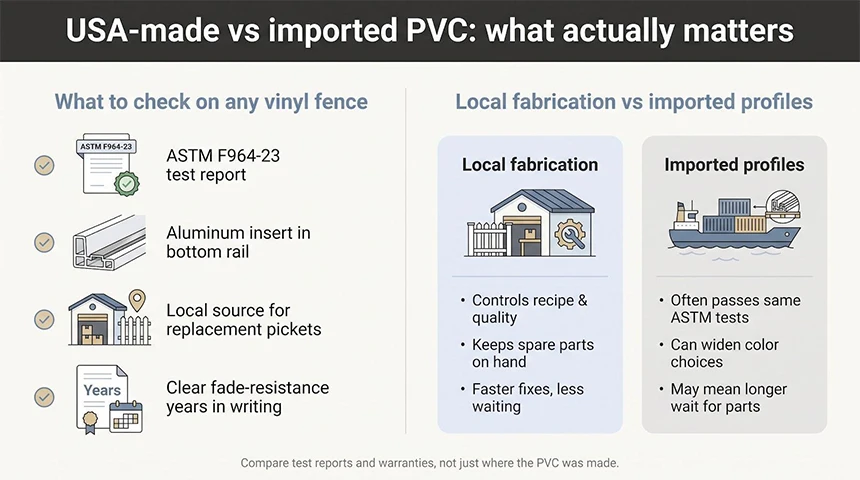
Local fabrication mostly performs better because the maker controls the product, keeps spare parts on hand, and can fix defects quickly. Imported profiles can also meet the standard, so compare the paperwork instead of the label.
Typical Cost Range
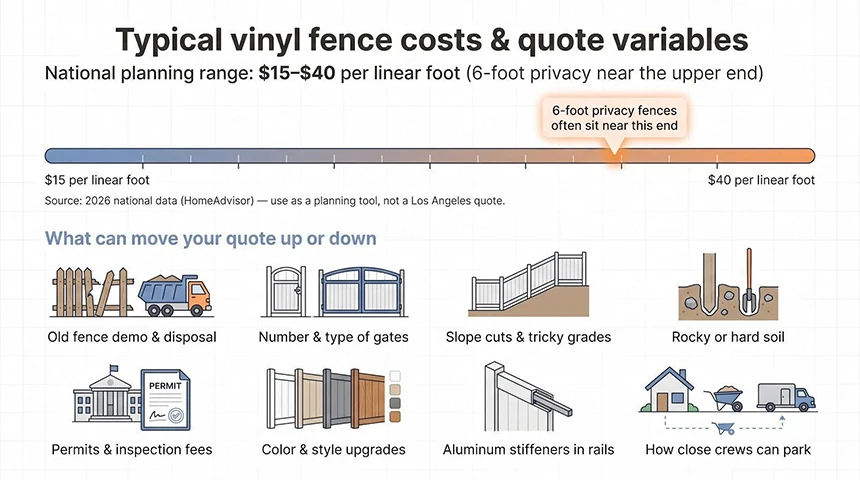
HomeAdvisor’s cost guide puts professionally installed vinyl fencing at roughly $15 to $40 per linear foot for most 4- to 6-foot fences, with 6-foot privacy fences toward the upper end. Treat that as a planning figure, not a quote. Local prices move with removal of an old fence, the number of gates, slopes, rocky soil, permit fees, color upgrades, and how easily the crew can reach your yard. Ask each bidder to list these items so you can compare quotes side by side.
HomeAdvisor’s cost guide actually offers professionally installed vinyl fencing at roughly $15 to $40 per linear foot for most 4- to 6-foot fences, with 6-foot privacy fences toward the upper end. Consider this as a planning figure, not a quote. Local prices change with
- removal of an old fence
- the number of gates
- Slopes
- rocky soil
- permit fees
- color upgrades
Ask each bidder to list these items so you can compare quotes side by side.
Upkeep Compared With Wood
Vinyl fencing often requires more than a rinse with soap and water once or twice a year and a quick check of gate hinges and latches. Whereas a wooden fence needs regular sanding and re-staining or repainting, plus board replacements when rot or termites set in.
If you are still weighing materials, it helps to compare common fence materials side by side before you collect quotes. For most gardeners, the time vinyl saves goes straight back into the beds and borders.
The Options at a Glance
| Vinyl Fence Style | Privacy Level | Best For |
| Full privacy panels | Complete | Side and rear property lines, patios, hot tubs |
| Semi-privacy designs | Partial | Gardens that need airflow and light |
| Horizontal vinyl | Complete or partial | Modern and mid-century homes |
| Wood-look vinyl | Complete or partial | Replacing an old wood fence |
| Wall toppers | Adds height | Existing low block walls |
| Vinyl and aluminum | Mixed | Private backyard, open front yard |
The Bottom Line
A good vinyl fence offers you privacy for decades and doesn’t ask anything in return. So, begin with your local height and permit rules, pick the style that fits your house and garden, check the quality and warranty paperwork, and get at least three written quotes. By doing all this, you can spend your weekend in the garden.
FAQs
What type of privacy fence lasts the longest?
Precast concrete and wrought iron last the longest.
What is the lifespan of a vinyl fence?
The lifespan of a vinyl fence is around 20-30 years.
What are the three most popular types of fences?
The three most popular types of fences are wood, vinyl, and chain-link.