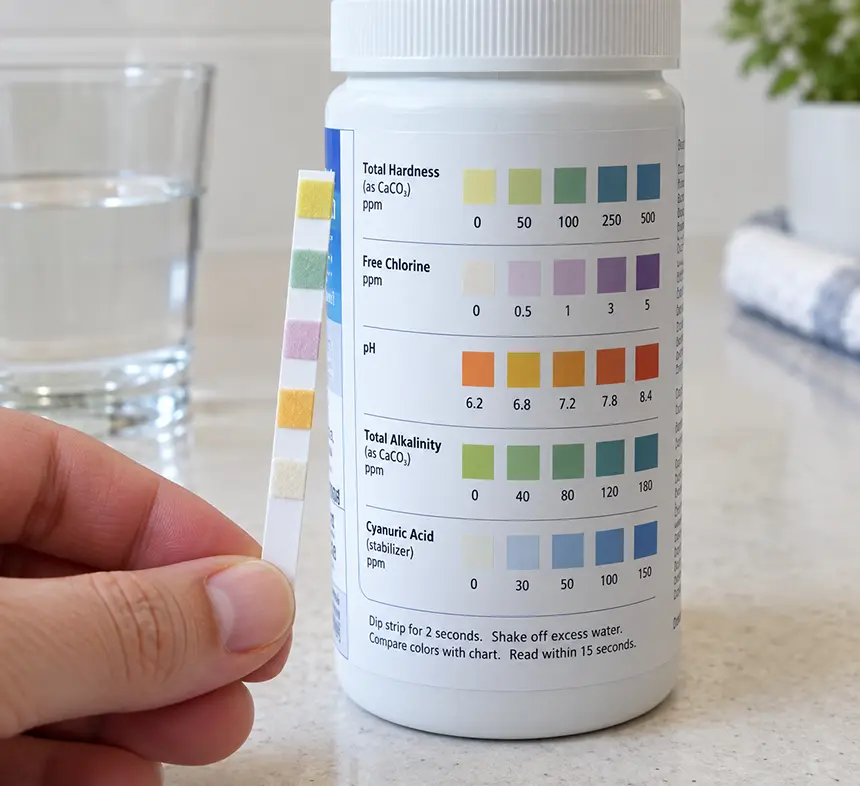
A strip of card about the length of your finger, with five small pads down one side. Dip it, wait a minute, and hold it against the chart printed on the bottle.
The pads change color. That part is real chemistry, and it works.
What happens next is where people go wrong, because a color change gives you a number, and a number is not the same thing as a decision.
Here’s what those strips can and can’t see, how the three kinds of water tests actually differ, and what to check before you spend money fixing anything.
What the Strip Is Actually Doing
Each pad on a test strip carries a reagent that reacts with one thing and ignores everything else. Chlorine, hardness, pH, nitrate, sometimes iron. The chemistry is sound, nd and the readings are broadly right, within a band.
The trouble is that “within a band” does a lot of work in that sentence. A strip will tell you your hardness sits somewhere between 120 and 180 parts per million. It will not tell you whether it’s 121 or 179, and for some parameters that gap is the entire question.
Safety is a threshold, not a state, and thresholds are set relative to what a society has decided to worry about. The questions behind a strip in an American kitchen and the ones Oxfam works on around Clean water access in humanitarian settings are separated by several orders of magnitude, which is worth remembering the next time a pad comes up faintly orange.
Three Tests, Three Different Answers
People use the phrase “water test” to mean three completely different transactions, and the confusion between them is responsible for most of the bad decisions in this area, including a fair number of expensive ones.
| Kind | What it gives you | Rough cost | Is the result actionable? |
|---|---|---|---|
| Drugstore test strip | A band for five or six common parameters | $10–20 for dozens | As a screen only. Nothing you’d act on alone |
| Mail-in accredited lab | Measured values, method-documented | $40–200 depending on panel | Yes. This is the one that stands up |
| Free in-home test | A demonstration, usually of hardness | Free | No. See below |
Yourhomify’s own guide to running a real water test covers the sampling side, which matters more than people expect. Rinse the bottle before you fill it, and a lab will reject the sample outright.
What No Strip Will Catch
Legionella is the example I keep coming back to, because it demonstrates the limit better than anything else on the list.
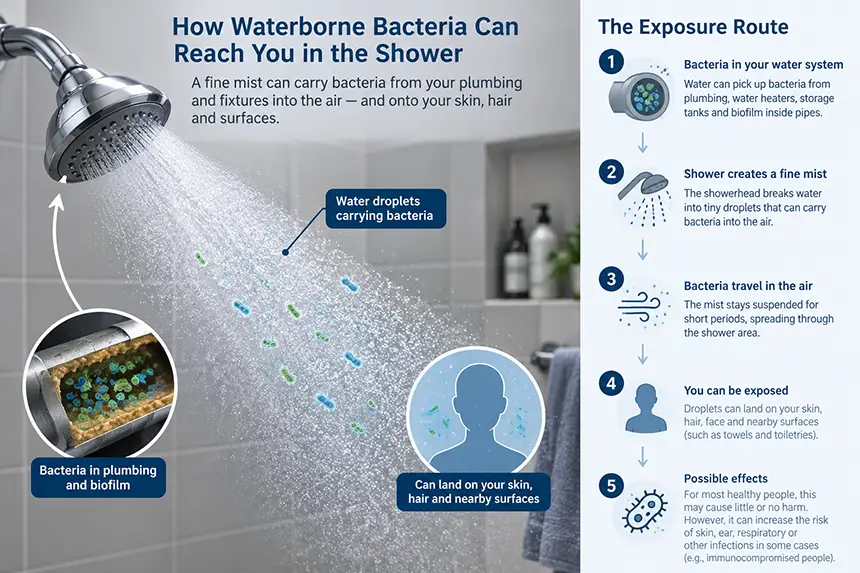
It has no taste, no color, and no smell, even at concentrations high enough to make someone ill. It grows in warm, still water inside your own plumbing rather than arriving from the utility, which means the water can be perfectly fine at the main and a problem at your showerhead. And you don’t get sick by drinking it. You get sick by breathing the mist.
No consumer strip detects it. Nothing you can buy in a hardware store detects it.
Accredited laboratories like ETR Labs run it as a separate culture test, and it isn’t on any general panel by default, which tells you something about how the industry thinks about it.
The same is broadly true of PFAS and of lead at the low end. The things most worth knowing about are the things a color chart cannot reach.
The Free Test Is a Sales Call
Someone tests your water for free. They come to the house, run the sample in front of you, and show you the result on the spot.
What they almost always test is hardness, because hardness is easy to demonstrate dramatically and because the product they sell fixes it. A soap-and-shake demo in your own kitchen is theater with a correct answer in it.
None of which makes hardness unimportant or the salesperson dishonest. It makes the test a marketing instrument rather than a diagnostic one, and you should read the result as exactly that.
What a Result Actually Changes
Before spending anything, work out what you’d do differently if the number were higher or lower, because for a surprising share of readings the honest answer is nothing.
High hardness is a nuisance rather than a health issue. It scales kettles and shortens the life of water heaters. Whether that justifies a softener is a maintenance-cost question, not a safety one.
Softened water then brings its own consequence, which is the part nobody mentions at the sales visit. Ion exchange swaps calcium for sodium, and the result is poor for houseplants, succulents especially, since the mineral buildup sits in a pot that never really flushes.
Anyone who has worked out how to water succulents properly and then started running them on softened water will have watched this happen.
Interesting Fact
If a strip does come back outside the range on something you care about, the sequence from there is short, and skipping to the end of it is how people end up with a useless filtration system.
Before You Spend Anything
- Get your utility’s report first. Public systems publish annual consumer confidence reports, and they’re free. Half the time your answer is already in it.
- Confirm with an accredited lab. Look for ISO/IEC 17025 accreditation or state certification. That accreditation is the difference between a number and evidence.
- Test the right tap, the right way. First-draw samples for lead. Follow the sampling instructions exactly, since a mishandled sample produces a wrong answer rather than no answer.
- Match the fix to the finding. A whole-house system for a problem confined to one fixture is money spent on the wrong thing.
- Check whether plumbing is the source. Old pipes and fittings contribute lead and copper regardless of what arrives at the main, and if there’s been a leak, the recovery from water damage work is a separate job from the water quality one.
Conclusion
Strips are fine. I keep some.
They’re a smoke alarm rather than a diagnosis: useful for telling you something has changed, useless for telling you what to do about it, and genuinely good value at the price for that narrow job.
The mistake isn’t trusting the strip. It’s letting a strip be the last test you run rather than the first, and then buying equipment on the strength of a color chart.
FAQs
Are home water test strips accurate?
Reasonably, within a range. They’ll place a parameter in a band rather than give you a precise value, which is enough to flag something and not enough to act on.
When should I pay for a lab test?
When a strip flags something, when you’re on a private well, after plumbing work, or before buying any treatment equipment.
Can a water test detect bacteria?
Not with a strip. Bacterial testing requires a laboratory culture, and specific organisms like Legionella need their own separate test.
Is a free water test from a company worth taking?
As a demonstration, it’s harmless. Just don’t mistake it for a diagnosis, since the parameter being tested is usually the one their product happens to fix.
ETR Laboratories — home plumbing, from “Legionella in Water: Home Plumbing and Water Heater Risks”, for the growth conditions inside household plumbing, the aerosol exposure route, and the point that the bacteria cannot be seen, smelled,d or tasted