Yellow flowers are symbols of hope, friendship, new beginnings, and happiness. Yellow flowers enlighten rooms with bright color, and people also connect them with enthusiasm. These flowers carry different meanings and symbolism in different cultures. In recent times, this flower has been connected with love after a TV series trend.
In this guide, I have talked about the meaning of the yellow color flower. Also read about the yellow flower’s meaning in different cultures and the meaning of different varieties. Also read about the occasion and the suitable yellow flower.
Quick Answer
Yellow color flower meaning happiness, friendship, joy, enthusiasm, and new beginnings. The warm and joyful color lights up the room. People give these to friends or someone they admire platonically. Popular yellow flowers are sunflowers, yellow roses, daffodils, yellow tulips, and marigolds.
What Do Yellow Color Flowers Mean?
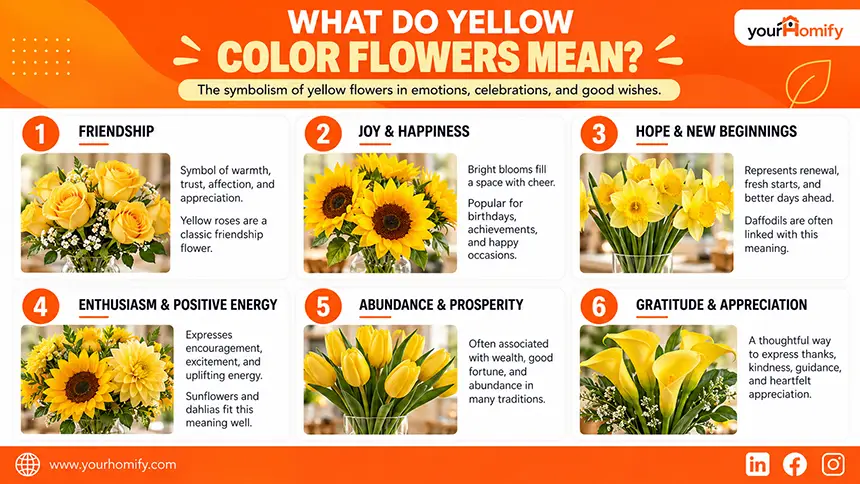
yellow color flowers meaning energy, enthusiasm, friendship, hope, new beginnings, and joy. This bright-colored flower resembles sunshine and positive energy, and it is a popular choice for expressing emotions and good wishes. This flower symbolises not just happiness but also gratitude, abundance, and prosperity.
Let’s explore what yellow flowers mean.
1. Friendship
Yellow flowers have been used as a symbol of friendship and platonic love for a long time. Gifting them showcases warmth, trust, affection, and appreciation in friendship. Yellow roses are usually exchanged to celebrate friendship, appreciate friendship, and tell them how much they mean.
2. Joy and Happiness
The bright yellow color of this flower makes the room fill with joy and happiness. Flowers like sunflowers, yellow tulips, and gerbera daisies are very popular, especially for celebrating happy moments, like birthdays, achievements, and special occasions.
3. Hope and New Beginnings
Yellow flowers also symbolise hope, renewal, and fresh beginnings. Yellow flowers like daffodil and forsythia are connected with fresh start and an indication of better days ahead. These are meaningful gifts for someone who is starting a new job, moving to a new place or starting a new chapter of life.
4. Enthusiasm and Positive Energy
The bright appearance of this flower is often connected with excitement, enthusiasm and positive energy. These can express encouragement and support towards someone who is working hard for their goal or to celebrate achievements. Sunflowers or dahlias can be the best option in this case.
5. Abundance and Prosperity
People use yellow for wishing wealth, abundance and good fortune. This significance comes from ancient maya where yellow was associated with corn that is an important source of food. In Chinese traditions similarly yellow flowers were connected with prosperity especially during the lunar new year celebrations.
6. Gratitude and Appreciation
Lastly people use this to express their gratitude to someone without using words. The warm color represents sincere appreciation like kindness, guidance and support. Flowers like calla lily, rose, tulip can be a thoughtful choice for this.
Did You Know?
Yellow flowers are attractive to many pollinating insects, too. Bees can learn to associate different flower colors with food rewards such as nectar and pollen. This is one reason flower color plays an important role in how pollinators find food.
What Do Yellow Flowers Mean in Love and Relationships?
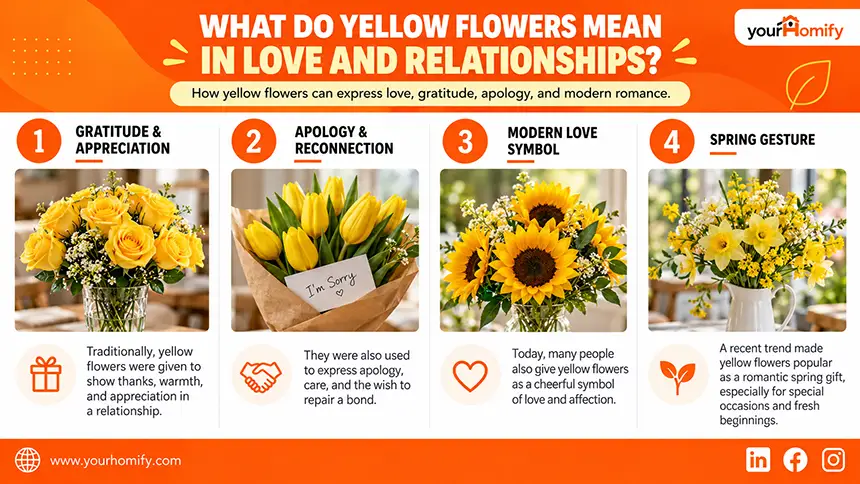
In romantic relationships, people use to give this flower to show gratitude or to apologise to their loved ones but with time it has changed as per the recent trend that started on TikTok, people are using this to convey their love to someone. They give this flower on the first day of spring to a young lady; this symbolism came from a TV series that got famous in Argentina.
So nowadays, you can give this as a representation of your love, or give it on their birthday or a special occasion as a symbol of your gratitude towards them. You can also mix this with different colors and make a bouquet.
Do Yellow Flowers Have Negative Meanings
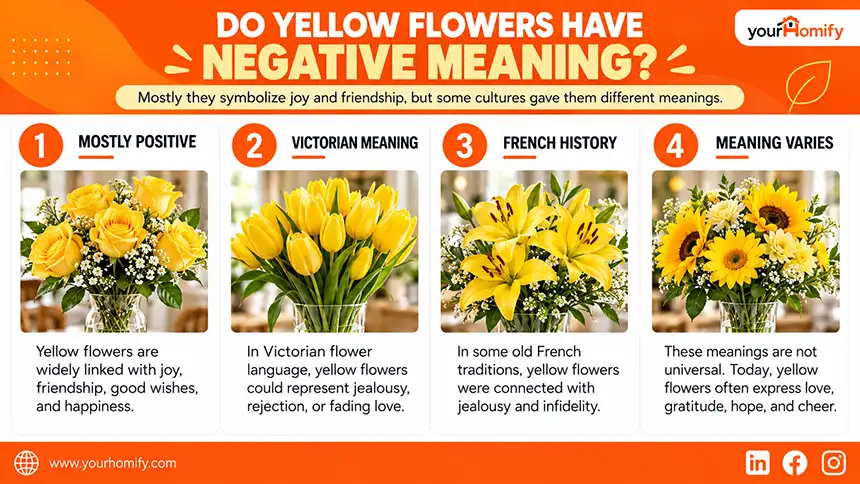
No, these flowers are connected with joy and friendship. However, in some cultures, this flower is connected to rejection, jealousy, greed, and infidelity, but this is not the universal meaning. The meanings keep changing from culture to culture.
As in the Victorian culture’s yellow flowers were connected with rejection, jealousy and fading love. Whereas as per the france history yellow color flowers were usually connected with jealousy and infidelity.
Well obviously these meanings are not universal and today these flowers are even connected with expressions of love, happiness and good wishes.
Meaning of Different Types of Yellow Flowers
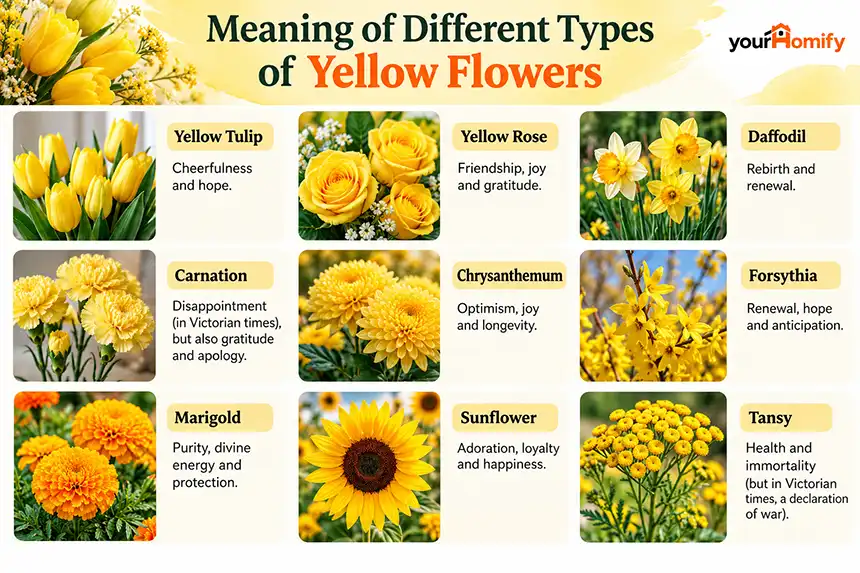
Different yellow flowers have different meanings, as tulips stand for cheerfulness, roses stand for friendship, daffodils for rebirth, carnations for disappointment, chrysanthemums for optimism, forsythia for renewal, marigold for divinity, sunflower for adoration, and tansy for war declaration.
I have discussed what does the color yellow mean for different flowers.
Yellow Tulip: Yellow tulip plants are connected with cheerfulness and hope. In the Victorian cultures, yellow tulips mean that there is sunshine in your smile to someone.
Yellow Roses: Yellow roses’ meaning is totally different from other roses; they are gifted to express friendship, joy, and a form of gratitude. This flower can be the best gift for your friends to make them feel special on Galentine’s Day.
Daffodil: Daffodil connects with rebirth and renewal, and it is also used for decorations in Easter arrangements. These are also March birth flowers, so you can gift them to your loved ones on your birthday.
Carnation: This flower is connected with disdain, disappointment, and rejection particularly as per the victorian symbolism. But this flower is gifted on mothers day for showcasing gratitude and people also gift it to their partner for apologising.
Chrysanthemum: Yellow chrysanthemums are used to signify optimism, joy, and longevity. Their full, layered blooms create a sense of abundance; that’s why this plant is considered an excellent choice for joyful arrangements.
Forsythia: Forsythia flowers are usually connected with renewal, hope, and anticipation. You can use them in easter decorations; the beautiful, dramatic flowers will become the focal point there.
Recommended Product
View all products
Forsythia is a deciduous flowering shrub that belongs to the olive family and is widely acknowledged for its low-maintenance qualities. This is a fast-growing genus known for its bright golden-yellow, bell-shaped blooms; hence, it is also called Golden Bells in some regions. Additionally, this spring-blooming Forsythia plant is native to China, Japan, and parts of Europe, and once established, it requires minimal care. Moving further, let us explore some astonishing features and benefits of this botanical marvel. Features and Benefits of Forsythia The Forsythia Linwood Gold is an ornamental bush. It is typically planted in large landscapes because of its fountain-like shape. Moving forward, let us briefly examine some key features and benefits of the genus. Forsythia sapling is especially popular among plant lovers and garden enthusiasts for its bright yellow, showy flowers. One of the major astonishing features of the plant is that its flowers grow even before the leaves emerge. The early blooms of the Forsythia shrub act as a major source of nectar and attract various pollinators like bees, butterflies, and hummingbirds. Apart from being a versatile shrub, the fruits of the Lynwood Gold Forsythia were used to make traditional Chinese medicine. The genus is best planted during late fall or early spring when other flowers are still dormant. If you are planning to add a hardy shrub to your garden space, then there is nothing better than this Golden Bell bush. Scientific Classification of Forsythia Lynwood Gold To understand more about the Lynwood Gold Forsythia, it is ideal to explore its botanical background and understand its taxonomy. Without any further delay, let's quickly walk through the scientific classification of the Forsythia shrub for sale. Scientific Classification of Forsythia Kingdom Plantae Clade Tracheophytes Clade Angiosperms Clade Eudicots Clade Asterids Order Lamiales Family Oleaceae Genus/Botanical Name Forsythia spp. This deciduous flowering shrub is a member of the Olive family and is truly a treat to the eyes. It lasts for only 40 years and is considered an amazing backdrop tree for large landscapes. Ideal Growing Conditions Needed for the Forsythia Plant If you are planning to add a vibrant golden yellow bush to your front lawn, it is ideal to understand the optimal growing conditions it requires to flourish. Optimal Growing Conditions Required Hardiness Zone 5-8 USDA Sunlight Exposure Requires a minimum of 6–8 hours of direct sun exposure. Water Needs Moderate watering is needed during the initial growing stage. Once established, it becomes drought-tolerant. Soil Type Prefers growing in loose, well-draining soil. It can also thrive in acidic or alkaline soil. Fertilizer No fertilization is required during the initial growing years. Add mulch around the roots to retain moisture. Though the Forsythia Lynwood gold can tolerate a variety of temperatures, it grows best in humid regions. Additionally, it can tolerate cold weather, but during frost conditions, it may not produce flowers. If you wish to grow this genus in a structured shape, pruning is the best option. Consider trimming once they are fully grown during spring. User Reviews and Ratings Alaya Jennifer: I spotted these beautiful, blooming golden yellow flowers and simply couldn't take my eyes off them. Rating: ⭐⭐⭐⭐⭐ Michael Burkz: Found these Forsythia bushes for sale last year and added them to my backyard. They have instantly enhanced the vibrancy of my garden space. Rating: ⭐⭐⭐⭐⭐ Jimmy Henforth: Our neighbors added this fountain-like shrub to their garden. The shape of the genus is its eye-catching element. Rating: ⭐⭐⭐⭐⭐ Isra Jeffery: Simply love how these stunning Forsythia bushes are easy to care for and can be pruned into any shape of your choice. Rating: ⭐⭐⭐⭐⭐ Frequently Asked Questions What is Forsythia used for? The sapling is mainly used for ornamental purposes, but its flowers are typically utilized for various medicinal properties. What is the common name for Forsythia? The Forsythia plant is commonly called the golden bell or border forsythia in its native regions. Does Forsythia smell good? The flowers of the genus are said to have a subtle and fresh fragrance, while many believe that the smell is more plastic-like and find it unpleasant. When can I buy Forsythia? Though you can buy the species year-round from any local nursery, it is ideal to purchase it during the dormant season (Nov to Feb) for best growth. What does Forsythia attract? The Forsythia shrub is a pollinator-friendly genus and attracts all kinds of pollinators, like bees, butterflies, and hummingbirds. How fast does Forsythia grow? Being a fast-growing shrub, under ideal growing conditions, it grows about 2 feet (0.61 m) per year.
- Common Name: Forsythia, golden bells
- Botanical Name: Forsythia spp.
Recommended Product
View all products
The cheerful golden blooms of ‘Zagreb’ tickseed (Coreopsis verticillata) will not only brighten your day, but your garden as well. It's the plant that keeps on giving, with five months of continuous blooms. The bright yellow flowers hover above delicate, fern-like foliage. Butterflies find this plant irresistible, as we're sure you will too! Coreopsis may look dainty, but we promise you, this compact cultivar can handle almost anything. It's a drought-tolerant ground cover that will quickly transform trouble spots in your garden. It's tolerant of heat, cold, humidity and is resistant to deer and common diseases. Try planting it in a container or as a border, and it won't disappoint!
Marigold: These flowers have been a part of celebrations and rituals across cultures. The flower has been used in India as a symbol of purity and divine energy; it is used to ward off dark energy. In Mexico, this flower is used in creating a pathway as a form of connection between the living and the dead.
Sunflower: Sunflowers symbolise adoration, loyalty and happiness. Their bold appearance and cheerful disposition make them a popular choice for bouquets and table arrangements.
Tansy: As per the flower dictionary of the Victorian era, yellow tansy flowers were associated with a declaration of war. However, this flower is connected to health, immortality, and loyalty, but in the Victorian era, this was considered a declaration of hostility.
Did You Know?
The Young sunflowers move in the direction of the sun throughout the day, but as they mature, the heads get settled towards the east side. As per studies, it is found that east-facing sunflowers warm up faster in the morning and attract more bees, which can improve their reproductive success.
Yellow Flowers Meaning Across Different Cultures
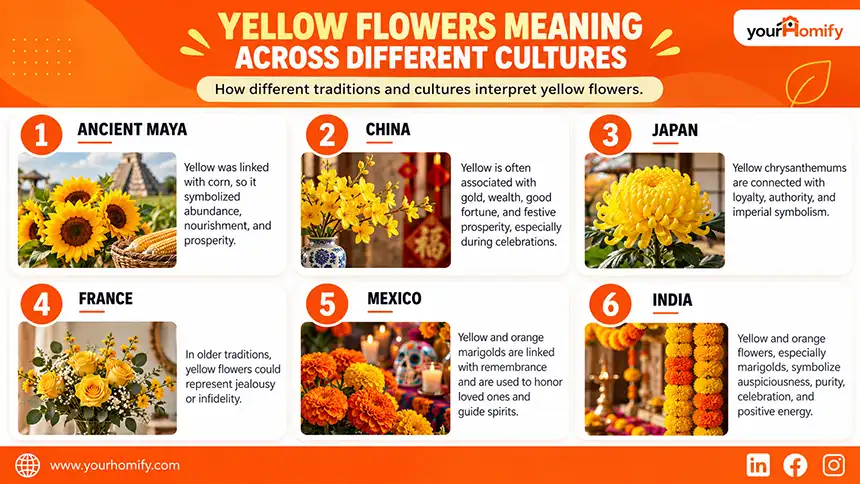
In old times, people used flowers to convey messages; yellow flowers are used as a form of rejection and, in some cultures, as a symbol of sacredness. This tradition is called the language of flowers.
Let’s take a look at the different significance of yellow flowers.
Ancient Maya: The yellow color is associated with corn, and it is an important crop, which makes yellow a symbol of abundance and prosperity.
China: In China, yellow color is mostly connected with gold, and both the colors are usually associated with wealth, good fortune, and prosperity. They are mostly used during celebrations like the New Year.
Japan: In Japan, yellow chrysanthemums are connected with royal family, loyalty and authority. This flower has been a part of royal ceremonies decorations.
France: Yellow flowers are connected to negative thoughts in the france culture, people connect it with jealousy and sometimes even with infidelity.
Mexico: In Mexican culture, yellow and orange marigold flowers are used in funerals to honor the loved ones. They create a way with these flowers that signifies a path that leads to the afterlife. Yellow flowers are also connected with remembrance.
India: Yellow and orange flowers specially marigold flowers are commonly used in religious ceremonies, festivals and weddings. In Indian culture the flower is connected with auspiciousness, purity and positive energy.
Why Do People Give Yellow Flowers on September 21?
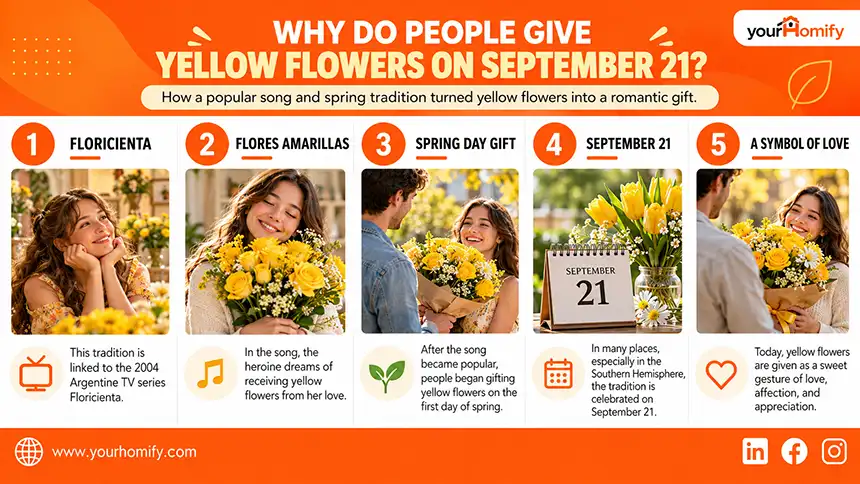
This trend of gifting yellow flowers on 21st September started from a TikTok trend after a song from the Argentina TV series went viral. A TV series named Floricienta was broadcast in 2004, in which the female lead, who is a young orphan woman, dreams of getting yellow flowers from his lover through a song named Flores Amarillas, which means yellow flowers.
After the song went viral, people started gifting the flowers to their loved ones on the first day of the spring season, that is, 21 September or 21 March, based on your locality.
When Should You Give Someone Yellow Flowers?
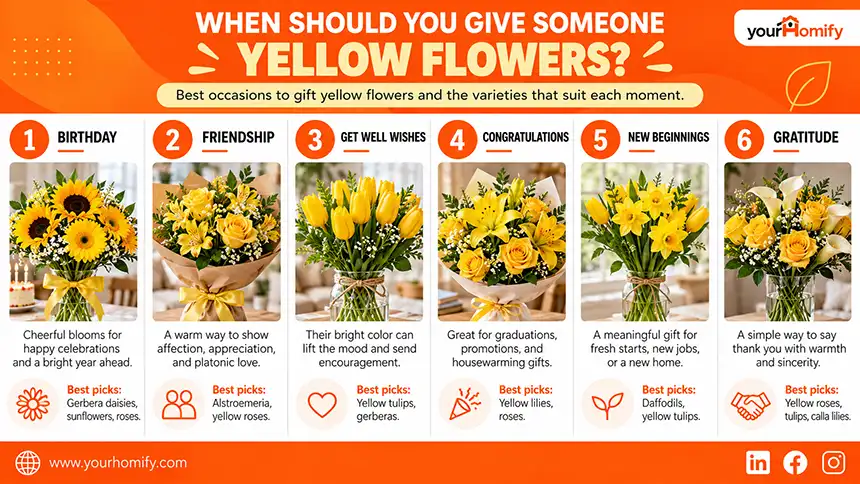
Yellow flowers can be gifted to someone on their birthday, to express friendship and affection, for get-well wishes, for congratulations, for new beginnings, and lastly for showing gratitude to someone.
Let’s take a look at the occasion and which variety will suit the occasion.
Birthday: Birthday is about celebrating happiness and the yellow color matches the occasion perfectly. You can gift flowers like yellow gerbera daisies, sunflowers, or roses to your friends, family members or colleagues. Their cheerful appearance of the flower will be perfect for wishing someone a happy year ahead.
Friendship Celebrations: Yellow flowers are the most popular choice for showing affection, warmth and appreciation to the friends. Go for yellow alstroemeria, that flower is associated with friendship and devotion from a long time, roses can be the best choice for celebration of friendship.
Get Well Wishes: this can also be the best choice for wishing someone strength in difficult times through gestures. Sending yellow tulip flowers or garbera flowers can be the best choice, as it represents hope, happiness and encouragement. Their cheerful appearance will add brightness to someone’s surroundings.
Congratulations: This can be the best option for gifting someone at a graduation, at their new home, or on promotions as a form of congratulation to someone. You can give yellow lilies to express joy and appreciation, both of which make beautiful congratulatory bouquets.
New Beginning: Gifting this flower to someone who is settling into a new city or has started a new job or a new phase of life. Yellow daffodils can be a meaningful gift for someone going for a renewal or starting a fresh beginning, you can also gift yellow tulips for cheerful thought and hope for the future.
Gratitude: These flowers can be enough to say thank you. Yellow roses, tulips and calla lilies can be the best choice to express gratitude. You can give them to your teacher, colleague, mentor, friend or to anyone who has made a difference in your life.
Personal Tip
Remember while gifting flowers, that if you’re making a mixed bouquet with yellow daffodils, keep them in a separate vase first. As the freshly cut daffodils release a sap that can affect the vase life of other flowers. Just leave them in water overnight and then transfer it with another plant and please don’t cut the stem when they are with other flowers.
How to Choose the Right Yellow Flowers for Someone?
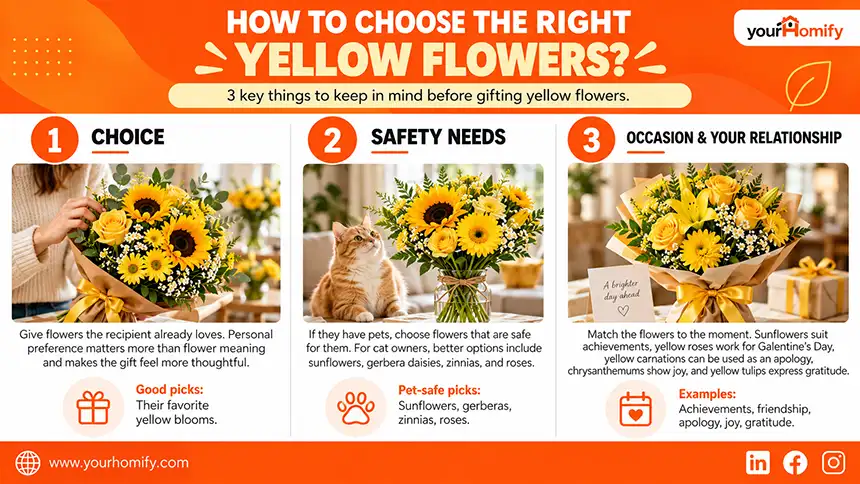
To select the best flower for gifting, you should keep three points in mind: first, their choices; second the safety needs; and third, which is the most crucial, the occasion.
Let’s take a look at these points in detail.
Choice: It would be better if you give flowers the recipient loves; in this case, you can avoid the meaning of the plant. This will make them feel more special.
Safety Needs: If the recipient owns pets, you should check that the plants are not dangerous for the pets before gifting them. If they own a cat, you should go for cat-safe flowers like sunflowers, gerbera daisies, zinnias, or roses.
Occasion and Your Relationship: Now this is the main part; on which occasion are you gifting the flowers? For new achievements, go for sunflowers; for Galentine’s Day, go for yellow roses; you can also give yellow carnations to your partner as an apology; to showcase joy, choose chrysanthemums, or for showing gratitude, choose yellow tulips.
Conclusion
Yellow flowers are more than just bright and cheerful blooms; their meaning ranges from friendship, happiness, and gratitude to remembrance and love. The meaning keeps changing based on the flowers and the cultural significance. Whether you choose yellow roses to appreciate friendship, sunflowers to appreciate achievement, or daffodils to wish a fresh start. Understanding the gesture makes the event more thoughtful. Selecting the best yellow flower that suits the occasion and expresses the feeling. Wanna learn about other color flowers and their meanings? Make a comment, and we will bring it for you.
FAQs
Why are people giving out yellow flowers?
People started gifting yellow flowers after a social media trend that came from the song Flores Amarillas. In which the young orphan woman gets flowers as a symbol of love. After that, people started gifting yellow flowers to their lovers in the spring season.
What does giving a girl yellow flowers mean?
Usually, the yellow-colored flower symbolises joy, happiness, and friendship, but the flower’s meaning changes as per location, cultures, and now, with social media trends like in Argentina, receiving yellow flowers is considered a symbol of love due to a famous TV series song.
When to give someone yellow flowers?
You can gift this flower on a birthday, graduation, or a new beginning. If you are thinking of giving it to someone you love romantically, then you should give it on 21 March or 21 September.
What do yellow flowers mean at a funeral?
You can take yellow flowers to a funeral as a symbol of friendship and a platonic relationship. This will also mean remembrance, joy, hope, and a sign of a life lived well.
What yellow flowers have negative meanings?
In some cultures, yellow flowers are symbolised as rejection. In the Victorian era, some people used them as a symbol of jealousy, greed, and infidelity. However, the meaning keeps changing from time to time.