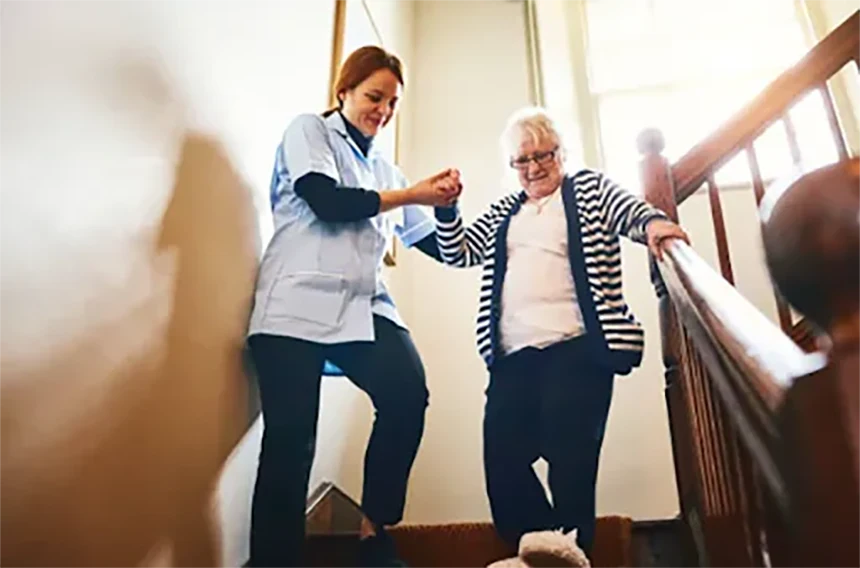
The railing on your staircase is on the wrong side, but you never seemed to notice until today, when someone had to help your dad up it.
Most people think care for the elderly in our home is usually all medical-related, but that’s far from reality in most cases.
In-home senior care is mostly about the house, which means being careful about the people living in it, so assume laundry, meals, and more as the primary form of care.
Here’s what the job actually involves, and what your house needs to do to make it work.
What the Work Actually Is
Most of what you assume the work to be is nowhere near what it actually is. Many people assume the work is going to the doctor’s, taking the medications, helping them transition after they come out of a big fancy surgery. But these are all fancy ways to put it. Once you strip away the brochure language, the real work left is mostly domestic.
For example, a caregiver’s day-to-day is built around actual day to day living activities like bathing the elderly, dressing, making sure you eat proper home cooked meals at the right temperature, moving them safely from one room to another and more.
These are not laborious tasks; in fact, most of these tasks are household chores in our day-to-day lives, like meal prepping, laundry, and getting the right medication for our family members.
Agencies publish their remit plainly enough. Companies that offer in-home senior care services in Bensalem list out exactly these chores, consisting of making meals, assisting with walking, medication reminders in a timely manner, and more as the standard.
The funny part is that none of this requires a real nursing license; essentially, all they do require is someone showing up every day.
The Distinction That Trips Up Most Families
Most families often lose both money and time here, because they confuse two things that sound the same but are completely different.
As similar as Home care and home health care might sound, they’re different services with completely different playbooks, and getting them mixed up is the most common way families lose money because they expect Medicare to pay for something it was never going to cover.
| Home Care | Home Health Care | |
|---|---|---|
| What it is | Non-medical help with daily living, also called personal or custodial care | Skilled clinical care for an illness or injury |
| Who delivers it | Trained caregivers and aides | Licensed clinicians such as nurses and therapists |
| Doctor’s order needed | No, families arrange it directly | Yes |
| Typical duration | Ongoing, often for years | Intermittent and goal-based, aimed at recovery |
| Who pays | Usually private pay; Medicaid in some states | Medicare Part A/B when conditions are met |
So, in brief, Medicare does not pay for non-medical support, which means that, apart from hospital admissions, medical equipment, and surgery, everything else falls outside its scope. Although Medicare can sometimes provide monetary assistance for non-medical home needs, it entirely depends on region to region and sometimes even on your situation.
A hospital stay comes with home health care for a few weeks because the daily support at home carries on for way longer than any hospital visit could account for.
Where the House Helps or Gets in the Way
Whether care works at home depends less on the carrier than people expect, and more on the building.
The Bathroom
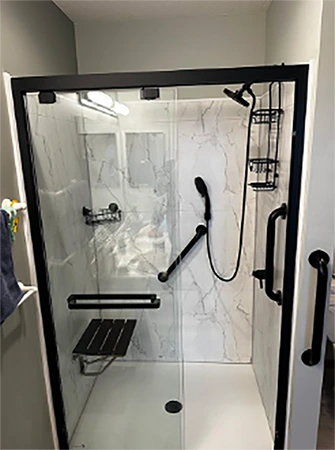
Bathrooms are the most injury-prone locations inside a home because wet tiles and tub walls being built high, with nothing solid and stable to hold, create exactly the settings for an environment where a transfer goes wrong.
In fact, the CDC actually calculated such instances of falls that occurred in people aged 65 and above. The number came out to be 14 million, and 37% of these actually resulted in an injury that had to be treated urgently.
So the best approach to avoid situations like these is to install grab bars into studs so that the elderly have something to hold when they are transferring. Having a low tub wall that can be passed without lifting your feet too high is also the most common and forgotten change that one can make to decrease the chances of injuries taking place.
Thresholds, Floors and Stairs
Every raised threshold should be carefully examined before making it accessible to the elderly. Loose rugs that slide on contact, the stair railing which has a short bottom step, and more are instances where balance can be easily lost and hence can result in injuries. These small things have to change to avoid such circumstances.
Light and Sightlines
As people get older, their ability to see things decreases because their eye sight getting weak.
That’s why one should always adjust the light settings of a house according to them, which typically means that hallways and stair routes should have considerably more amount of lighting than what is normally used in our homes. Also, a better approach to ensure the safety of the elderly is to install motion-activated sensor lights, which can help save both electricity and the elderly from falling.
The Kitchen
With growing age, even day-to-day functions of living can get difficult, like reaching overhead for crockery or bending low to pick up the pan.
To tackle this, you should arrange daily-use items like pots and pans at a height suitable for them to get it at so that there’s no difficulty for them.
Such small changes in their direct environment might not cost money, but they can be a useful replacement for them.
What Someone in the House Every Day Notices
Here is the part nobody puts in a brochure. The most valuable thing a caregiver does is notice things.
As reported by data from the CDC through The National Safety Council, older adults who fall in the bathroom on a certain day might not remember to mention it to their doctor the next day because they might not remember. But a caregiver who was there when the incident happened or saw the bruises the next day can clearly help get that information known to the doctor so that there’s no scope left for internal injuries, which might become a problem later.
Similarly, Healthline’s medically reviewed guidance states that most adults who spend a lot of time sleeping aren’t necessarily getting the highest quality of it. This drowsiness can come from a side effect of a new prescription they’ve been put on recently or anxiety and depression, which might be in their early stages right now.
All of these instances show that noticing a change in an adult’s patterns and the choices they choose to make is a signal. While sleeping through an entire afternoon can just be normal tiredness, it can equally be a side effect of a new prescription, and the only way to ever know which one is to report this to a doctor. And this can only be done when someone is noticing them.
The rule worth holding onto: report changes, don’t interpret them. Nobody should stop a medication because a caregiver noticed drowsiness. But nobody should sit in on the observation either.

Planning the House Before You Need It
Most people plan for this too late, usually in the fortnight after something goes wrong.
AARP’s 2024 Home and Community Preferences Survey found 75% of adults aged 50 and over want to stay in their current home as they age. Just over half said they would need a home that actually supports independent living to do it. Of those anticipating changes, 72% pointed to grab bars and 71% to entryway modifications.
The gap between those two numbers is the exact problem because choosing to stay in a home you’ve always stayed in and staying in that house comfortably is not the same. Even if most adults want to grow old in their own homes, the homes aren’t designed in a way to support them.
That’s why it’s important to make adjustments like moving their bedroom downstairs, replacing the tub with a lower-threshold shower, or even widening a doorway can make a huge difference in how comfortably they can live inside their own home.
All of these replacements and renovations cost both time and money, but the cheapest way to do this is while all of these replacements still feel like a choice you’re making for the safety of your loved ones. Because when they are done during a crisis, they take twice the amount of time and money and still don’t turn out well.
FAQs
Is in-home care available only for extremely sick adults?
That’s not necessarily true; any elderly person you feel requires a bit more attention than he’s been getting can get in-home care.
Will Medicare cover a caregiver at home?
For most non-medical purposes, Medicare doesn’t cover the expenses of a caregiver; however, it can definitely vary from region to region.
What single home change makes the biggest difference?
Bathroom safety, in most houses. Properly anchored grab bars, a seat in the shower, and a low or level threshold address the room where falls cluster.
- CDC — Older Adult Falls Data
- AARP — 2024 Home and Community Preferences Survey
- National Council on Aging — Seven Things You Should Know About Medicare’s Home Health Care Benefit
- National Safety Council — OldUnusualt Falls
- Healthline — unusual sleepiness