


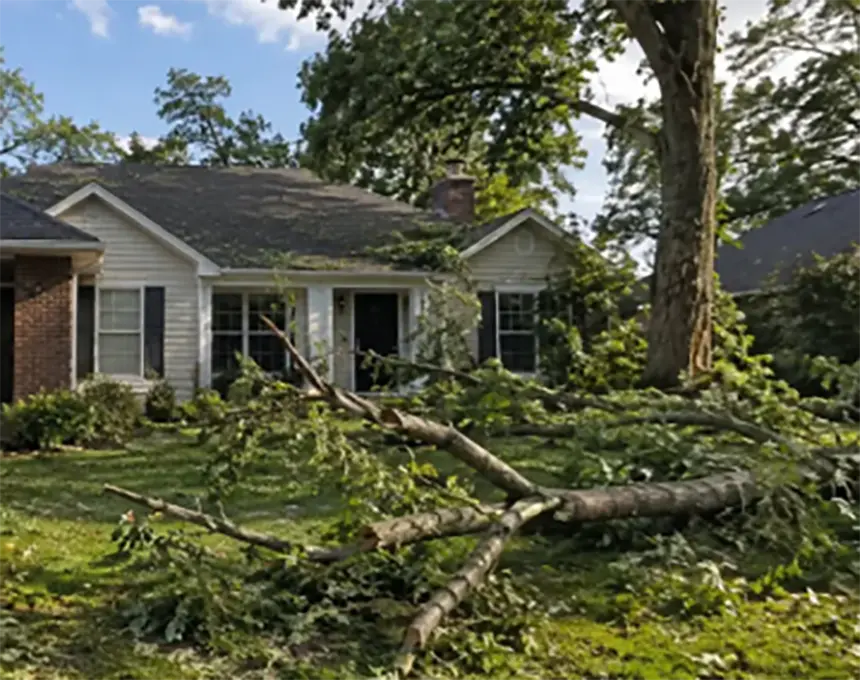
The morning after, the yard tells you there was a storm, and the roof does not. A branch is down. The bins have moved twenty feet.
Up top, the shingles look exactly as they did on Friday.
That is the normal outcome, and it is why storm damage gets missed. The evidence is there, just not on a surface you can see.
Here is where it actually sits, how to tell a real finding from a look-alike, and what to do in the week after.
Why the Damage That Matters Sits on the Side You Cannot See
When a hailstone hits an asphalt shingle, it causes functional damage to the shingle by destroying its structural integrity. The hailstone knocks the ceramic granules on the shingle loose. These granules are used to protect the shingle from harmful UV rays. Moreover, the hailstone also exposes the asphalt layer underneath the granules, and it fractures the organic mat, which makes up the backbone of the shingle.
Since the mat is a structural part of the shingle, fracturing it means that the shingle’s ability to shed water that falls on it vanishes. This is what roofing engineers mean by functional damage.
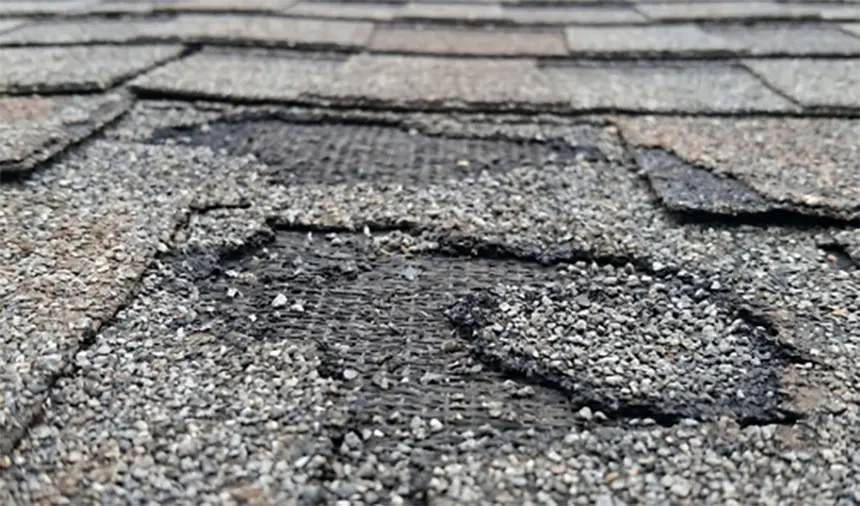
Here is the part that makes it latent. Writing in Interface, the roofing engineer Darrell Smith notes that a hail-impact fracture is usually observable on a shingle’s underside. The side lying against the roof deck. Nobody turns a shingle over on a walk-around, and the fracture does not leak while the granules above it still cover the asphalt.
So the roof works. It keeps working through fall. Then the exposed asphalt weathers, the fracture opens, and water finds it in a storm nobody connects to the one that caused it.
Functional damage, in the engineering sense, means the roof’s water-shedding or its expected service life has been reduced. A roof can lose years of service life to one hailstorm and pass a visual inspection the same afternoon. Guides to repairing roof damage on rental property put the inspection ahead of the estimate for that reason.
What Counts as Storm Damage, and What Only Looks Like It?
Most people assume storm damage to be completely different from what it is, and that’s the most expensive mistake that can be made. It is thus always advised to know what storm damage actually is so that one can replace it as soon as possible.
| What people report | What actually counts |
|---|---|
| Shingles that are no longer stuck down | Shingles that are creased, folded, torn, or gone |
| Scuffing and color variation across a slope | Bruises you can feel as soft spots under thumb pressure |
| Granules in the gutter after any rain | Granule loss clustered in impact marks, with asphalt showing |
| Damage spread evenly over every slope | Damage concentrated on the slopes the storm actually hit |
The one that is usually misunderstood by a lot of people is the first one. An unsealed shingle that shows no sign of creasing, folding, or tearing is not something that is caused by a particular storm event.
Forensic engineers and insurance adjusters state that shingles unseal for a lot of reasons, all of which cannot be tied back to storm or wind damage. Shingles usually stay sealed for roughly four or five years and unseal more often after that. Some other reasons that are attributed to unsealing of shingles can be cold-weather installation, contamination, and ordinary thermal movement.
When a wind catches an asphalt shingle, it lifts the shingle upwards and backwards if the wind is too powerful. This creates a crease in the shingle, which is still present even when the shingle lies back down flatly after the storm ends. Thus, to actually check for creasing or damage that may have been induced on the shingle, close inspection and tactile manipulation, like lifting it and physically touching it, is more beneficial than just photographing it from a far-off driveway.
Did you know?
Damage that shows up consistently across the majority of a roof’s slopes points away from hail, not toward it. Smith’s guidance treats that pattern as a sign of a manufacturing defect or ordinary deterioration instead. Storms come from a direction, and genuine hail damage is usually worst on the slopes that faced it.
So What Should an Owner Do in the First Week?
Doing the right thing is often what matters more for the longevity of your shingle rather than how fast you do it.
- Always make sure that you record everything in the form of photographs from the ground up to the roof. This way, you have a dated record of the condition you started from.
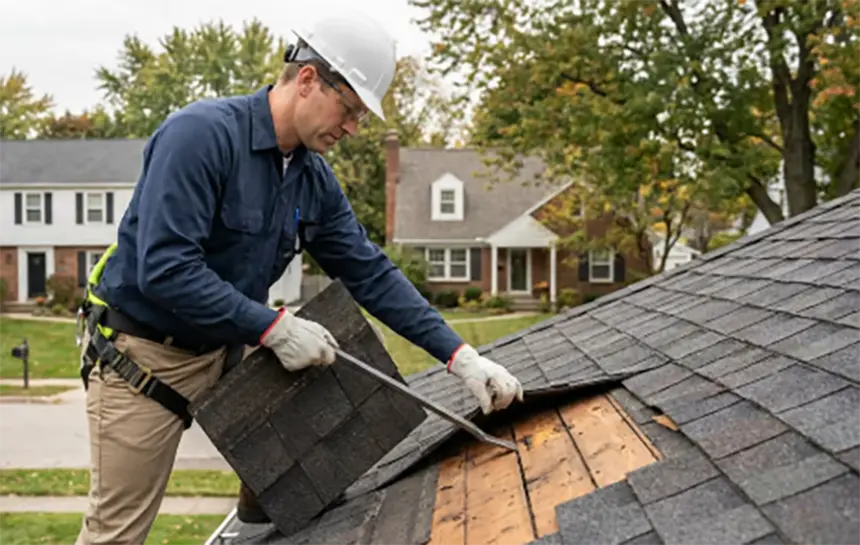
- Hire someone for the job who will actually lift the shingles to know where the creasing is instead of just looking at it and making an assumption.
- Ask for the findings by slope and by direction, not as one verdict for the whole roof.
- Keep the written report even if nothing is claimed, because it dates the condition for the next storm.
- Notify the insurer while the weather event is still documented, and before the granules start wearing off the fracture.
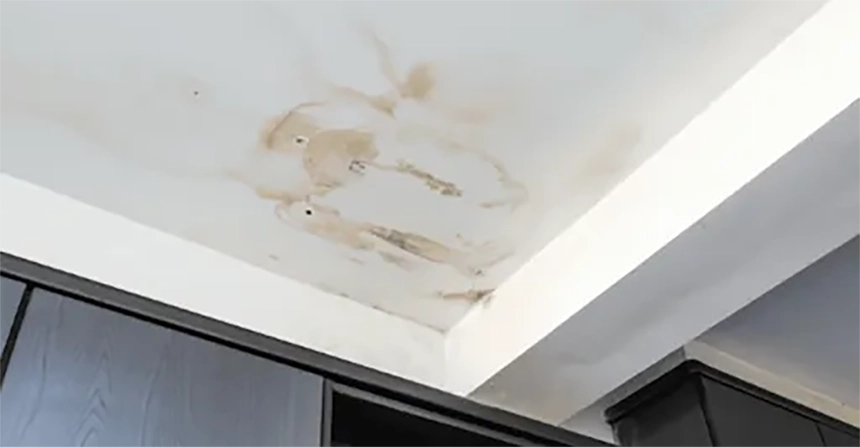
Owners who live elsewhere have the harder version, because the ceiling stain nobody reports for six weeks is the whole failure mode. Working with a Prince George’s County MD property manager puts somebody local in the loop who can get an inspector onto the roof in the days after a storm rather than after a tenant calls.
Skip the drone-only survey if it is offered as the whole inspection. It photographs the surface, which is the one part of this that reliably looks fine.
Summary: What the Roof Is Not Telling You
A roof that looks fine after a storm is telling you very little.
The damage that costs money is on the underside of a shingle, or in a crease you find by touch rather than by looking. Neither reaches you as a leak for months.
So treat the week after a storm as the inspection window. And if a report says every slope is equally damaged, read it twice. That pattern usually means age.
FAQs
How long after a storm can hidden roof damage stay hidden?
Months, sometimes past a full season. The fracture does not leak while the granules above it still cover the asphalt.
Does a shingle that has come unstuck mean wind damage?
Not by itself. Engineers assessing wind claims look for creases, folds, tears, or missing pieces, and an unsealed shingle with none of those is usually age or installation.
What does a hail bruise feel like?
A soft spot under thumb pressure, where the mat underneath has fractured. It photographs as nothing, which is why camera-only inspections miss them.
Is a drone inspection enough after a storm?
For a first look, yes. For a decision, no, because the evidence sits on the underside of the shingle and in how the surface feels.
Should I report damage if I am not going to claim?
Yes. A dated report costs nothing and establishes the roof’s condition, which matters when someone later asks which storm caused what.
- Asphalt Composition Shingle Damage, Hail or Manufacturing Defect? — Darrell L. Smith, Interface, IIBEC: https://iibec.org/publication-post/2013-02-smith/
- Misconceptions of Wind Damage to Asphalt Composition Shingles — Lopez, Goode and Morrison, IIBEC: https://iibec.org/misconceptions-wind-damage-asphalt-composition-shingles/




Why Regular Roof Inspections Matter for Your Home
[…] as strong proof for insurance coverage. Support from professional documents makes it easier to demonstrate that damage was a result of natural processes. Doing this ensures easy claims without […]