Eva Romano is a floral content reviewer at YourHomify. She researches flowering plants, species, symbolism and care to ensure every article is accurate, well-structured, and easy to understand.
Certification:Diploma in Floristry
Areas of Expertise
Flower Writing
Editing Content
Floral Symbolism
Sustainable Flower Care
Ask Eva
Daffodils and jonquils are very popular spring-blooming flowers that are known for the cheerful colors and the large, trumpet-shaped blooms. Although they belong to the same genus called Narcissus, which is native to Mediterranean regions, both flowers have different growing requirements, bloom size, leaf shape, and flower size.
In this, I will explain the difference between jonquil vs daffodil, their similarities, and lastly, the right flower for your garden.
Quick Answer
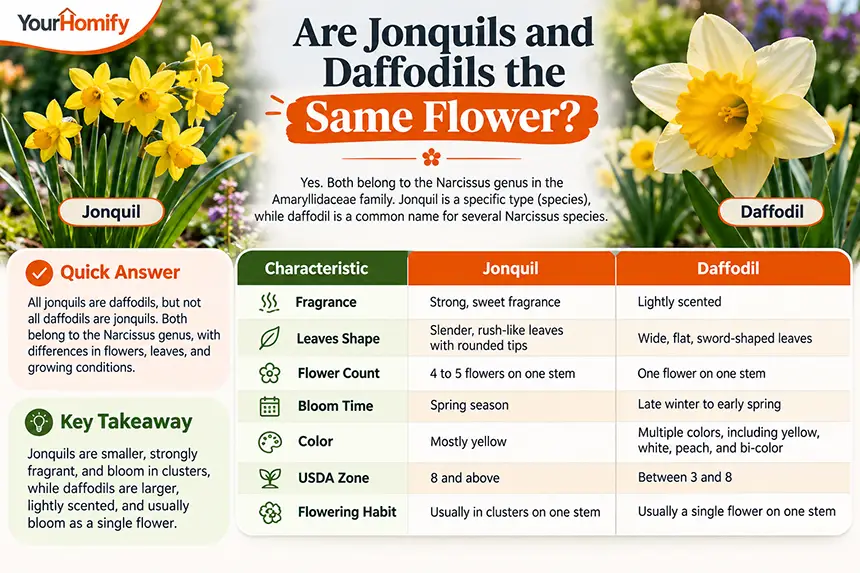
All jonquils are daffodils, whereas not all daffodils are jonquils. Both of these plants belong to the Narcissus genus. These flowers have different flowers, leaves, and climate preferences. Daffodils produce lightly scented flowers, whereas jonquils produce strongly fragrant flowers
Are Jonquils and Daffodils the Same Flower?
Yes, jonquil vs daffodil vs narcissus all belong to the same family named Amaryllidaceae; narcissus is the genus, and jonquil is the species. Daffodil is a common name for different species of the Narcissus genus.
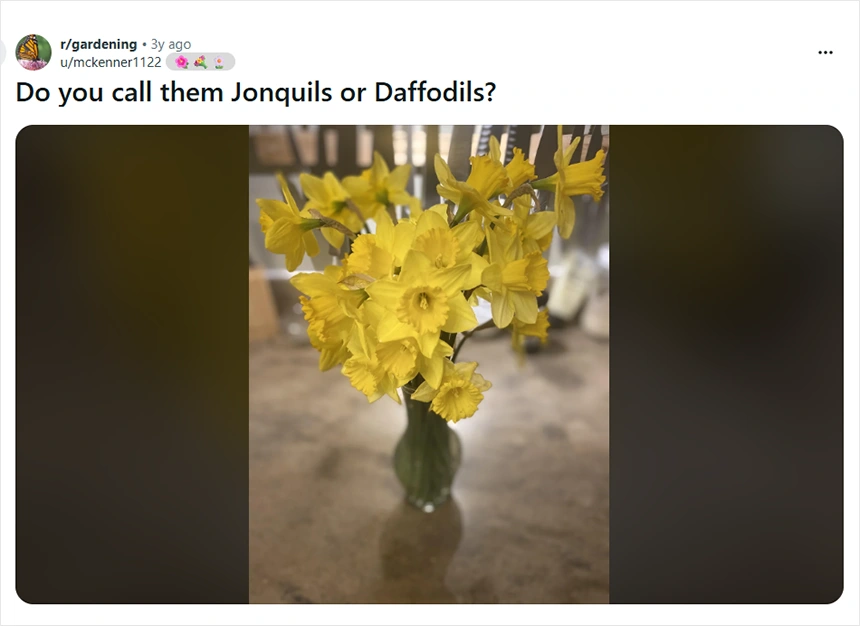
Jonquils and Daffodils share a similar appearance; they only have subtle differences that make identification tricky. Sometimes even garden enthusiasts get confused, as seen in one of the Reddit discussions, where people were confused about what to call this yellow bloom.
Question Related to Jonquil vs Daffodil.
Jonquils and daffodils belong to the same genus, Narcissus, but they do not belong to the same group. Daffodils are widely used for the entire genus, whereas jonquil is specifically used for narcissus jonquills, which is a garden hybrid. Jonquil flowers are known for the slender, rush-like leaves and the small yellow flowers that have a strong fragrance, whereas daffodils are known for the large flowers in trumpet shapes, broader leaves, and different-colored blooms.
Let’s take a look at different parameters of difference between jonquil vs daffodil.
Characteristic
Jonquil
Daffodils
Fragrance
Strong sweet fragrance
Light scented
Leaves Shape
Slender-shaped leaves with rounded tips.
Wide and flat, sword-shaped flower.
Flower count
4 to 5 flowers on one stem.
One flower on one stem.
Bloom time
Spring season
Late winter to early spring season.
Color
Yellow flowers
In multiple colors, including yellow, white, peach, and bi-color.
USDA zone
8 and above
Between 3 and 8
Flower Count
Usually have flower clusters on one stem.
Usually have one flower on one stem.
What are the Key Differences Between Jonquil vs Daffodil?
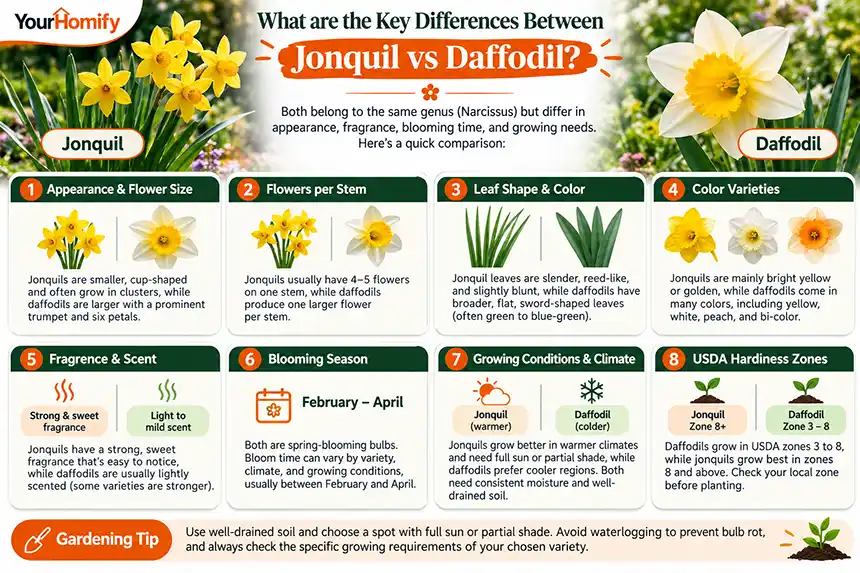
Jonquil and daffodil flowers belong to the same genus, but they are different in appearance, fragrance, and growing habits. Understanding the structure of these flowers will help with identification and choosing the right variety.
Take a look at the comparison between daffodil vs. jonquil, keeping different parameters in mind.
1. Appearance and Flower Size
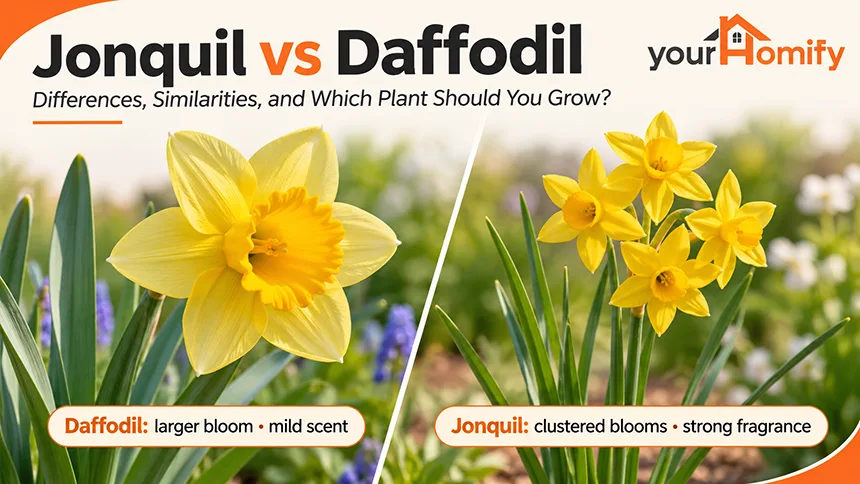
Daffodil flowers are large in size, with a central trumpet that is surrounded by 6 petals, whereas jonquils are smaller, cup-shaped, fragrant flowers that most often grow in clusters. Creating a fuller appearance in each stem.
Jonquils are the best choice for someone who likes smaller blooms if you like larger blooms than you should go for daffodils.
2. Flowers per Stem
This differs between the two flowers. Jonquils produce cup-shaped flowers, and on one stem you will get to see a cluster of 4 to 5 flowers, whereas daffodils produce 1 flower per stem; the blooms are trumpet-shaped and are larger in size.
3. Leaf Shape and Color
Jonquil leaves have a slender shape and produce reed-like leaves that have a slightly blunt tip; the foliage of this flower is thin like grass, whereas daffodils have flat, broader, and strappy leaves that have wide green to blue-green foliage, depending on the variety.
4. Color Varieties
These flowers are mostly available in yellow; some varieties also produce white, orange, and pink colors. Jonquils produce bright or deep yellow or golden-colored blooms that bring brightness to the garden in the spring season. However, daffodils produce different-colored flowers that have different combinations, depending on the cultivar.
5. Fragrance and Scent
Jonquil produces a sweet and strong scent at a high frequency. The fragrance can easily be noticed when there are several blooms. It will smell great near walkways or seating areas.
Daffodil flowers usually have a milder fragrance. Some of the varieties have a strong perfume smell. But if you like fragrance, then jonquil is the best choice.
6. Blooming Season
Jonquil and daffodil are both bulbous perennial plants that bloom in the spring season; the bloom time can change based on the varieties, climate, temperature, and sunlight. Usually, the plants bloom between February and April.
7. Growing Conditions and Climate
Jonquil flowers grow better in warmer climates while daffodils prefer colder climates. Jonquil needs full sunlight and partial shade for growing; this plant belongs to the Mediterranean region, specifically from Spain; however, daffodils like cold and are native to the European region.
Both the plants need sufficient moisture to grow rapidly, but avoid waterlogging.
Gardening tip
Use well-drained soil for planting and select a spot that gets full sun or partial shade. Ensure well-drained soil to avoid bulbs rotting, and always check the varieties’ growing requirements before planting.
8. USDA Hardiness Zones
Both of these flowers have different hardiness zones; daffodils bloom in USDA zones 3 to 8, but jonquils grow in hardiness zones above 8. These hardiness zones can differ based on the species and the cultivars. You should check the hardiness zone before planting it and ensure that it suits the local climate.
What are the Similarities Between Jonquil and Daffodil?
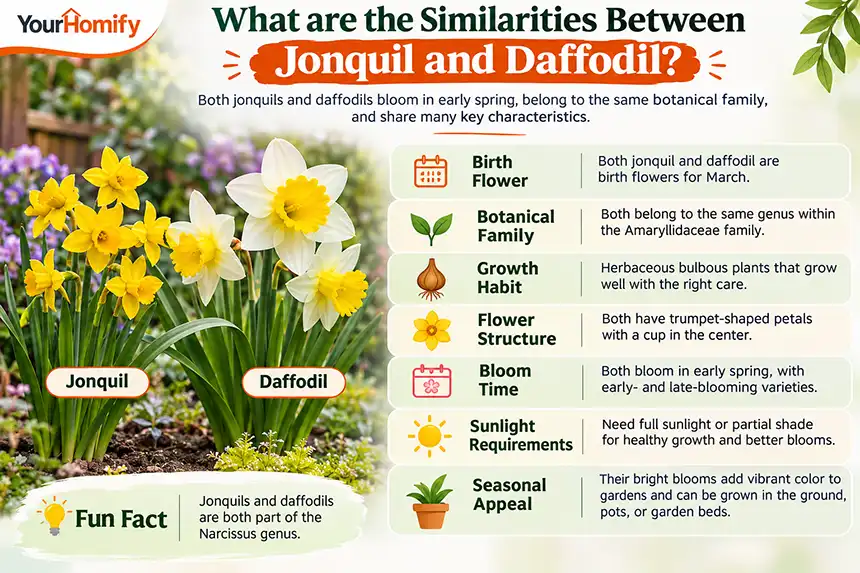
Jonquil flowers vs daffodil flowers bloom in early spring and belong to the same botanical family; both the flowers produce trumpet-shaped flowers and need full sunlight for proper growth.
There are so many differences between jonquils and daffodils, but it also has multiple similarities because they belong to the same genus.
Let’s take a look at the main similarities of these flowers.
Birth Flower: Jonquill and daffodil are both birth flowers for March.
Botanical family: Both these plants belong to the same genus within the Amaryllidaceae family.
Growth habit: These are herbaceous bulbous plants that will grow rapidly if provided suitable growing conditions.
Flower structure: The flowers have trumpet-shaped petals with a cup in the center.
Bloom time: Both of these flowers bloom in the early spring season; however, there are early- and late-blooming varieties.
Sunlight requirements: This plant needs full sunlight or partial shade for proper growth.
Seasonal appeal: These bright-colored flowers help in bringing color to the garden. These blooms can be planted in the ground, pots or in garden beds.
Fun fact
Some of the daffodil varieties have small cups that have split coronas, or double flowers with extra petals like segments.
Jonquil vs Daffodil: Which Flower Should You Grow?
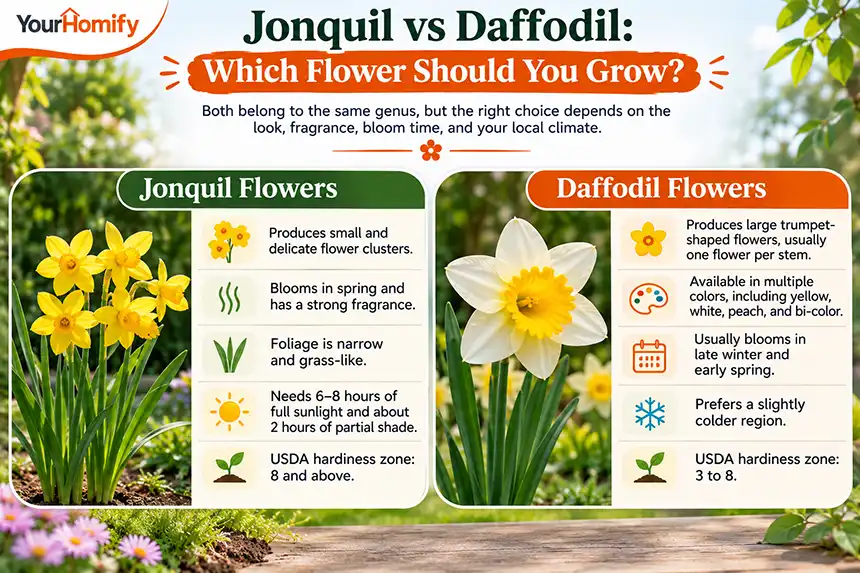
Choosing between jonquils vs daffodil depends on which kind of flowers you prefer; jonquil blooms are small in size and cluster, whereas the daffodil blooms as a single flower, so you have to choose based on the appearance, fragrance, and the climate requirements of the plant.
Here are some points based on which you can make a choice.
Jonquil flowers:
They produce small and delicate flower clusters.
They usually bloom in the spring season and have a strong fragrance.
The foliage is narrow and grass-like.
The plant needs 6 to 8 hours of full sunlight and 2 hours of partial shade, and the USDA zone should be 8 or above.
Daffodil flowers:
It produces large trumpet-shaped flowers, one flower per stem, that are usually yellow, but there are different colors in different varieties.
They usually bloom in late winter and early spring.
This variety prefers a slightly colder region.
These blooms grow in hardiness zones 3 to 8.
Important to Know
Both jonquil and daffodil contain toxic components, particularly in the bulbs. Please keep them away from pets and babies. Don’t keep daffodils in mixed flower arrangements because the stems release sap that can affect other flowers.
Conclusion
Jonquils vs. daffodils: both flowers belong to the same genus; they have lots of differences, like leaf size, fragrance, bloom time, appearance, and growing requirements. But they also have many similarities, such as flower shape, color, bloom time, flower structure, and botanical family. By understanding these differences, you can select suitable flowers for your garden and enjoy spring blooms. If you have any confusion or something that I have missed, drop a comment, and we will definitely help you out.
Frequently Asked Questions
Are jonquils and daffodils the same?
No, they are not the same. All jonquils are daffodils, but not all daffodils are jonquils. Jonquils and daffodils are both spring-blooming yellow flowers that are bulbs that belong to the Narcissus genus. Daffodil is the broad family name for the entire group.
How can you tell a jonquil from a daffodil?
Jonquils are different in appearance from daffodils; you should check the leaves and flowers, clusters, scent, and bloom color. Both of these belong to the Narcissus genus. Jonquil produces multiple flowers in one stem, whereas a daffodil produces a single flower on one stem.
Do jonquils smell stronger than daffodils?
Yes, they have a stronger smell compared to daffodils. They produce a rich and sweet smell that has a perfumed aroma. Daffodils produce a light fragrance and are barely scented.
Are all jonquils yellow?
No, not all jonquils are yellow in color; some classic flowers are yellow, but some are traditional bright golden yellow blooms. Some of the varieties also appear in white, ivory, cream, and bicolored combinations.
Do jonquils bloom before daffodils?
Yes, jonquils bloom in the earliest spring season. That is generally before the standard season for daffodils. This often starts in late winter and early spring.