


The flowers that start with S are a gardener’s delight because they offer versatility and variety, which makes a garden look more lively and unique with minimal effort — and the flowers that start with T bring just as much variety to explore next.
Whether it is the charm of sunflowers or the uniqueness of spider lilies, these flowers offer everything needed to elevate the garden space. Hence, if you are looking for new blooms to grace your garden, come along and explore the 15 flowers that start with S with their distinctive features.
List of Flowers That Start With S
The flowers that start with S include sedum, scabiosa, sunflower, silver bell, sun star, Siberian iris, spider flower, and many more, which can be planted as both indoor and outdoor plants.
Here is the list of 15 flowers that start with the letter S:
- Sedum
- Scabiosa
- Sunflower
- Silver Bell
- Sun Star
- Siberian Iris
- Snow-in-summer
- Sweet William
- Spider flower
- Spring Vetch
- Shrub Rose
- Stokes’ Aster
- Spider Lily (Red)
- Sweet-scented bedstraw
- Solitary Clematis
15 Popular Flowers That Start With S
If you are an anthophile, these flowers that start with S will surprise you with their versatility and uniqueness.
Sedum

- Botanical name: Sedum spp.
- Native: Northern Hemisphere
- Hardiness: USDA zones 3-10
- Height: Up to 2 feet
- Colors: White, yellow, and pink
- Plant type: Perennial succulent
- Bloom season: Late summer to fall
- Soil Type: Well-drained loamy or sandy
- Maintenance: Low-maintenance
The sedum plant is a succulent indoor and outdoor plant that has a mat-forming growing habit. Interestingly, the meaning of this plant is associated with the idea of resilience and affection.
Quite low-maintenance, this succulent is best grown in full, direct sunlight. According to the NCBI, the sedum flower has anti-inflammatory properties.
Did you know?
Sedum is the largest genus of succulent plants, which contains over 600 species of plants.
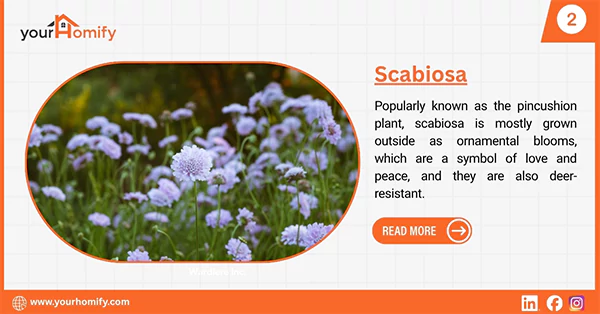
- Botanical name: Scabiosa
- Native: Europe, Asia, and Africa
- Hardiness: USDA zones 3-7
- Height: 1-2 feet
- Colors: Lavender, blue, violet, pink, and white
- Plant type: Herbaceous annual (can be a perennial too)
- Bloom season: Spring to frost
- Soil Type: Nutrient-rich, neutral to alkaline soil.
- Maintenance: Moderate to low
Scabiosa is a herbaceous annual flower that is mainly grown outside as a garden border. Best grown in full sunlight and with regular watering, the pincushion flower symbolizes the idea of pure love and peace.
Interestingly, scabiosa is a deer-resistant flower, which makes outdoor planting worry-free.
Sunflower
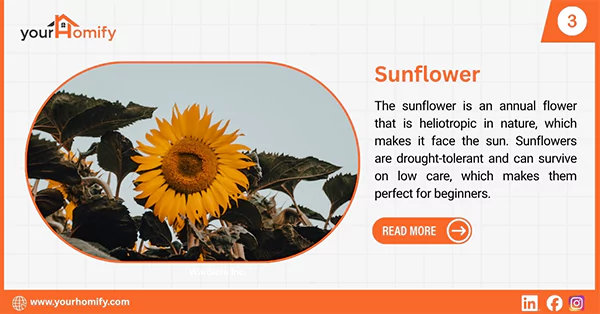
- Botanical name: Helianthus annuus
- Native: North America
- Hardiness: USDA zones 2-11
- Height: 3-10 feet
- Colour: Yellow
- Plant type: Herbaceous annual
- Bloom season: Summer
- Soil Type: Compost-rich, neutral to alkaline (6.0-7.0)
- Maintenance: Moderate to low
Sunflowers are popular ornamental blooms used as cut flowers that thrive in full sun and are drought-tolerant once established. This sunflower’s meaning is associated with loyalty, positivity, and devotion.
Additionally, the sunflower is a heliotrope; that means it turns its face towards the sun and tracks its movement, which gives justice to its name.
Did you know?
Sunflowers are the national flower of Ukraine.
Silver Bell
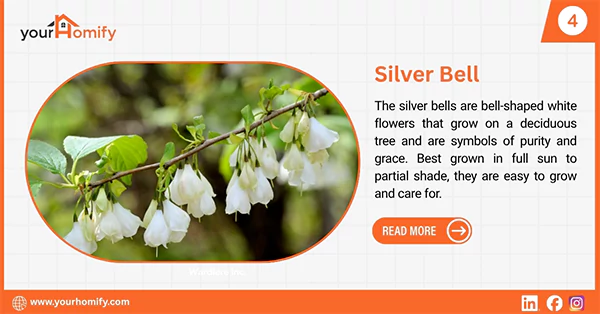
- Botanical name: Halesia carolina
- Native: Southeastern America
- Hardiness: USDA zones 5-8
- Height: Up to 30 feet
- Color: White
- Plant type: Deciduous tree
- Bloom season: Spring
- Soil Type: Well-draining acidic sandy-loam soil
- Maintenance: Moderate
Also known as the chocolate vine, the silver bell is a flowering vine that is grown in full sun to partial shade. With gorgeous white flowers shaped in the form of bells, these flowers represent purity and grace.
Although quite low-maintenance, propagating the silver bell tree can be a hassle, and therefore, my advice would be to use root cuttings and dip them in rooting hormone to accelerate growth.
Sun Star

- Botanical name: Ornithogalum dubium
- Native: South Africa
- Hardiness: USDA zones 5-10
- Height: Less than 1 foot
- Color: Orange, red, and yellow
- Plant type: Herbaceous perennial
- Bloom season: Late spring to early summer
- Soil Type: Well-draining, sandy loam soil
- Maintenance: Low
The sunstar flowers grow best in full sun and are popular as ornamental blooms, perfect to add that pop of color to your garden. Associated with the idea of joy and happiness, these perennial blooms are rewarded for their resilient nature and ability to endure poor conditions as well.
Siberian Iris
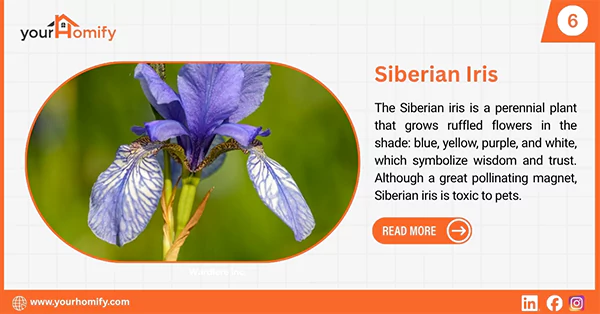
- Botanical name: Iris sibirica
- Native: Europe to Central Asia
- Hardiness: USDA zones 3-8
- Height: 2-3 feet
- Color: Blue, yellow, purple, white, and violet
- Plant type: Rhizomatous
- Bloom season: Late spring to early summer
- Soil Type: Well-draining, slightly acidic soil
- Maintenance: Low
Siberian irises have unique ruffled flowers that symbolize wisdom and trust. Grown best in full sun to partial shade, this herbaceous plant is a pollinating magnet that can be planted in cottage gardens.
According to ASPCA, the iris flower is toxic to animals and therefore should be kept away from pets.
Snow-in-summer

- Botanical name: Cerastium tomentosum
- Native: Europe
- Hardiness: USDA zones 3-8
- Height: Less than 1 foot
- Color: White
- Plant type: Perennial
- Bloom season: Late spring to early summer
- Soil Type: Well-drained rocky soil
- Maintenance: Moderate to low
Also known as the Jerusalem star, the snow-in-summer flower needs direct sunlight to grow its star-shaped white flowers, which symbolize purity and innocence. These drought-tolerant flowers have a vigorous growth habit and can self-seed if not maintained properly.
Best grown in a rock garden, the snow-in-summer blooms are salt-tolerant and are best paired with dianthus and yucca.
Sweet William
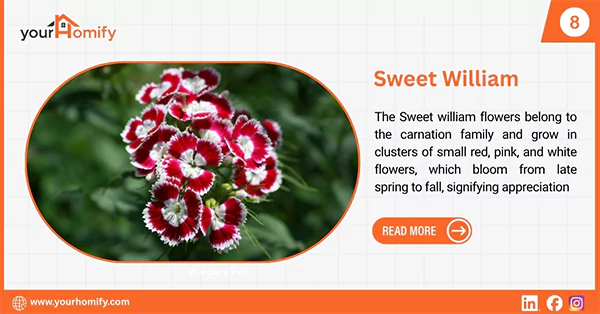
- Botanical name: Dianthus barbatus
- Native: Southern Europe
- Hardiness: USDA zones 3-8
- Height: 1-2 feet
- Color: Red, pink, white, purple, and maroon
- Flower type: Herbaceous perennial (can be grown as a biennial too)
- Bloom season: Late spring to fall
- Soil Type: Loamy, well-drained soil.
- Maintenance: Low
The Sweet William is a spring flower from the carnation family that is grown for its cluster of small blooms that signify appreciation and elegance. Mostly grown for ornamental purposes, these biennial flowers need full sun to thrive and also have edible flowers.
Spider flower
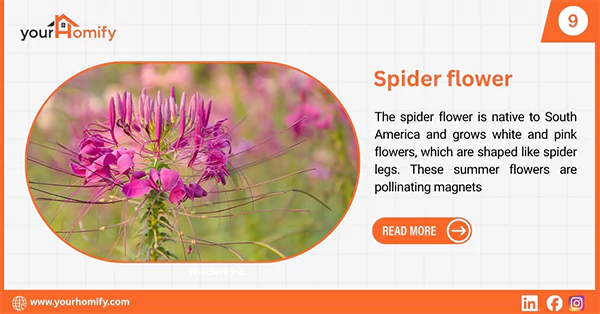
- Botanical name: Cleome
- Native: South America
- Hardiness: USDA zones 10-11
- Height: Up to 1 foot
- Colour: White and pink
- Plant type: Herbaceous annual
- Bloom season: Summer
- Soil Type: Well-draining, sandy soil
- Maintenance: Moderate to low
Named after its webby bloom shape, the spider flower is an exotic, deer-resistant flower that is best planted with salvia or lavender. Planting the spider flower is never a waste, as it attracts beneficial pollinators to the garden.
Lastly, the spider flower’s meaning is associated with the idea of mystery and curiosity.
Spring Vetch
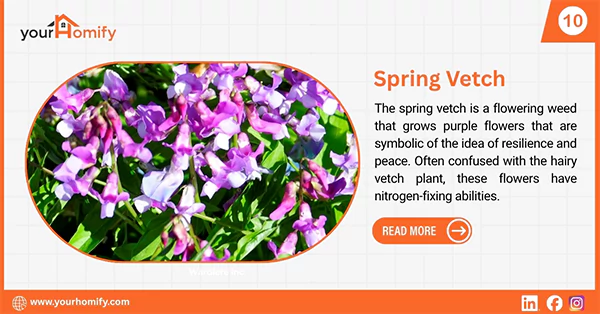
- Botanical name: Vicia lathyroides
- Native: Europe
- Hardiness: USDA zones 3-9
- Height: 2-3 feet
- Color: Purple and violet
- Plant type: Herbaceous perennial
- Bloom season: Early spring
- Soil Type: Chalky or clay well-draining soil.
- Maintenance: Low
Part of the bean family, the spring vetch is a common weed that grows in full, direct sunlight. Often confused with hairy vetch, this spring weed has nitrogen-fixing abilities and improves soil fertility.
The spring vetch flowers are symbolic of the idea of resilience and growth.
Shrub Rose
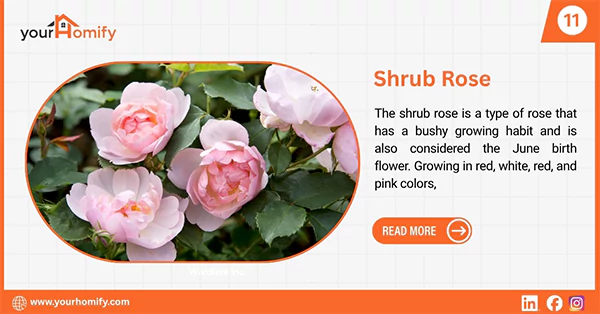
- Botanical name: Rosa
- Native: Northern Hemisphere
- Hardiness: USDA zones 3-11
- Height: Up to 10 feet
- Colors: Pink, red, white, yellow, and orange
- Plant type: Deciduous shrub
- Bloom season: Late spring to fall
- Soil Type: Well-draining sandy loamy soil
- Maintenance: Low
Often referred to as the June birth flower, the shrub rose is a type of true rose and not a completely different species. Popular for its bushy appearance, the flowers grow best as garden hedges in full sun.
Associated with the idea of love and affection, roses are also a cat-safe flower, which makes indoor planting hassle-free.
Stokes Aster
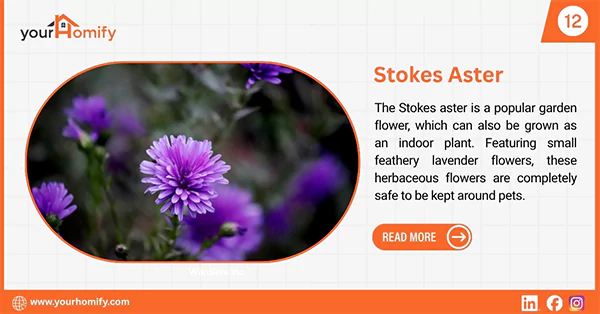
- Botanical name: Stokesia laevis
- Native: North America
- Hardiness: USDA 5-9
- Height: 1-2 feet
- Colors: Blue, lavender, and purple
- Plant type: Evergreen herbaceous perennial
- Bloom season: Summer
- Soil Type: Well-drained neutral soil
- Maintenance: Low
Stokes’ asters are a great choice for container gardening due to their pincushion-type flowers, which also self-seed, but I prefer planting them outdoors. They require full sun and consistently moist soil to grow.
I love them personally also because they are completely non-toxic to pets and are easy to care for, especially for novice gardeners.
Spider Lily (Red)

- Botanical name: Lycoris radiata
- Native: Asia
- Hardiness: USDA 6-10
- Height: 1-2 feet
- Colours: Red, white, orange, pink, white and yellow
- Plant type: Perennial bulbs
- Bloom season: Summer
- Soil Type: Fertile, sandy soil with organic matter
- Maintenance: Low
Part of the Amaryllis family, the spider lily is different from the spider flower. These herbaceous perennials are also not the same as the “Lycoris albiflora,” which grows only white flowers, as these feature funnel-shaped red flowers resembling a spider.
They prefer full sun to grow and to be moved less frequently once planted. In many cultures, the spider lily flower means death and remembrance.
Sweet-scented bedstraw
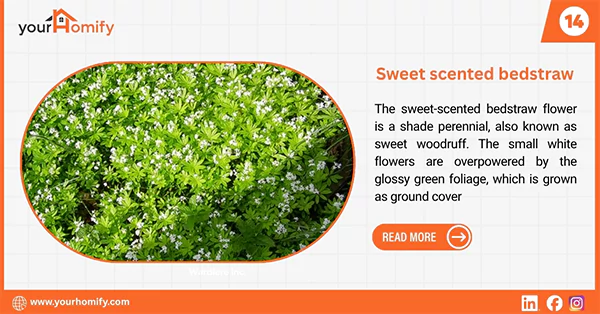
- Botanical name: Galium odoratum
- Native: North Africa, Asia, and Europe
- Hardiness: USDA zones 4-9
- Height: Up to 1 foot
- Colour: White
- Plant type: Herbaceous perennial
- Bloom season: Late spring to early summer
- Soil Type: Well-draining, humus-rich sandy loamy soil
- Maintenance: Low
Also known as sweet woodruff, this shade perennialis best grown as a ground cover because of its low-growing habit. The small white flowers and glossy green leaves perfectly complement each other.
Historically, the sweet-scented bedstraw was used as an herbal medicine for its anti-inflammatory properties.
Solitary Clematis
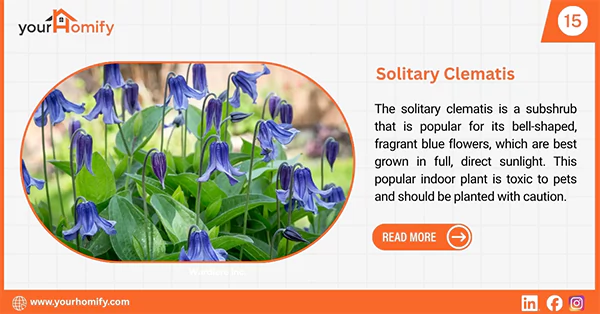
- Botanical name: Clematis integrifolia
- Native: Europe, Russia, and Central Asia
- Hardiness: USDA zones 3a-7b
- Height: 1-3 feet
- Colours: Yellow, purple, white, blue, and pink
- Plant type: Herbaceous perennial
- Bloom season: Spring to summer
- Soil Type: Well-draining, humus-rich soil
- Maintenance: Moderate to low
Not to be confused with the clematis vine, the solitary clematis is a sub-shrub that grows fragrant bell-shaped blue flowers. They prefer full sun to partial shade and can be grown both indoors and outdoors.
Note that they are considered toxic to pets and hence should be placed cautiously and out of reach from your furry friends.
Concluding Remarks
The flowers that start with letter S are a perfect mix of perennial and annual flowers that are not only great for seasonal color but also yearly structure, which does not let the garden look dull at any moment.
FAQs
What are the red flowers that start with S?
Spider lily, shrub roses, and sweet william are red flowers that start with S.
What are the perennial flowers that start with the letter S?
Sedum, scabiosa, sunstar, and sweet William flowers are the perennial blooms that start with S.
Are there any toxic flowers that start with an S?
Siberian iris and solitary clematis are toxic flowers that start with S.
Is the shrub rose the same as the true rose?
Shrub roses are a type of rose that includes other varieties, too.
Is the sunflower an annual flower?
Yes, sunflowers are an annual flower.
Sunflowers – BBC
Flowers That Start With R: 15 Elegant Types & Care Guide
[…] the flowers that start with R offer versatile and elegant choices for every plant lover, and the flowers that start with S continue that variety just as […]